Basic Major Pentatonic Scale Theory
Let's first learn the building blocks of major pentatonic and where it comes from.
As the name denotes, major penta-tonic is a major scale with just five tones.
Like every scale, major pentatonic can be given a whole and half step interval formula that tells us the "distance" between each tone in the scale starting on a given root (1).
W = whole step/tone. WH = whole + half step/tone.

So whatever root note you start on, the scale sequence remains the same from that position: W W WH W WH
Why does the scale miss out a 4 and jump straight to 5? Because major pentatonic does not include a 4th interval, due to how it's formed. You'll understand this in greater detail in time.
The root corresponds to the letter we use before the scale name. For example, if the root was C, we'd have C major pentatonic. If the root was E, we'd have E major pentatonic.
This whole/half step can be visualised across a single string on the guitar. For example, the open G string would provide the root of G, and we'd continue the scale from there up to the 12th fret G octave...
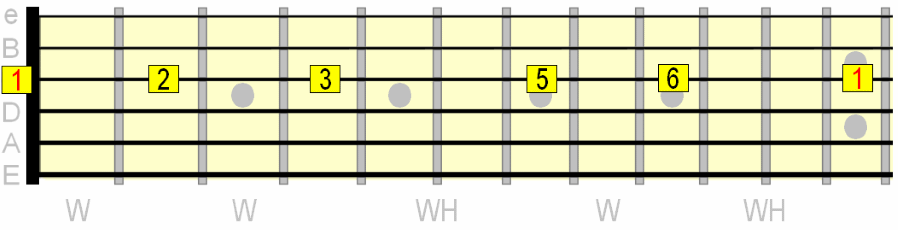
Can you see where the 4 would have been if it was included? On one of those two frets between 3 and 5. But we don't use that tone in major pentatonic.
You can of course do this on any string and even start the sequence from a fretted note. Learning scales across single strings like this is a good way of developing your "horizontal" playing skills.
Why Major?
All scales have what is known as a "root chord" (or arpeggio, whichever way you look at it). This is the chord built on the root of the scale. With major pentatonic, and all major scales for that matter, it's the presence of a major 3rd (3) and perfect 5th (5) interval on top of the root that gives the scale its major flavour and name.
These three tones - 1 3 5 - make up a major triad. It's the skeleton around which the scale is built.
This also tells us it'll work predominantly over major chords and major key progressions. So if a song was in the key of A major, you could try A major pentatonic.
Major Pentatonic Patterns
Think of patterns as the "roadmap" for the scale. Don't just memorise the fingering, also work on memorising where each note is positioned in the pattern and its relation to other notes.
In the video, I highlighted three key tones within the pattern to memorise - the root, 3rd and 5th. Why? Because these three tones correspond to the major chord around which the scale is built. Therefore, learning these tone positions will give you safe targets and resting places to keep your scale movements connected to the backing chord.
Basic "Box" Pattern
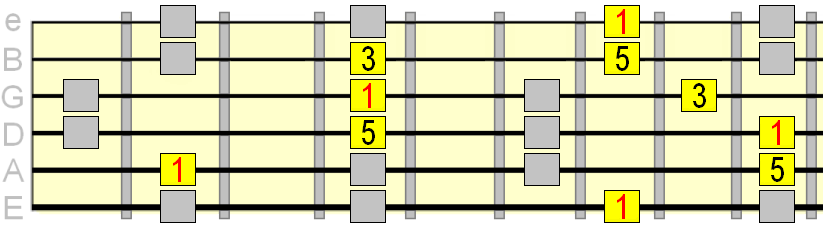
Learn this one like the back of your hand first. Start by memorising the root positions (choose any starting root you want), followed by the 3rd and 5th. Note that I've added an optional lower sounding 6th on the low E string.
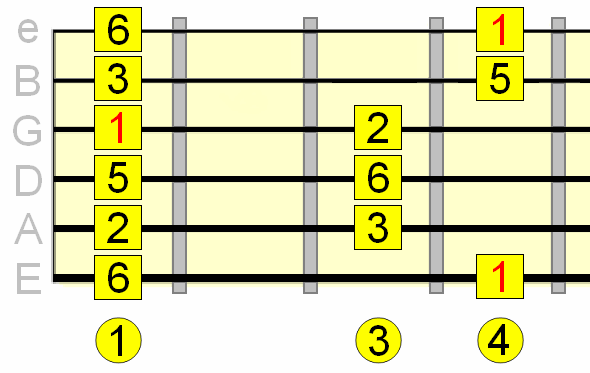
The suggested fingering beneath the diagram assigns one finger per fret. However, you'll end up adjusting your fingering as you approach notes in different ways. Just go with what feels most comfortable/economical.
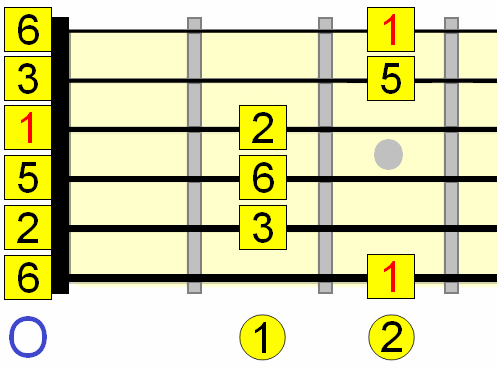
The G Major "Open" Box
If you're playing in G major (at the 3rd fret), you'll have access to some open strings (tip: notice how the open Gmaj chord shape exists within this pattern - can you see it?).
Extended Pattern
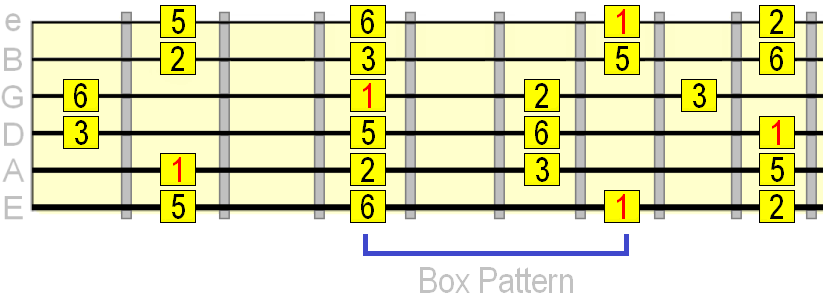
Here we extend either side of the box pattern, giving us additional
positions to play the scale. Notice how this gives us two extra root
positions, on the A
and D
strings. So if you used those root positions as your starting point,
you'd know how to move into the box pattern from there.
Tip:
Try finding these patterns an octave up, beyond the 12th fret, so you
can play the scale higher in pitch.
Pattern Chord Shapes
Notice how we can pick out familiar major chord shapes from within the
patterns, namely the A and E form barre chords.
A major chord consists of the 1 3 and 5 of the scale. Some players find
it useful to first visualise a chord shape as a familiar "starting
point" and then build the related
pattern around it.
Basic Targeting Exercises
In the video I outlined a process for building simple but musical phrases, using our knowledge of the key target note positions. So we have the lead up sequence and the "landing" note connected to the chord we're playing over.
You can use the following chord tracks on three respective roots as accompaniment (there's no beat so you can play at your own speed)...
In the below examples, I'm using C major across the extended pattern, but see if you can apply this process to other roots.
Start with a two note lead up to one of your target positions. For
example, here I'm targeting the root...

I'm targeting the 3rd
this time...

Finally the 5th...

Once you're confident with three note phrases, add in a 4th, 5th and more notes, gradually building up your targeting sequences.
By practicing in this way, you'll not only memorise the patterns, but you'll also develop your ability to improvise your way through the scale musically and intuitively. The target notes are your guide posts. Take your time.
Use a metronome to keep time and gradually build speed. Start as low as you feel comfortable (50 BPM is a good starting point) and increase by 10 BPM as you get more confident and can play without mistakes.
In the next part (coming soon!) we'll expand on what we've learned and introduce chord changes, which will be a lot easier now you know "the process"!
In the meantime, I hope you enjoyed the lesson and feel motivated to practice and jam this scale.