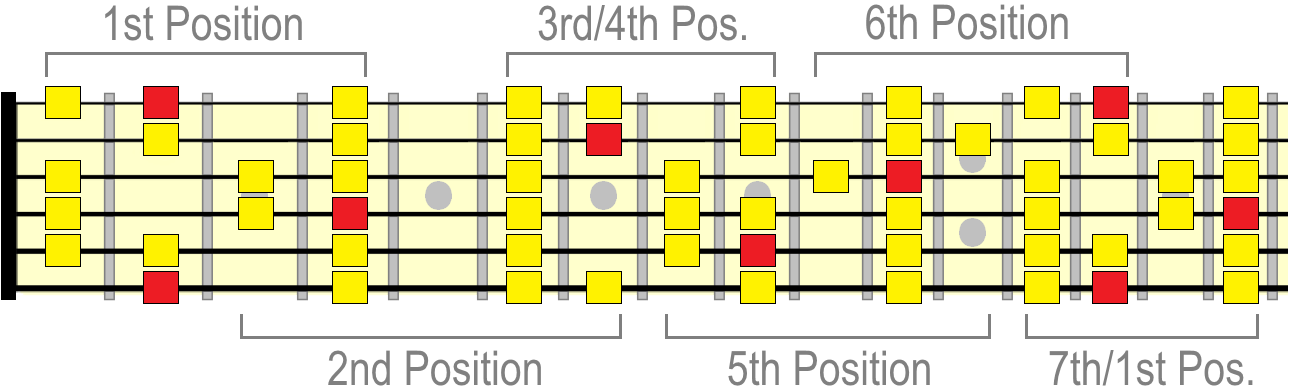
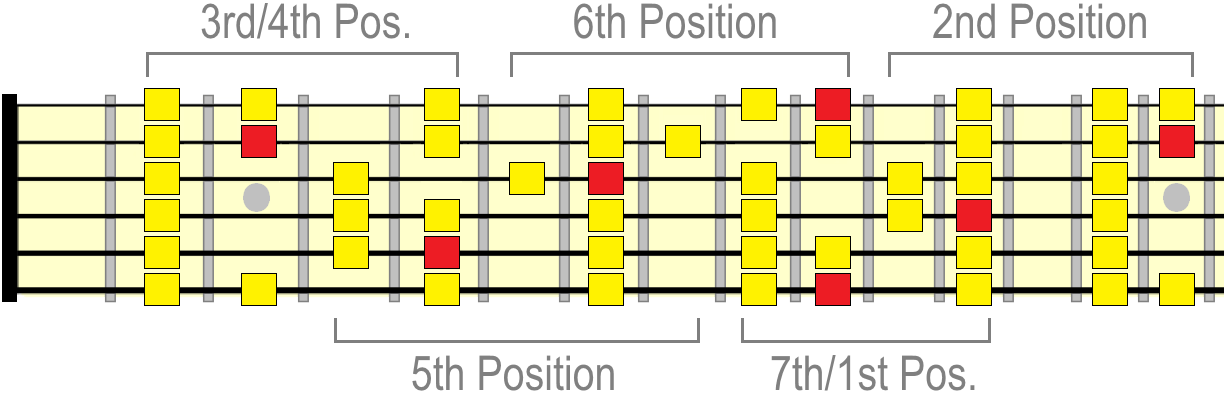
Stringing the Positions Together
What we've done here is start a new box pattern at each degree of the F♯ Major Scale, creating one large pattern across the neck...
The best way to link up these positions smoothly and seamlessly is to start by connecting the boxes two-at-a-time.
For example, start by connecting the 1st and 2nd positions. Then the 2nd and 3rd. Then 3rd and 4th etc. until you reach the 1st position again.
Then, try connecting three-at-a-time. 1st, 2nd and 3rd positions. Then 2nd, 3rd and 4th. Then 3rd, 4th and 5th etc.
Using this process, you'll soon have the entire, neck-wide pattern memorised.
Remember, once we get passed the 7th position, the sequence repeats... until we run out of neck!
Try challenging yourself to "land" on different tones within the pattern. For example, you could move from root to root throughout the connected sequence. This is great for building your spatial awareness of related notes.
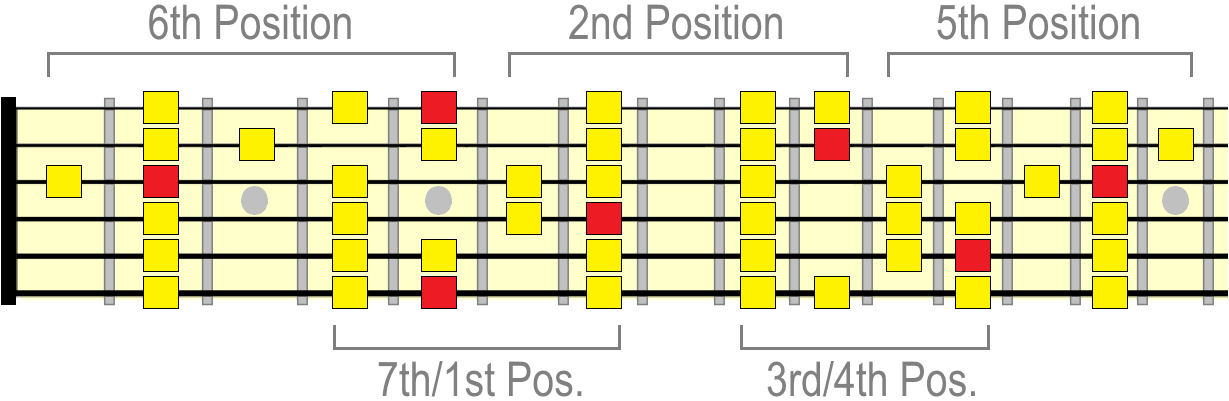
The next stage is to practice this same sequence on other roots. For example, A Major...
B Major...
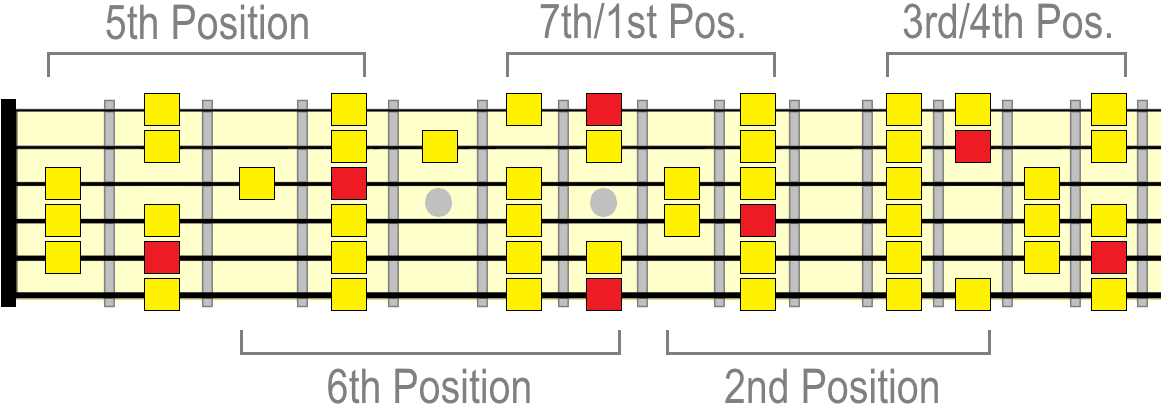
D Major...
When the root note changes, the entire pattern moves with it. The important thing is you can gauge the position of these root notes from the individual position patterns you learned. So spend time learning each position pattern by heart before you attempt to link them together.
Also, as well as linking the Major Scale positions together into one large pattern like above, try creating your own larger patterns by linking two or more positions together (for example, three-notes-per-string). This will allow you to use runs and other scale techniques in more economical spaces on the fretboard, especially at higher frets. More help with that in the next part.
Expanding Out Of "Box Think"
Box scale patterns are useful for three main reasons:
1) They help you see convenient chord shapes that can be built around the scale you're playing (since chords essentially use the same intervals). We looked at this in part one, pulling related chord shapes out of the scale patterns.
2) They allow you to create scale runs in a confined area which is useful for quick legato playing and arpeggios (more on these in their own lessons).
3) At first, they help you break down the large scale pattern into "bite sized" chunks. You can move between the boxes and keep your bearings (since you now know each scale degree's box pattern and where it lies in relation to the next/last!)
However, when soloing, you'll eventually want to have the option to play across larger fretboard areas. This is about smooth, fluid movements right across the fretboard and wider interval movements across each string. Sliding is one way to utilise these wider movements, but also regular picking higher up the fretboard where the fret spaces are narrower (e.g. you may be able to span 8 frets between your index and pinky finger rather than just 4 or 5).
To help connect these boxes in your mind, we need to work on the interval relationships of the scale in various positions on the fretboard. We touched on this in the major scale lesson, but now we know the scale across a much larger area, these interval relationships can now be visualised across the entire fretboard.
Let's look at some examples, going back to that large F♯ Major Scale pattern. Don't worry, you won't have to do this for every scale you learn since many scales share the same core intervals...
Root - 3rd degrees.
The major 3rd is responsible for giving the scale its major quality...
Root - 3rd - 5th degrees.
These make up a major triad/arpeggio...
Root - 3rd - 5th - 7th degrees...
We can see the root is a semitone (1 fret) above the 7th. Therefore, you'll know wherever the root appears, the 7th will be right behind it. Together these make up a major 7th (maj7) chord/arpeggio...
So, you get the idea - explore different degree/interval relationships across the wide scale patterns and relate them to the positions from earlier - this allows you to effectively "connect the boxes".
For example, you could play a wide run, ending up inside the 6th position box where you could then play around just in that box pattern for a few bars. This gives your soloing a dynamic edge, because both styles of playing - boxed and wide movements - produce different sounds, even though you're still playing the same scale!
If you want to learn how to use these patterns to unlock more scales, and learn how they connect to related chords, take a look at my Ultimate Roadmap book.