
logo for fretjam.com
Home
Jamorama
Tuning
Beginners
Chords
Scales
Lead
Rhythm
Theory
Heavy Metal
Contact

Subscribe To
This Site

XML RSS
Add to Google
Add to My Yahoo!
Add to My MSN
leftimage for fretjam.com
Home > Learn Guitar Chords > Guitar Barre Chords

Guitar Barre Chords and
Movable Chord Shapes

Barre chords are just a special type of movable guitar chord - These are chords you can shift up and down the fretboard in their fixed formation. This in turn allows you to use those same familiar chord fingerings in any key, simply by positioning them at a new fret.

The "barre" refers to positioning one of your fretting fingers (most often your index finger) flat across more than one string. You'll see how different types of barre are used in different chord shapes throughout this course.

Barre for the Course

1) E shape barre chords

2)
A shape barre chords

3)
C shape barre chords

4)
G shape barre chords

5)
D shape barre chords

6)
Chord relationships

In these lessons, we'll be looking at 5 main chord shapes. Why shapes? Well, the five main barre chords are derived from the shape of those 5 open position chords most of us learn as absolute beginners - you know the ones - E, A, D, G and C, down at the first few frets.

These are our foundation chord shapes, and we refer to these same basic shapes as we move them up the fretboard and create barre chords from them.

So, in a nutshell, here's what you have to look forward to learning:

1) Automatically knowing how to play several voicings of the same chord in several different positions over the fretboard. This is about expanding your creative options.

2) Knowing how to modify the standard barre chord shapes to create tons more interesting chords, almost as second nature.

3) Having the physical confidence and the muscle memory to change between what would otherwise be awkward chord shapes!

So, let's get stuck in, starting with the E-shape barre...


Quick Links > The Theory | Fingering | Exercise & Jam Track | Chord Chart

E shape barre chords - First, the theory

Time and time again, I hear people simply refer to the E-shape barre chord as the dreaded "F chord". It's often seen as the first milestone after learning the 5 main open chord shapes.

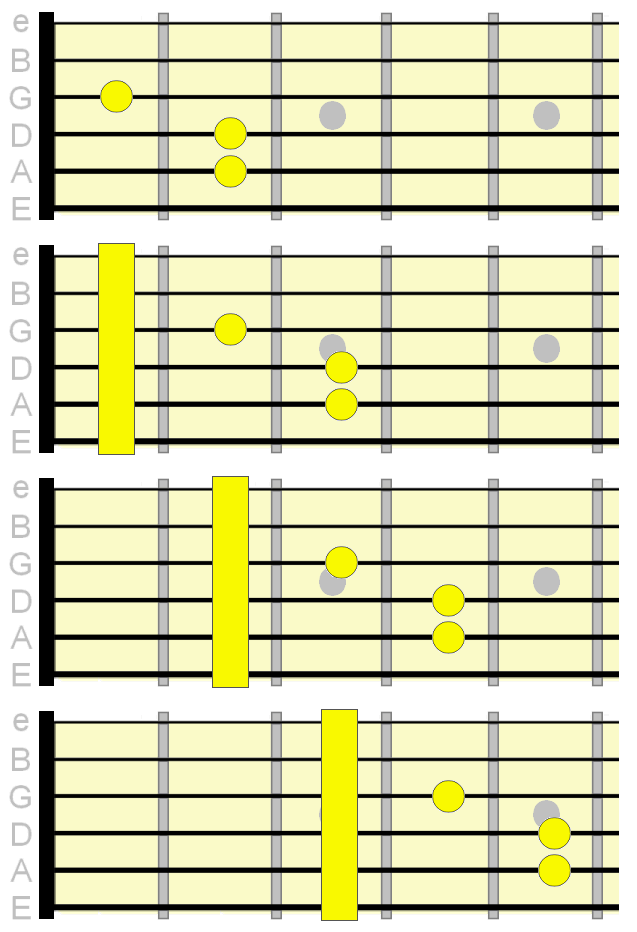
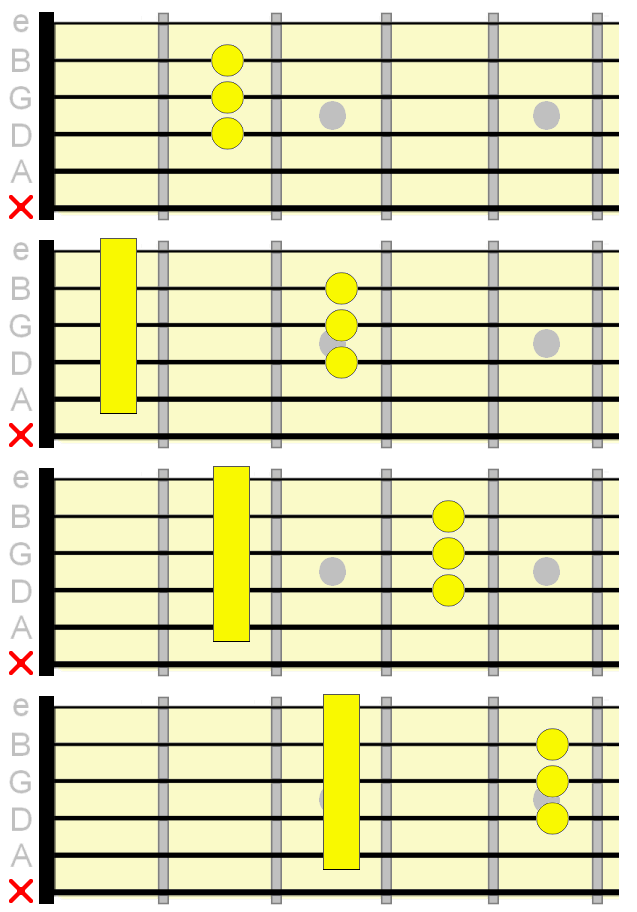
So, what makes it the "E-shape"? The sequence below starts off showing us the E major open position chord that I'm sure you're familiar with. This "shape" simply gets moved up, meaning we have to barre our index finger to represent where the nut (or capo) would be.

Don't try and play anything right now - just observe and listen...

Click diagrams in this lesson to hear


...and that shape can be positioned anywhere up the fretboard depending on what key you're playing in.

Now take a look at a similar diagram below...
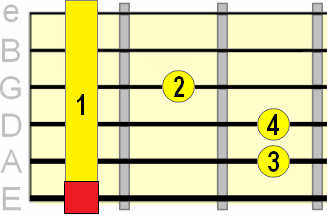

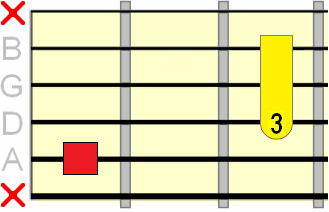
This is just one way of identifying the key of the barre chord. The root note of the E-shape barre (the fretted red dot) is always on the E string, so if that root note was positioned at fret 5, it would be an A major chord.

There are higher root notes positioned on the D and high E strings, but at this stage, it's easiest to identify the key of the barre chord by looking at that lowest root note, as the rest of the chord is built from this point in this particular shape.

-----Side note----------------

Know all the root notes on the low E string? If not, this lesson will help.

-------------------------------

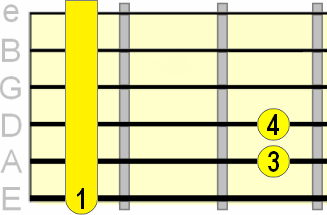
The E-shape also has a minor chord shape taken, like before, from the open E minor shape we're already familiar with. 


Just like before, your barring finger acts as the nut, or capo, so you can position that whole shape wherever you need on the fretboard.


Now, the physical side - Building up those finger muscles!

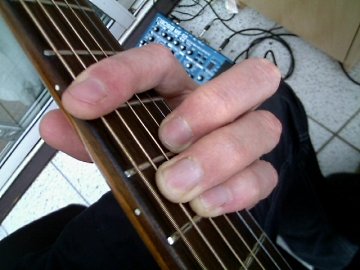
At first, ouch! You'll find that barring your index finger across all 6 strings like that is difficult to begin with.

With only your index finger barred, try picking each string - does each one sound cleanly? Is there any buzzing? If there is buzzing, it means the string isn't being fretted properly. Adjust your barre finger position, and try again, until each string sounds cleanly.

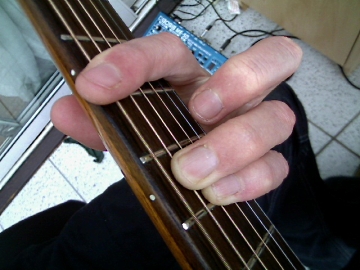
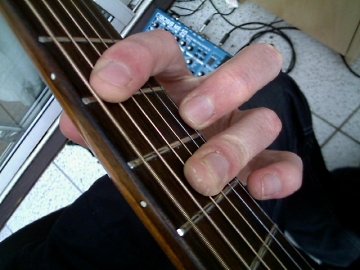
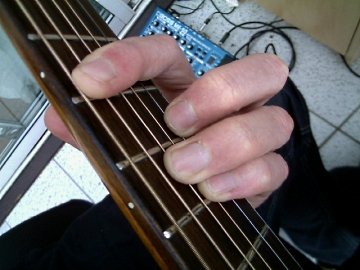
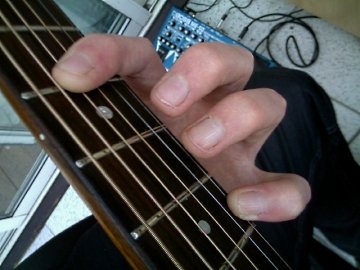
Notice how the barre finger is placed as close to the fret wire   as possible, without actually being on the fret wire itself. The non-barre fingers stand tall and arch down onto the strings without collapsing back. Fret with the finger tips.

Be patient - it won't feel comfortable at first, but judge it based on whether all 6 strings sound cleanly... if they do, it's simply a case of physically getting used to it, and trust me, you will!

TIP: Give that index finger a workout! Barre the strings, like above, for 10 seconds, play all 6 strings, then release the barre, barre for 10 seconds again, then release etc. This will help the muscle memory set in.

Like I said before, just make sure each note sounds cleanly when you're barring.

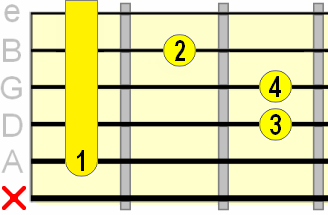
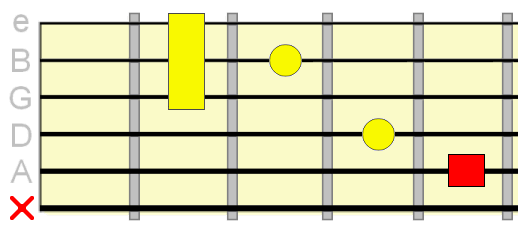
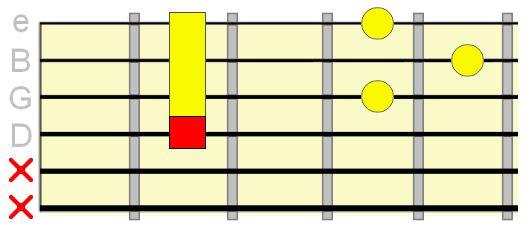
When you're confident with your barring strength, apply the other fingers of the E-shape major chord, and once again make sure each note in the chord rings cleanly.

Here are some more pics to help, starting with the major shape...

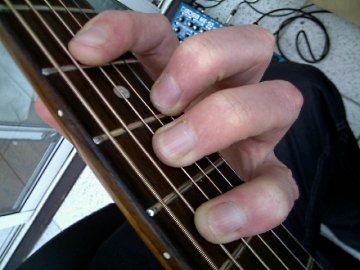
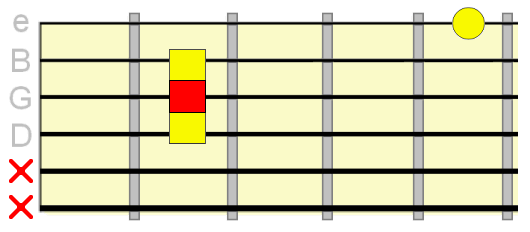
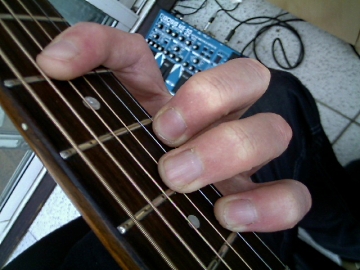
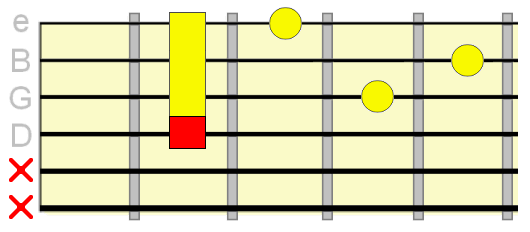
And now the minor shape (all we do is remove the 2nd finger)...


Once you're confident with the above, try changing from an open position chord to an E-shape barre chord. Try the below exercise for reference (the barre chords are underlined)...


Guitar Example - Download Jam Track


Highly Recommended

Download your own drummer to make practicing barre chords more engaging and enjoyable. This helps you naturally develop your sense of rhythm & explore your creativity. More >


What other chords can you create using the E-shape?

There are tons of chords that stem from this one shape! You see, as you delve deeper into the theory behind chord building, you realise that you're just pulling different tones or "flavours" from the major scale. The chord shape literally just gets superimposed over whatever notes are used from the major scale. This is covered in more depth in the theory section.

Now, I'm usually against just throwing chord charts in front of you (known as "parrot fashion" learning!), but now we know the basic concept of this barre chord shape, it's just a case of knowing all the variations and chord flavours we can build around it.

Either use the chart below for just some of the chords you can create based around this shape, or, if you're more interested in really understanding chords and building interesting chords from scratch yourself, take the guitar chord theory lessons here.

When playing a chord progression using regular major and minor chords, try some of the major and minor variations below to see if you can spice up the song. You'll eventually learn which chord flavours compliment particular movements in a song!

Note: The diagrams below use a suggested fingering - if you're playing a particular progression, you might want to alter the fingerings to accommodate...

Major E-shape
Barre/Movable Chords

Major (e.g. A)

Dominant 7 (e.g. A7)

Higher-voiced Dominant 7

Major 7 (e.g. Amaj7)

Add 9 (e.g. Aadd9)

Add 6 (e.g. Aadd6)

 7 Add 9 (e.g. A7add9)

7 Add 6 (e.g. A7add6)

Higher voiced 7 Add 6

13 (e.g. A13/A7add6+9)

Minor E-shape
Barre/Movable Chords

Minor (e.g. Am)

Minor Dominant 7 (e.g. Am7)

Higher-voiced Minor Dominant 7

Minor Major 7 (e.g. AmM7)

Minor Add 9 (e.g. Amadd9)

Minor Add 6 (e.g. Amadd6)

Minor 7 Add 9 (e.g. Am7add9)

Minor 7 Add 6 (e.g. Am7add6)

Higher voiced Minor 7 Add 6

Minor 13 (e.g. Am13/Am7add6+9)

Suspended E-shape Barre/Movable Chords

This is where the major or minor 3rd is replaced with the 4th/11th - more on this in the seperate chord theory lessons (see below if you're interested). They tend to be used as tension chords because of their "unresolved" feeling within a progression.

Sus 4 (e.g. Asus4)

Sus 4 Add 6 (e.g. Asus4add6)

Dom 7 Sus 4 Add 6 (e.g. A7sus4add6)

Dominant 7 Sus 4 (e.g. A7sus4)

Sus 13 (e.g. Asus13)

Sus 4 Add 9 (e.g. Asus4add9)

To really make sense of how these chords are essentially built from their associated major scale shape, take the guitar chord theory lessons here.

They key thing is always the same though - EXPERIMENT!

Start with the basic E-shape barre chord, major and minor, and see what chords you can create by adding and removing notes, using your index finger barre as the structural base and that low E root note.


Highly Recommended

Download your own drummer to make practicing barre chords more engaging and enjoyable. This helps you naturally develop your sense of rhythm & explore your creativity. More >


Where next?...

Learn the other 4 main chord shapes in your own time. Each shape offers an array of movable chord voicings, and the more creative options you give yourself, the more expressive your music can potentially be.

Thanks for your time!

Learn another barre chord shape >
 
< Go Back to Rhythm Guitar Lessons Main Page
 
<< Return to Guitar Lessons Home


footer for guitar barre chords page