Hammer-On Guitar Technique - Quick Start Guide
In this lesson we'll do three main things:
1) Get introduced to hammer-ons as a core lead guitar technique (video included).
2) Play around with some effective exercises to get all our fingers involved.
3) Look at larger lead patterns that involve more than one "hammer".
But first, for those of us who are completely new to this technique...
What is a Hammer-On?
As the name suggests, "hammering on" involves fretting a string as usual, but landing down on the string with more speed and force (like a hammer action!) so the note sounds without you having to pick it. The sound of the note is made purely through the action of hammering your finger on to the string at a particular fret.
The utility of hammer-ons is twofold:
1) It creates a different sound from the more percussive attack of a picked note. In changes how we express a note.
2) It allows us to quickly connect a sequence of notes more smoothly (known as a "slur" in music).
It's one of the "big four" core legato techniques (along with pull offs, bends and slides) we should become familiar with and have ready in our lead tool box.
We just need to get physically comfortable with it first...
Basic Hammer-On Exercises
A practical (and musical) way to begin is to reference the minor pentatonic scale. Hammering up and down this scale is an effective exercise to get physically comfortable with the technique and develop our muscle memory in a melodically integrated way. The pentatonic scale is by far the most versatile scale, so it makes sense to build our technique from there.
But don't worry, we're going to focus on single strings first!
First, familiarise yourself with the basic pentatonic box pattern. Finger numbers are labelled on the diagram 1 = index to 4 = pinky...
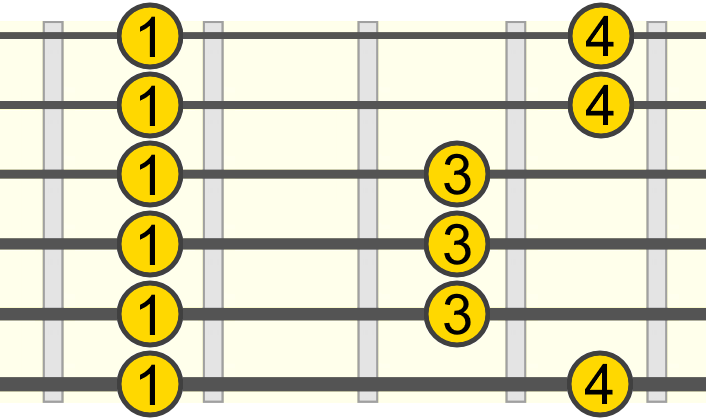
So, our index/1st finger will be the lower, fretted base for each hammer-on, on each of the strings.
Starting with the 6th (lowest) string...
Fret your index (1st) finger at the 5th fret (it can be any fret really, as this scale pattern is movable, but we'll stick at the 5th for now). This is our base finger, positioned below the hammer-on fret.
Pick the string as usual, but right after you've picked it, hammer your pinky/4th finger on to the 8th fret on that same string. It should look something like this...
The key thing is not how much force you hammer-on with, but rather how quickly your finger taps down on to the string/fret. The hammered note should resonate cleanly.
Once you've hammered down, hold it there and assess how well the note rings out. If it's muffled or decays too quickly, you'll need to increase the speed at which your finger taps down on to the string. Ensure the hammered string is fretted just as it would be if you were picking it.
Tip: Think of it like how you might tap a finger tip on a table top. The volume and resonance of the tap is more about how quickly you come down on it. You could come down slowly and apply force once your finger touches the table - it won't create a sound. But if you come down quickly, it's impossible to not make a sound!
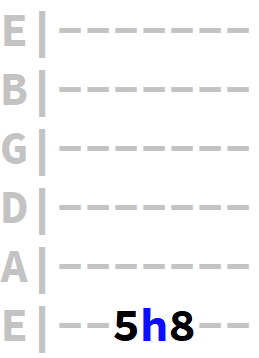
When writing/reading tab, the h symbol tells us when a hammer-on is used between two frets/notes.
So this tab means "5th fret hammer-on to 8th fret".
Let's now move to the next string up in this pentatonic pattern - the A/5th string. We're using exactly the same hammer-on technique, but this time we'll be hammering on with our ring/3rd finger...
Even though we're using a different finger, the technique is exactly the same.
Remember, the hammer finger needs to hit the string in the same place you would fret it normally - just behind the fret wire. This will maximise its clarity and resonance.
Use the same index-ring technique for the 4th and 3rd strings, and then we're back to the index-pinky hammer-on interval on the 2nd and 1st (highest) strings...
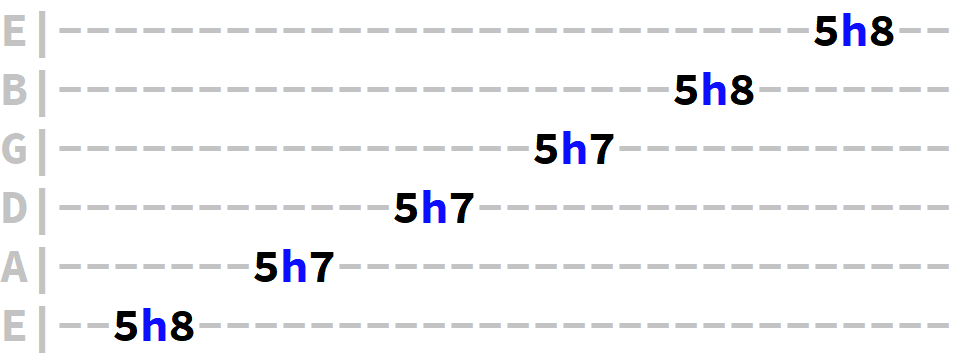
Once you're confident with your hammer-on technique one string at a time, try hammering your way up and down the pentatonic scale in an uninterrupted sequence as follows (take it as slow as you need)...
Tip: Once you can do one string, try combining two strings, then three, then four etc. Build up your movement of hammer-ons across strings gradually like this.
To really set in that "muscle memory", try hammering around the scale pattern in varied, staggered patterns. Just go where you feel like going with it!
Now, we also need to get physically comfortable with hammering on between our index and middle/2nd finger. We can alter our pentatonic pattern slightly to accommodate this...
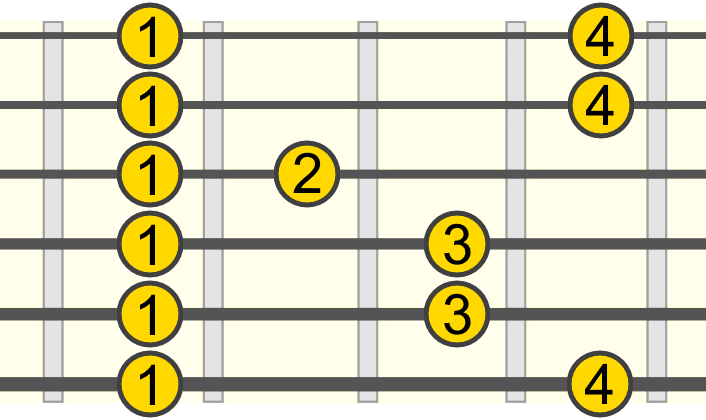
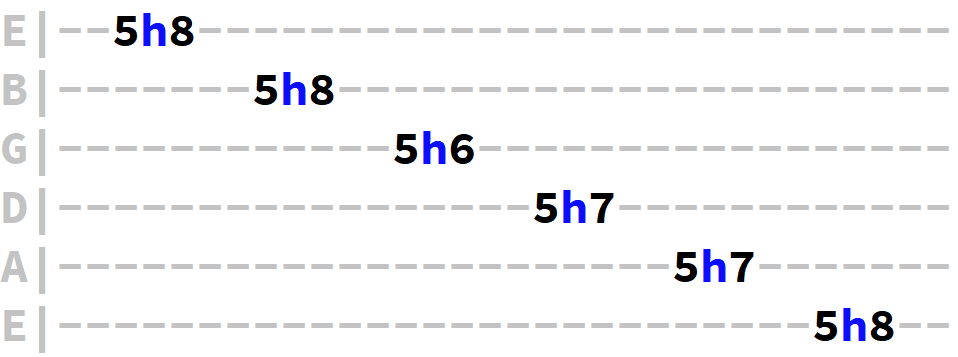
Another addition - hammering on between our ring/3rd finger and our pinky/4th finger. We'll just modify the pattern further to accommodate this addition...
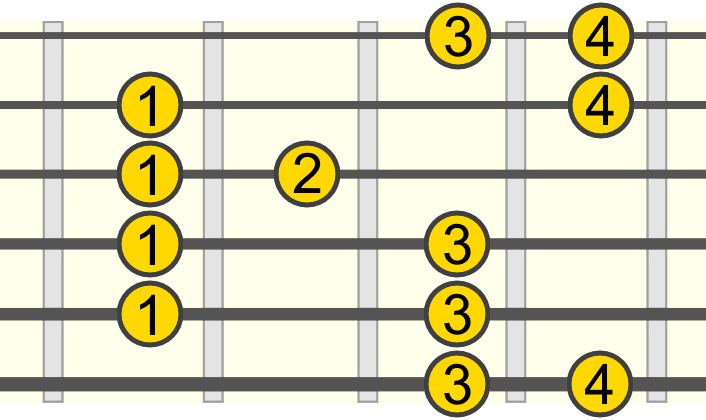
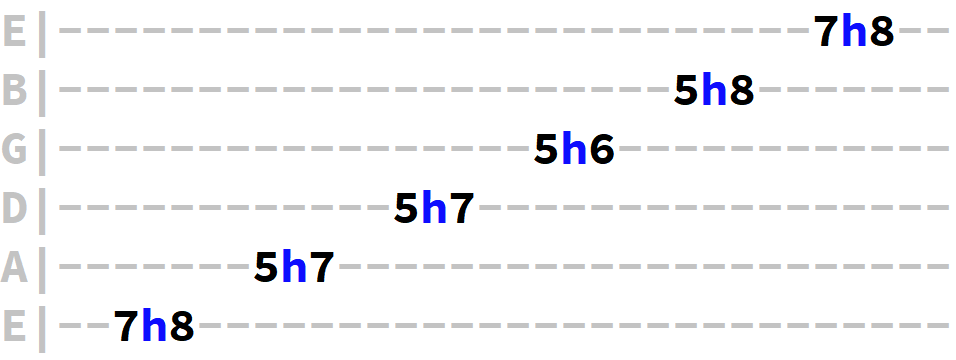
So now we have a sequence we can work all combinations of our fingers up and down. It includes the most common hammer-on intervals you'll come across within scales.
Make sure you work on these movements in different positions up the fretboard.
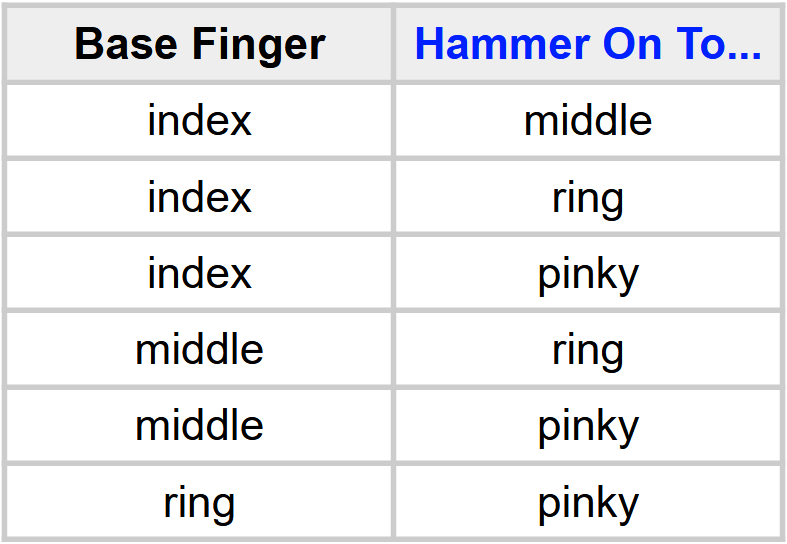
If you're looking for some good hammer-on warmup exercises, try using the below intervals from 1st to 6th string (and then back up, down, up etc.)...
More Than One Hammer-On Per String
Ready for the next challenge?
Once you're physically comfortable with the basic hammer-on technique, you can move on to larger phrases by using more than one hammering finger across each string.
When played at speed, this creates what is known as a "slurred" effect. Rather than each note in the sequence being cleanly separated by a pick stroke, they roll into each other creating a smoother line of articulation.
When we come to learning pull offs (the inverse of the hammer-on), and mix both hammer-ons and pull-offs in the same phrase, this legato style of playing will be enhanced further.
A great scale pattern to experiment with this technique is the dorian box pattern, which can be seen as an extension of minor pentatonic (two additional notes, basically)...
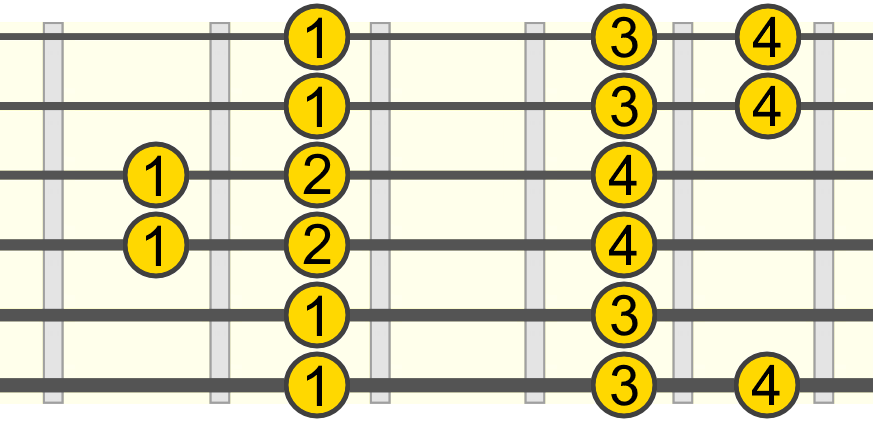
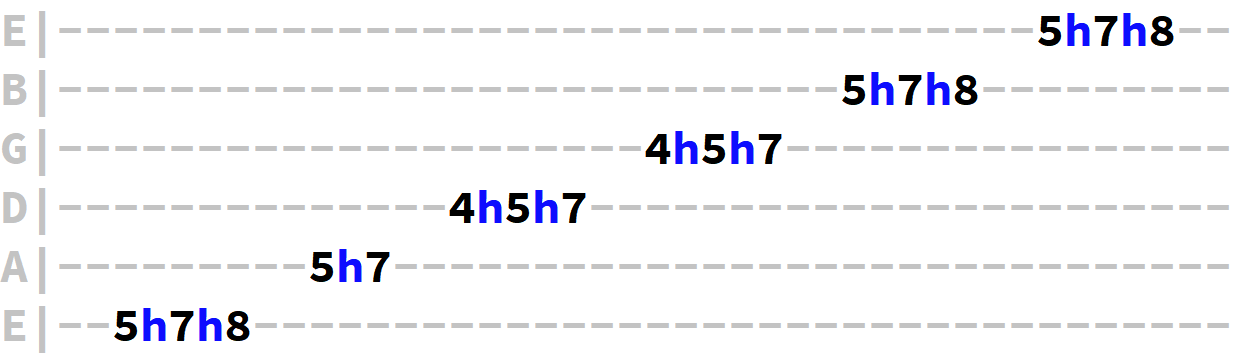
So, two successive hammer-ons per string there (except for the 5th string). In fact, a lot of boxed scale patterns that use three-notes-per-string will allow you to put this technique to use.
Also, don't forget to work on instances where two hammer-ons might be used in tighter spaces, such as within three semitones, as found in this extended blues scale pattern...
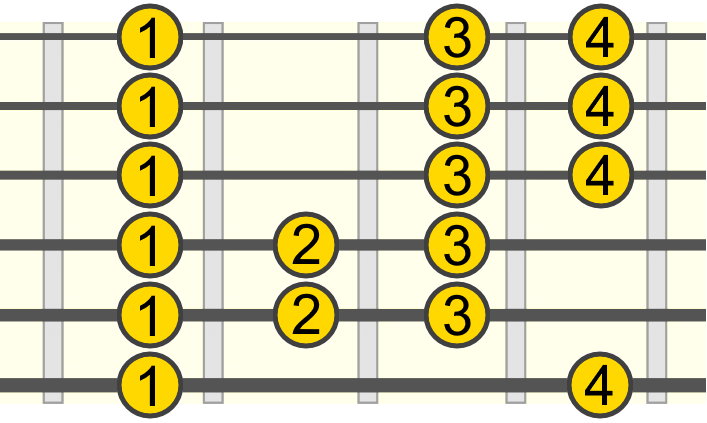
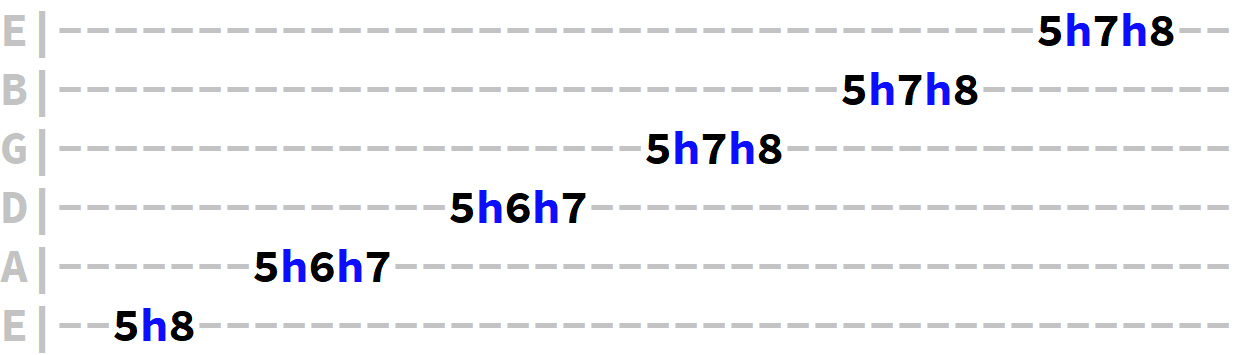
And of course, once you learn scale patterns over a wider fretboard area, you'll be able to apply multiple hammer-ons across wider areas. For example, this three-notes-per-string major scale pattern...
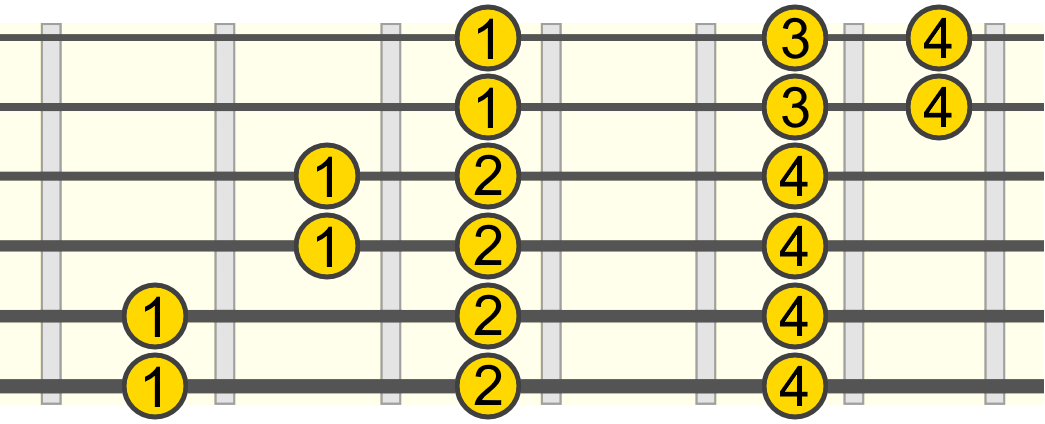
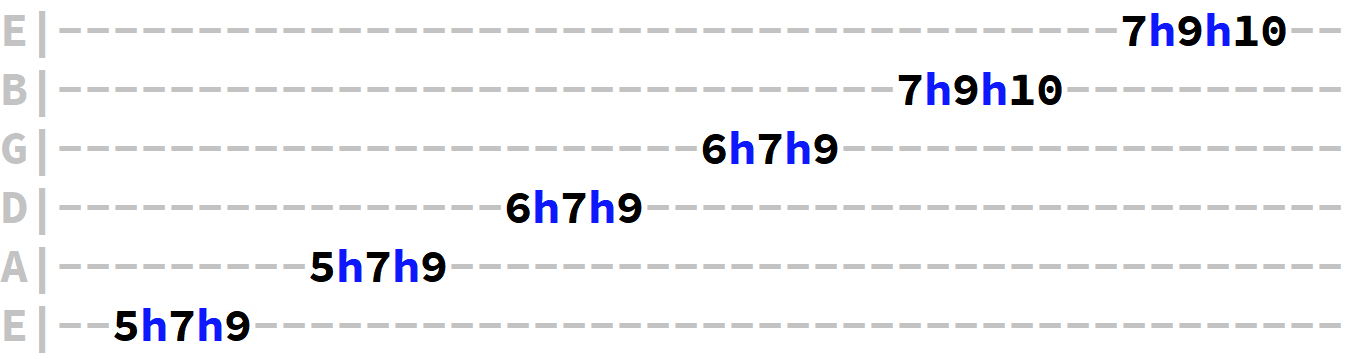
Don't forget to descend from the 1st (highest) to 6th (lowest) string using these patterns as well! Ascend and descend in equal measure.
Take it one or two strings at a time at first. Then add in a third strings and build things up from there. This is really just about getting all combinations of fingers involved in the physical technique.
Keep working on the exercises we've covered in this lesson and try and come up with some of your own. The more you work on it, the more the muscle memory will set in, and the more confidently you'll be able to apply hammer-ons in your solos.
Frequently Asked Questions With Hammer-Ons
Why does my hammer-on sound weak, quiet, muffled, or not at all?
Why does my hammer-on sound weak, quiet, muffled, or not at all?
- Ensure the hammer-on finger is hitting the string quickly. Imagine it's like a real hammer. It needs to come down quickly in order to create the required force. Focus on the speed at which the finger comes down on to the fret space.
- Maintain the same discipline in terms of where the hammer-on finger strikes the fret space as you would when fretting it as normal. You want the finger to be as close to the fret wire as possible. For example, if you're hammering on at the 5th fret, you'll want the hammer finger to be as close up to the 5th fret as possible, without actually being on the fret itself.
- Make sure there's enough of an initial gap between the hammer finger and the string before you hammer-on. It might get muffled if you're accidentally touching the string before you hammer-on. There needs to be a little space between finger and string for it to hammer down and strike the note.
How much force/strength do I need for hammer-ons?
How much force/strength do I need for hammer-ons?
There is some strength and muscle memory building involved, especially when connecting multiple hammer-ons in sequence. But it's more about how quickly you hammer-on rather than brute force. The finger has to fully press the string against the fret wire, but it's how quickly that happens which is most important.
What's the best way to practice hammer-ons for beginners?
What's the best way to practice hammer-ons for beginners?
Start with single strings. Pick any string, using your index finger as the "base" fret. Then hammer-on to each finger (2nd, 3rd, 4th) from that position at the appropriate frets. Repeat each hammer finger several times before moving on to the next one.
Next, use your 2nd finger as the "base" and hammer-on to your 3rd and 4th fingers from there.
Next, use your 3rd finger as the "base" and hammer-on to your 4th finger.
Move to other strings and repeat the same exercise.
Why is hammer-on harder on acoustic vs electric guitar?
Why is hammer-on harder on acoustic vs electric guitar?
Acoustic guitar strings tend to be higher gauge (thicker) and higher off the neck (higher action). So they carry more resistance and therefore require more force to hammer them on to the fret.
Should I hammer from open string or always from a picked note?
Should I hammer from open string or always from a picked note?
You can absolutely hammer-on from an open string. It's basically the same concept and you can make good uses of open string hammer-ons with open position chords to give them more internal movement. Start with fretted notes as the base as they tend to be physically easier. The string is already pressed down closer to the wire from the base (picked) note, making the hammer-on easier to voice. Once your strength has built, try an open string as the base for the hammer-on.
What are common mistakes with hammer-ons?
What are common mistakes with hammer-ons?
- Not keeping the base finger planted (lifting it accidentally mutes).
- Slow tap (no note sounds).
- Poor accuracy (missing the fret or landing flat).
- Rushing before building strength/speed.
- Tension in the hand/arm.
How long does it take to get good at hammer-ons?
How long does it take to get good at hammer-ons?
Short bursts of daily practice is more important than longer periods days/weeks apart. Aim for ten minutes per day using the exercises in this lesson. You can use hammer-ons as part of a warmup routine. With consistent daily application, you'll be surprised at how quickly the muscle memory develops. Involving hammer-ons in existing licks and scale runs will help to develop this muscle memory further.