


Thrash Guitar Lesson - Building Speed & Timing Accuracy
This is the lesson where we dramatically reduce the life of our guitar strings! Thrash metal gave birth to some of the fastest and most aggressive guitar playing techniques known to man.

|
By building on techniques we've looked at in the other lessons (see below), we can work on more complex riff patterns suitable for this style of playing.
This lesson should be seen as a physical exercise rather than a lesson in melodic theory!
Once you're confident with the physical aspects, you can then get more creative with your own ideas.
Lessons to take before this one...
 Fast Picking in Metal
This thrash guitar lesson will expand on the guitar lessons above to look at more complex scratch-pick rhythms, using pick groupings (such as triplets), which requires you to be in firm control of the tension release in your pick hand wrist.
So if you're confident with
palm muting and alternate picking at speed, then let's now
push this a step further...
Basic thrash metal speed picking
After going through the two lessons above, you should know how to position your picking hand for palm muted riffs.
The most common techniques used in thrash metal involve fast alternate picking (sometimes called tremolo picking) whilst palm muting. Most often, it's done on one string at a time, but you can widen your picking sweep over a two-string powerchord for a chunkier sound.
Below are a couple of speed variations of this muted alternate picking. I've recorded them clean, without distortion so you can really hear the pick strokes. You should make sure, before you move on, that you can at least hold a constant alternate picking rhythm on the lowest 3 strings on your guitar...
Speed picking on the low E string
As we'll see in this next
exercise, this becomes our rhythmic base to build on how
we want...
A little thrash metal warm-up to begin with
Nothing overly complex to start with - let's just hammer out the riff below to warm up our picking wrist (based on the fast, palm muted, alternate picking technique from above).
This type of continuous, "wall-of-noise" scratch rhythm is commonly applied on the lowest open string (e.g. the low E string) for that deep chugging undertone. The only downside is, and I say this as an avid listener of thrash metal, this particular application is why a LOT of thrash sounds the same to the casual listener. It's become a bit of a cliché.
Use it to support your music, don't just use it because it's the easiest option!
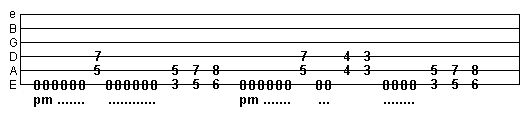
Slow Example - Faster Example
Tip: See those non-muted powerchords as marker points in between the palm muted wall of noise - this helps to establish an accurate overall rhythm, even if your scratch timing in between isn't 100% accurate.
Here's an interesting technique to use if you're away from that root E string. Use the same, fast alternate picking, and use the area around that fret to inject other notes from the bottom 3 strings (or more if you like). Whilst one finger is occupied on that root string, try to use all your remaining fingers around it to find a melody you like...
Click the tab to hear.
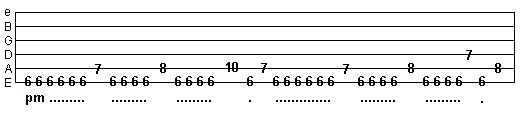
Tip: It's often easiest to use downstrokes for the non-muted notes in riffs like this. This helps keep the momentum of attack.
Try mixing that second
exercise with the first - it's common to hear
the second type of pattern used as a kind of interlude, before crashing
back down to that low E powerchord, but don't tie yourself to
traditional dynamics - experiment and mix shit up.
Jam! Try some of your ideas over the drum track below. It's a typical old-school, mid-tempo blast beat with a short interlude. At 50 seconds long, it's a good initial test for your alternate picking stamina. Loop it in your media player...
Download the beat here (right click and "save as")Pick groupings in thrash metal rhythm guitar
As we looked at in the more advanced palm muting lesson, we can group our alternate picking strokes (down-up-down-up etc.) in different quantities (e.g. triplets - down-up-down) to create short bursts of rhythmic guitar.
This is the foundation of rhythm guitar in thrash metal and requires strict control of the picking wrist to release this burst of tension accurately. So, time for some self-discipline!
Try experimenting and mixing up the rhythms to create more dynamic riffs. It's all about grouping those alternate picking strokes (e.g. in groups of three, four, five picks etc.) - that's what creates the rhythmic intricacies in the music.
The exercises below should help you improve your sense of pick timing if you work on them every day. Listen to the slow examples first, then see how the timing relates to the up-down pick diagrams and try to replicate it.
A metronome will be essential in building up speed with these.
The black dots indicate where a non-muted powerchord/diad is played in the pattern.
The black squares indicate a fully muted stop. Listen to the audio to get your bearings.
Regular pick groupings

Slow Example - Faster Example

Slow Example - Faster Example

Slow Example - Faster Example

Slow Example - Faster Example

Slow Example - Faster Example
Mixed pick groupings
These patterns involve mixing different pick groupings into one repetitive sequence..

Slow Example - Faster Example
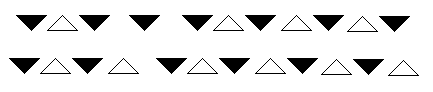
Slow Example - Faster Example

Slow Example - Faster Example - Even Faster Example
Injecting mini-lead lines into your thrash riffs
Thrash guitar doesn't always have to be about thick powerchords, you can add some melody to the chaos by mixing various lead techniques and phrases with the powerchords...
It's good to get into the habit of using alternate picking in these lead phrases, as this will allow you to eventually speed up more easily whilst keeping pick positioning under control.
The faster example below shows how you can incorporate these mini-lead phrases into a fuller riff, working with the percussion for more rhythmic support.
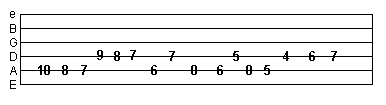
Slow Example - Faster Example
So what next?
Now it's time to experiment! This lesson should have provided you with some good physical picking exercises that define the brutal nature of thrash metal, that you can now take away and apply your own creativity to.
Like I always say: you should never look for guidance on what to play - that's ultimately what will single your music out from the rest.
Keep practicing and mixing up those picking rhythms with the aid of a trusty metronome, and you'll get to the level of confidence you need very soon.
| |
Tweet |
Sign up to the newsletter for updates and grab your free Uncommon Chords book
Related Lessons
Death Metal Guitar
Back to Metal Guitar Lessons



