


More Advanced Palm Muting in Rock & Metal
This second lesson in the series will introduce you to more palm muting techniques used in all the rock and heavy metal subgenres.

|
Before we start, make sure you know the basics of palm muting
Also, this lesson covers an extension of another playing style, tremolo picking (fast alternate picking). If you need a quick intro to this, take the fast guitar picking lesson. You may however just pick it up as we go.
Follow the exercises on this page for some essential palm mute techniques used by many heavy metal bands old and new. It's just part of the style now.Palm muting in drop tuning
When in drop tuning, nothing changes as far as the physical palm muting technique, but there is a subtle difference in how everything feels, since the lowest string is a bit slacker and you also need to think about changing from drop power chord shapes on the lowest string to regular shapes on the A string.
So, not too difficult, but still worth covering.
When thinking about timing over slower tempos like below, it's probably easier just to think of "1 and 2 and 1 and 2 and..." instead of "1 2 3 4 1 2 3 4...". This helps segment the riff more clearly in your mind. Use a metronome to build up your speed.
We're in drop D tuning for this example, but it applies to any drop tuning. Click the tab to hear...
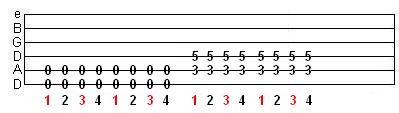
The exercise below will help you practice changing chords quickly up the fretboard whilst muting. This means you have two things to think about - keeping rhythm and the accuracy of the chord changes...
Again, click the tab to hear.
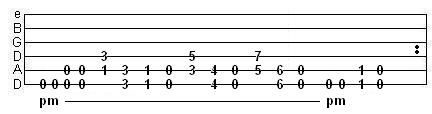
The rested part of your fret hand (the part that does the muting) should be pretty much stationary the whole time, covering the lowest 4 strings at least. Only your pick has to change strings when changing chord.
Basic palm muted grooves
Metal guitarists commonly play in different timing to the drummer. A typical example is 3/4 time over a drummer's standard 4/4. Lock in to the red beats below...
| Drums | 1 | and | 2 | and | 1 | and | 2 | and |
| Guitar | 1 | 2 3 | 1 | 2 3 | 1 | 2 3 | 1 | 2 3 |
Listen to an example of this below...
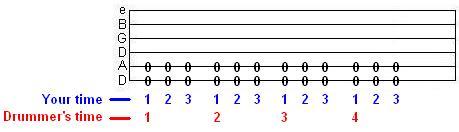
Now let's try this kind of "1 2 3 1 2 3" timing in a proper riff...
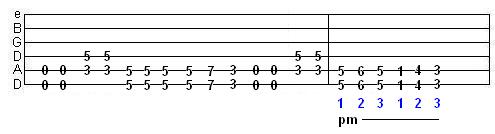
Notice how the 3/4 time kept tight against the drummer's regular 4/4 time. This adds a groove (or swing) to the standard 4/4 time. A common palm muting technique used in groove metal.
Palm muting triplets
In metal alternate picking is commonly used in groups of 3 strokes (triplets) - down up down.
Still resting your "palm" just over the bridge to partially mute the strings, use this alternate picking pattern in bursts of 3...
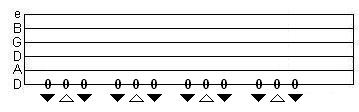
You could hear in that last one I almost lost it! It requires a fair amount of endurance in your pick hand so work on it every day using a metronome.
Keep your pick hand relaxed and make sure only the point of the pick scrapes over the string so to keep obstruction minimal.This is the foundation of rhythmic scratch guitar - it takes some practice, but use that metronome to gradually build up speed like in the examples above (I'm starting to sound like a broken mp3 here).
More complex palm muting rhythms
We're still using that foundation alternate picking but this time, to create a more intricate rhythm, we'll position the odd downstroke to juxta the rhythm a bit. Very hard to explain in words so see and hear below...

Used in Slayer's Exile, and a few others, it incorporates that same triplet technique but adding those occasional downstrokes interrupts the regular timing.
If playing in a band, the members need to work very tightly together on timings like this to make sure everyone knows when the bar starts and ends.Galloping palm muted riffs
Galloping?! That's something a horse does, right? This technique sounds a bit like it. It's just another way to use the triplet technique like before.
This is actually a lot more difficult, you have to stop and start palm muting in strict syncopation or it all goes pear shaped...

One of Sepultura's many great riffs.
If you look at the tab, you'll see those "down up down" symbols again to show you where the alternate picking comes in. This is also when the palm muting should be engaged.
Keep your palm in position
ready for engaging, but raise it only slightly when not used so it can
be quickly applied again.
Dealing with slower tempos
It's just as important to have accuracy and control at slower tempos. The example below is a brilliantly simple but powerful Machine Head riff that uses palm muted bursts at a slow tempo to create a weighty atmosphere.
This riff uses the machine gun picking we've looked at above, but instead of groupings of 3 strokes, it's in groupings of 5 (down-up-down-up-down)...
Hear me speed up from a slow example
Click the tab to hear...
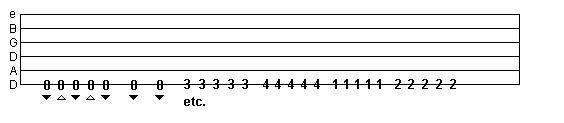
It takes time to be able to release tension accurately in your picking wrist (i.e. to keep the pick groupings strictly at a certain number). The only advice I can give is to... yes, gradually speed up using a metronome.
In a way, this requires more
accuracy because the ears pick up errors more efficiently at slower
tempos!
Palm muting and double stops
It's important to be able to palm mute all 6 strings so you can add some variety to your lead guitar.
With the exercise below we're using the mixed muted/unmuted method on two strings at a time, known as double stops, starting with the top two strings and working down. The muted strings won't actually be heard too clearly in a fast riff, they just help carry the riff.
The red squares indicate where you lift off the muting to strike the strings normally.

Of course, more on this in the lead guitar section.
To summarise...
Quite a big lesson that, but I hope you've got some ideas and exercises there to improve your timing and accuracy with palm muting.
Final words from the broken record...
-
Use a metronome to build up speed gradually
-
Listen to different styles of rock and heavy metal and how they use palm muting
-
Listen to it with HEADPHONES, the guitar will be heard much more clearly.
| |
Tweet |
Sign up to the newsletter for updates and grab your free Uncommon Chords book
Related
Fast Palm Mute Guitar
Thrash Guitar Lesson
More Rhythm Guitar Lessons




