



Fast Palm Mute Guitar in Metal
Speed palm muting has given styles such as thrash metal its trademark rhythmic aggression. This lesson will show you the techniques used by a whole generation of speed/thrash metal bands that used fast palm mute guitar as the driving force behind their music.|
First,
make
sure you know beginner
palm mute guitar Also, take a lesson in fast guitar picking in metal for some good primer stuff. |
This lesson is about using the palm muting technique over fast, complex rhythms. So take your time, as it's a playing technique that requires reasonable levels of concentration and physical endurance. There'll be drum tracks and practical exercises to help you. So let's take a look!
The foundations of fast palm mute guitar
Assuming you already know the essential palm mute technique (so you'll know it's not really your palm which does the work here!) we now need to look at picking techniques to build up that driving rhythm and speed.
Basic picking technique
First, there's the basic palm muted down stroke which gets you that percussive, muted sound:
(Click the diagrams in this lesson to hear)
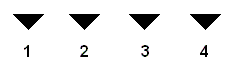
You'll find that with practice you can build up a good speed with just your downstrokes. Use a metronome to help gradually build up speed with this.
Now, a lot of guitarists make the big mistake of listening to, say, a fast thrash track and assuming all the palm muting is done using down picks only. Well, you might be able to down pick on the faster riffs for a few seconds, then your wrist will seize up and start to ache, slow down and become sloppy. It won't be able to handle the endurance at some of the higher speeds.
To get around this, we can simply add an up stroke to the pattern, which makes use of the upward motion of your pick as you bring it back up for the next down pick. This will allow you to execute fast palm mute guitar for longer (and eventually as long as you need).
So instead of picking down-down-down-down, we're picking down-up-down-up. This is known as alternate picking.
Choosing the right pick
Play around and find which pick position is best for you. I find if I hold the pick too close to the point, my thumb can get in the way when coming back up for the up stroke. Also think about pick thickness - some people prefer hard picks (e.g. .8mm and above), I prefer softer picks (around .6mm) for less obstruction, as softer picks can flex over the string more easily.
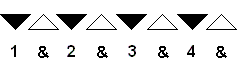
Remember to keep your pick hand rooted to the spot, muted across at least the bottom 3 strings, and use your wrist as a pivot point to drive the action.
This is a form of alternate picking used with palm muting. Keep playing around until you get the sound you want.
When we add the upstroke in, it's a lot cleaner to just hit one string - preferably the bass note of its relative chord/powerchord - it's this bass note that really gives the driving rhythm some melodic definition (the bass player will help with this too).
| Tip: Some guitarists like to use wide and aggressive pick sweeps, and this does deliver a more percussive attack to palm muted riffs. I personally try to keep the pick sweeps as tight as possible (without sacrificing the firm pick strokes) because it's generally good practice to be as efficient as possible with the physical side of things. This will improve your endurance. |
OK, I think we've covered the
foundations of fast palm mute guitar here, so when you're ready, let's
move onto building accuracy, a crucial element of
speed rhythm guitar in metal.
Fast palm muting - accuracy & timing
The more extreme sub-genres of heavy metal can use very technical drum rhythms, so the guitarist has to be prepared to chop 'n' change at the crash of a symbol. This most commonly involves mixing fast palm muted phrases with regular bursts of non-muted strumming to complement the drums.
It's all in the wrist - the key to accurate palm mute rhythm guitar is discipline with your picking wrist! You need to apply and release tension appropriately - but try to relax overall and let the natural flow of the rhythm dictate your picking movements. Practice and persistence will get you there. It's as much mental as it is physical.
Also, make sure you listen to a variety of metal that uses this technique (I assume you like this style of music anyway), and listen with headphones for more clarity - when you listen, picture yourself playing along, even move your wrist in sync. This is when air guitar actually becomes useful.
Using the alternate picking, palm mute technique from above, try the exercises below - first listen to the slow example, then the quicker example.
As always... build up speed with a metronome!
Alternate picking fast palm mute exercise
Follow the upstroke/downstroke arrows!
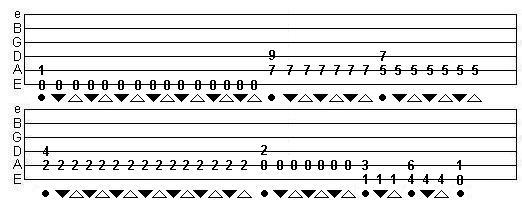
At first, some guitarists find alternate picking more difficult on the higher strings (e.g. powerchords with the root on the A string) because you have a string below and above you to avoid accidentally picking. The space for your pick sweep has been reduced, and therefore requires more accuracy. You can do two things:
1) Try to narrow down your picking sweeps to make your down-up movements as small as possible - this is what I do.
2) Just block out the string below by touching it (effectively muting it) with one of your fret hand fingers. This, you have to admit, is the lazier option, but if it works, it works!
OK, now let's try an exercise over a simple drum track. The double bass technique is used a lot in heavy metal drumming and, as a guitarist, you can complement this by timing the attack of your palm muting with the timing of the bass drum - this sounds awesome if done accurately...
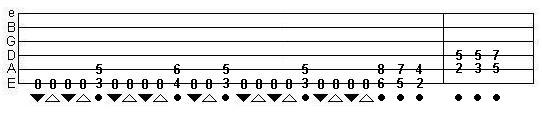
Now, sometimes, especially when playing a riff across more than one string, it makes sense to just use down picking (as opposed to alternate picking), otherwise we will lose the direction we need in our picking to help execute the riff accurately and cleanly. Example...
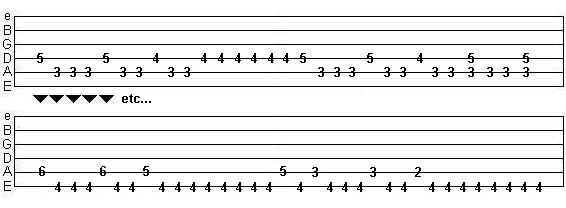
So, all down picks in that riff. There's no doubt that the momentum created from pure down picking gives your riffs more physical attack. So if the tempo is slow enough to only down pick, do it!
| Tip: When
using only down picks
I find, unlike with alternate picking, it helps to hold the pick
as far towards the "nib" as possible so you get the full support of
your thumb behind the
pick. This will help keep the picking firm, adding to the
percussive attack of the muted sound. The reason I mentioned not to hold the pick at the point for alternate picking is because your thumb might obstruct the upstrokes if it's too far down. |
Maybe now we should move onto more technical fast palm mute guitar rhythms... you are still awake aren't you?
More technical fast palm mute riffs
As mentioned before, it's the mix of fast palm muted riffs and rhythmic bursts of chord/powerchord that gives heavy metal guitar its unique and energetic dynamics (that, along with high gain/distortion of course). We can, of course, be as technical as we like with this (it's all down to what you think sounds good).
Try the exercises below, first listening to the slow version, then the quicker version, and finally the drum track which you can play over if you like. With both exercises, try and think about your pick position from the diagrams earlier on, and also when to release your "palm" from the strings to allow those non-muted bursts.
You have to be quick with this, because as soon as the palm muting starts again, your hand needs to be back on the strings, ready in place.
Don't forget the metronome to start with!
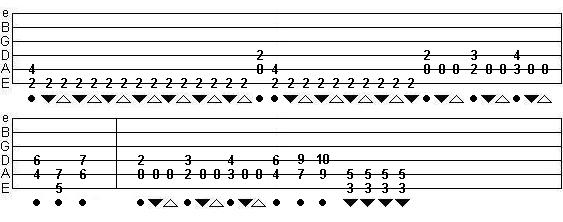
Below is a little something inspired by Fear Factory who use pinpoint rhythmic palm muting in a "machine-like" way...
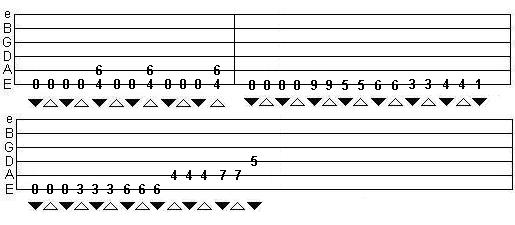
Happy thrashing.
| |
Tweet |
Sign up to the newsletter for updates and grab your free Uncommon Chords book
Related
Thrash Guitar Lesson
Death Metal Guitar Lesson
Use Fast Palm Mute with Other Metal Techniques



