


3 Guitar Tuning Tips for More Accurate Tuning
Before we take a look at some effective guitar tuning tips, make sure you've been through the main guitar tuning page as there are lessons covering many different methods of tuning up.

|
There are some quick and simple "checks" you can do...
1. Once you think you've tuned up (using whichever method you've chosen), try playing chords right across the neck to make sure the tuning is accurate. Some chord voicings can highlight inaccuracies better than others.
2. You can also compare the same note on two or more strings to check that the guitar is at least tuned to itself and all the strings are working together in tune.
3. You can use harmonics to pick up on the vibrating effect that occurs when two strings aren't tuned perfectly to their interval.
Let's expand on these tuning tips and put them into practice...Tuning Tip 1: Using chords to identify tuning inaccuracies
The truth is, some guitarists simply don't have an ear for tuning. Some guitarists will be satisfied with a guitar that's "there and there abouts" in tune. Don't let that be you, because although not everyone who hears you play won't pick up on these minor inaccuracies, some will (even if they don't know what's causing it to sound "off"), and it will compromise your music. You can train your ear to instantly pick up on any inaccuracies in your tuning.
Let's look at an example of how you can use the notes in a chord to tune up accurately.
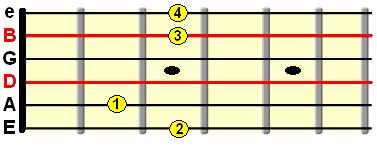
One variation of the open G major chord includes a note twice.
Look at the diagram below (click diagrams to hear). Once you've fretted the G major chord, play the red strings - they should be the same note, and in tune with each other...
The open A major chord also includes doubled up tones which you can play to check they are tuned together...
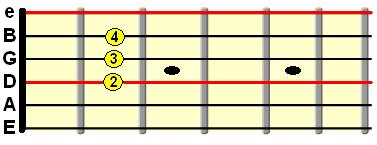
So you can look for two occurrences of the same note within chord shapes you're familiar with and listen closely to check they're both tuned together (all barre chords contain two "root notes", one an octave of the other (higher, but still the same note).
Tuning Tip 2: Use string relationships for fine tuning
Most guitarists are familiar with the 5th fret method of tuning, but many also find it can yield inaccurate results, depending on the setup of your guitar.
This is because with the 5th fret tuning method, while fine for just casual playing on your own, involves tuning an open string to a fretted string which can cause natural inaccuracies (especially with cheaper guitars).
However, you can overcome this by tuning fretted strings to other fretted strings all over the fretboard.
For example - fretting the A string and G string in the following positions...
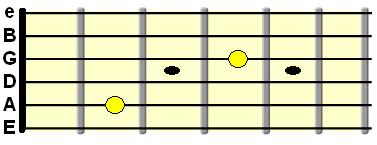
Those two strings should be exactly the same note (with the G string being the higher octave), and tuned together accurately.
Guitarists commonly tune up and find that if you do the test above, the G string sounds too high or low and it needs adjusting.
There are more string relationship diagrams to help you tune like this on the note relationships page.Tuning Tip 3: Use harmonics to tune accurately
Tuning using harmonics is a more advanced method, but a very accurate way to fine tune the guitar, more accurate than the 5th fret method.
It involves using your ear to pick out imperfections in the intervals between the strings. To hear these imperfections more clearly, we use harmonics to create a high pitched frequency that oscillates when an imperfect interval between two notes is sounded.
As you tune the string more perfectly to its interval, this oscillation effect straightens out.
Very difficult to explain in plain
English, so see the lesson on tuning
harmonics for more on this method.
Happy tuning.
| |
Tweet |

More Guitar Tuning Lessons



