


Home
> Progressions
>
vi Variation

Click to hear
And an example with the vi minor 7th chord rooted on the 6th string (using an E shape barre chord)...
Click to hear
The idea is to experiment with the different types of minor chord you learn in the chords section. For example, how does a minor 9th (e.g. Am9) chord sound in the vi position? You don't even need to know chord theory, just add and remove fingers/notes to the standard barre and open fingerings you learn and hear if the modifications sound good in that position.
You can see that, as we learn how to enhance/modify each chord in the scale we're building, we can put it all together and make the progression as a whole lot more interesting and tone-rich. This brings out natural harmonies embedded within the chord sequences we pull out of the scale. In turn this can help you pick out vocal and lead phrases to complement the chord progression. More on this later in our songwriting journey.
The major VI chord is most commonly associated with jazz music, and you'll hear why in examples below. It gives the submediant a completely different sound, although its function becomes slightly more limited. This is where you need to experiment and trust your ears to judge what sounds good and what perhaps sounds "out of place" in a flowing chord progression. I can't show you every possible chord combination unfortunately!
For example, a movement from V to VI might sound too disjointed, whereas a movement from I to VI flows better.
The most common way to use the major VI chord is to enhance it by using a dominant 7th chord (e.g. A7, B7, D7 etc.), just like the V chord, so with this in mind...
Click to hear
Another great (and especially jazzy) way to enhance the VI7 chord is to add a ♭13, the most common chord shape for which is below...
Click to hear
In fact, any dominant 7th based chord works well in this position, though a simpler major triad would also work.
Remember, all these chord types can be learned in the chords section
While at the moment it may still seem a little constrained, that won't be an issue once you begin to see it in the context of what you can play around this scale. All these chord positions will become mere reference points within a larger musical expression. However, it's important not to forget that some of the most loved music out there only uses the chord positions from this scale, with no "outside chords".
See you in the next part!
Mediant iii Chord
Main Guitar Chord Progressions Section
Submediant vi Chord Variation
In the vi chord lesson, we added a chord known as the submediant (also known as the 6 or vi chord), to our foundation chord scale. Just as with previous chords we've added, let's explore some more of this vi chord function to give us more creative options when writing our chord progressions.Spicing up the minor submediant
As we learned in the last part, the submediant is naturally a minor chord. As well as playing the basic minor chord forms (e.g. the minor barre and open chord shapes), we can try adding tones to this basic minor triad.vi as a minor 7th chord
Minor 7th chords give the basic minor triad more depth and colour. You can learn several ways to play a minor 7th chord, and the theory behind it in the chords section, but here are a couple of examples...Click to hear
I
- Dmaj7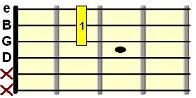 |
vi
- Bm7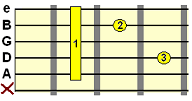 Fret 2 |
ii
- Em7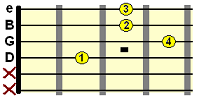 |
V
- A7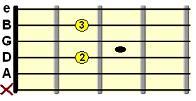 |
And an example with the vi minor 7th chord rooted on the 6th string (using an E shape barre chord)...
Click to hear
I
- B major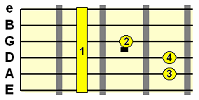 Fret 7 |
ii
- C♯m7 Fret 4 |
vi
- G♯m7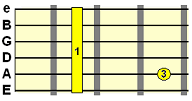 Fret 4 |
IV
- E
major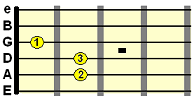 |
The idea is to experiment with the different types of minor chord you learn in the chords section. For example, how does a minor 9th (e.g. Am9) chord sound in the vi position? You don't even need to know chord theory, just add and remove fingers/notes to the standard barre and open fingerings you learn and hear if the modifications sound good in that position.
You can see that, as we learn how to enhance/modify each chord in the scale we're building, we can put it all together and make the progression as a whole lot more interesting and tone-rich. This brings out natural harmonies embedded within the chord sequences we pull out of the scale. In turn this can help you pick out vocal and lead phrases to complement the chord progression. More on this later in our songwriting journey.
The major VI chord
Just as we learned we could turn the minor ii chord into a major II chord, the same applies for vi.The major VI chord is most commonly associated with jazz music, and you'll hear why in examples below. It gives the submediant a completely different sound, although its function becomes slightly more limited. This is where you need to experiment and trust your ears to judge what sounds good and what perhaps sounds "out of place" in a flowing chord progression. I can't show you every possible chord combination unfortunately!
For example, a movement from V to VI might sound too disjointed, whereas a movement from I to VI flows better.
The most common way to use the major VI chord is to enhance it by using a dominant 7th chord (e.g. A7, B7, D7 etc.), just like the V chord, so with this in mind...
Click to hear
I
- F major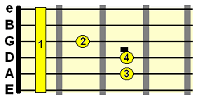 |
VI
- D7
(D dominant 7)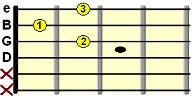 |
ii
- G
minor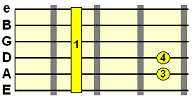 Fret 3 |
V
- C7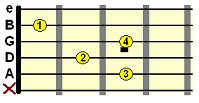 |
Another great (and especially jazzy) way to enhance the VI7 chord is to add a ♭13, the most common chord shape for which is below...
Click to hear
I
- C♯maj7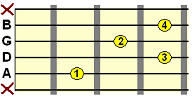 Fret 4 |
VI
- A♯7♭13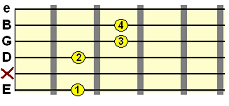 Fret 6 |
ii
- D♯m9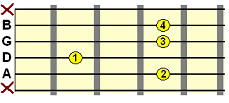 Fret 6 |
V
- G♯7add6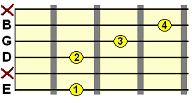 Fret 4 |
In fact, any dominant 7th based chord works well in this position, though a simpler major triad would also work.
Remember, all these chord types can be learned in the chords section
Keep experimenting!
The more chord combinations you can play around with, in multiple keys, the more your ear will be trained to the intrinsic function of this scale as a whole.While at the moment it may still seem a little constrained, that won't be an issue once you begin to see it in the context of what you can play around this scale. All these chord positions will become mere reference points within a larger musical expression. However, it's important not to forget that some of the most loved music out there only uses the chord positions from this scale, with no "outside chords".
See you in the next part!
| |
Tweet |
Stay updated and learn more
Sign up to the newsletter for updates and grab your free Uncommon Chords book
Sign up to the newsletter for updates and grab your free Uncommon Chords book
Related
Mediant iii Chord
Main Guitar Chord Progressions Section



