


Home
> Progressions
> vi Chord
There are 3 remaining chords to complete this foundation
scale. By just playing around with the 4 chords we've already added (I,
ii,
IV
and V),
you can create simple, 4 chord songs using different chord combinations
and variations.
You may even recognise some of these combinations used in songs you know. This scale is used by songwriters more often than you might think. It's where many of those "radio friendly" hit songs come from, but classical music also uses the scale. However, I don't want you to be restricted to this scale, so we will build on these foundations in later lessons.
In this lesson we're going to add the 6th degree of the chord scale - the vi chord (or 6 chord).
The submediant, in its natural form, is a minor chord, represented by the lower case numeral vi (6), but as we'll learn later, we can turn it into a major VI chord.
The vi chord is often referred to as the relative minor of the major key tonic (I). This is because when playing in a minor key, the vi chord becomes the new tonic. More on this another time!
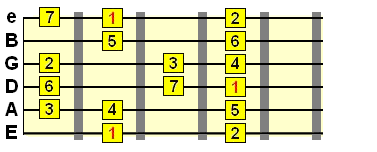
First, let's look at its position on the fretboard in relation to the tonic I chord. Below is a movable major scale pattern. Just like we've done in previous lessons, all you need to do is identify the same degree of the major scale as the chord degree. So in this case it's iv/6 - the 6th degree of the major scale...
Now, as we're building chords on this 6th degree, we need to know its position on one of the lower strings of the guitar, as this will be the bass root note for our vi chord and gives us a good visual reference for playing between chord relationships.
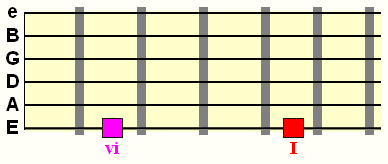
Let's say our tonic chord (built on the first degree of the scale) was rooted on the low E string. Here's how the submediant root note would look in relation to that...
Don't forget the A string as well...
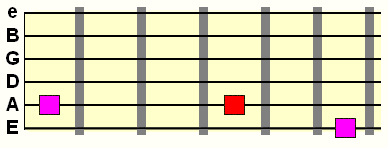
^ With the tonic rooted on the A string, the same submediant position lies in two immediate places. The position on the low E string allows us to build barre/movable chord shapes that use a low E string bass note (or at least use this root position as a reference point). You can see also how this then links to the first diagram, with the vi on the low E string.
If you know your interval names, the tonic can be seen as a minor 3rd interval from the vi chord.
Also, the position of vi can be identified as one whole step (two frets) up from the V chord (which we learned about in a previous lesson)...
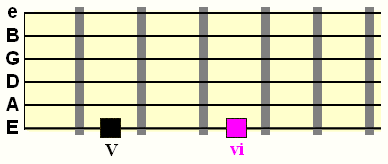
This whole step V - vi relationship interval is the same on the E A and D root note strings.
If we were to combine the positions of all the root notes of the chords we've learned so far, here's how it would look, starting with the tonic (I) chord rooted on the low E string (hint: it's exactly the same as the major scale's intervals!)...
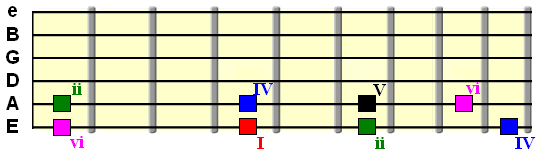
...and the tonic chord rooted on the A string...
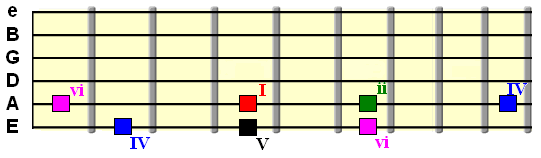
Learn how these root note positions sit alongside each other in their sequence. Once you learn their positions, you'll be able to move between the chords intuitively.
So, now we know the basic vi position in relation to the other chords, let's get to know the sound of its chord relationship. Starting with a tonic A major - F# minor example...
Click to hear
Just from hearing/playing this, you may recognise this movement as used in many popular and classical pieces. The relationship between the tonic and submediant is similar to that between the tonic and subdominant - it's a relaxed movement that doesn't create much tension/resolution at all (unlike the relationship between the tonic and dominant, for example).
Let's look at how the submediant can interact with the other 4 chords we've learned in this course so far...
So, just like in previous lessons, I'll show you a few example combos. Remember, you don't have to use all 5 chords and you don't always have to begin on the tonic chord.
When I say experiment I really mean it! ;)
Here are some commonly used major key progressions that involve the vi chord (we'll come to minor key progressions in a later lesson)...
I vi IV V - click to hear
Note that, because the positions of some of the chords in the above key of A major, I was able to use those common open chords in place of barre chords. Something to think about.
I V vi IV - click to hear
ii V I vi - click to hear
...and don't forget, as your songwriting develops, you might want to create progressions that use alternating patterns. For example...
I vi IV I ii V
Over time, you'll be able to "feel" when, for example, a vi chord might be an effective addition to one of your chord sequences. By learning its sound in relation to the other chords in this scale we're building, that feeling will become more and more intuitive.
Share your thoughts...
Have any questions, thoughts or ideas about this lesson? Let us know using the comments form below.
Submediant Variation
Main Guitar Chord Progressions Section

Submediant vi Chord in Chord Progressions
Over the past 5 parts in the chord progressions section, we've been building what's known as the diatonic chord scale - 7 chords built upon the degrees of the major scale.
 |
You may even recognise some of these combinations used in songs you know. This scale is used by songwriters more often than you might think. It's where many of those "radio friendly" hit songs come from, but classical music also uses the scale. However, I don't want you to be restricted to this scale, so we will build on these foundations in later lessons.
In this lesson we're going to add the 6th degree of the chord scale - the vi chord (or 6 chord).
Submediant vi chord on the fretboard
As with the other chord positions we've been learning, don't worry about what the name "submediant" means, just get to know its relationship with the other chords in the scale.The submediant, in its natural form, is a minor chord, represented by the lower case numeral vi (6), but as we'll learn later, we can turn it into a major VI chord.
The vi chord is often referred to as the relative minor of the major key tonic (I). This is because when playing in a minor key, the vi chord becomes the new tonic. More on this another time!
First, let's look at its position on the fretboard in relation to the tonic I chord. Below is a movable major scale pattern. Just like we've done in previous lessons, all you need to do is identify the same degree of the major scale as the chord degree. So in this case it's iv/6 - the 6th degree of the major scale...
1
W
2
W 3
H
4
W
5
W
6
W 7
H
1
Now, as we're building chords on this 6th degree, we need to know its position on one of the lower strings of the guitar, as this will be the bass root note for our vi chord and gives us a good visual reference for playing between chord relationships.
Let's say our tonic chord (built on the first degree of the scale) was rooted on the low E string. Here's how the submediant root note would look in relation to that...
Don't forget the A string as well...
^ With the tonic rooted on the A string, the same submediant position lies in two immediate places. The position on the low E string allows us to build barre/movable chord shapes that use a low E string bass note (or at least use this root position as a reference point). You can see also how this then links to the first diagram, with the vi on the low E string.
If you know your interval names, the tonic can be seen as a minor 3rd interval from the vi chord.
Also, the position of vi can be identified as one whole step (two frets) up from the V chord (which we learned about in a previous lesson)...
This whole step V - vi relationship interval is the same on the E A and D root note strings.
If we were to combine the positions of all the root notes of the chords we've learned so far, here's how it would look, starting with the tonic (I) chord rooted on the low E string (hint: it's exactly the same as the major scale's intervals!)...
...and the tonic chord rooted on the A string...
Learn how these root note positions sit alongside each other in their sequence. Once you learn their positions, you'll be able to move between the chords intuitively.
So, now we know the basic vi position in relation to the other chords, let's get to know the sound of its chord relationship. Starting with a tonic A major - F# minor example...
A
major barre chord (I)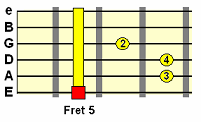 |
F#
minor barre chord (vi)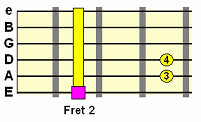 |
Click to hear
Just from hearing/playing this, you may recognise this movement as used in many popular and classical pieces. The relationship between the tonic and submediant is similar to that between the tonic and subdominant - it's a relaxed movement that doesn't create much tension/resolution at all (unlike the relationship between the tonic and dominant, for example).
Let's look at how the submediant can interact with the other 4 chords we've learned in this course so far...
Chord progressions involving the vi chord
By now, you should know what the next stage is! Yep - simply experiment with different combinations of the chords in the scale and try and memorise their positions in different keys.So, just like in previous lessons, I'll show you a few example combos. Remember, you don't have to use all 5 chords and you don't always have to begin on the tonic chord.
When I say experiment I really mean it! ;)
Here are some commonly used major key progressions that involve the vi chord (we'll come to minor key progressions in a later lesson)...
I vi IV V - click to hear
A major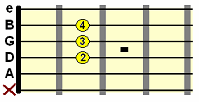 |
F# minor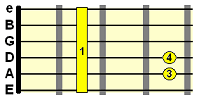 |
D major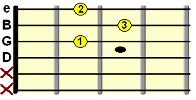 |
E
major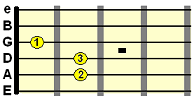 |
Note that, because the positions of some of the chords in the above key of A major, I was able to use those common open chords in place of barre chords. Something to think about.
I V vi IV - click to hear
A flat
(Ab) major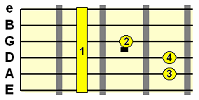 Fret 4 |
E
flat
(Eb) major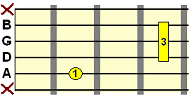 Fret 6 |
F minor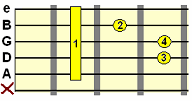 Fret 8 |
D flat (Db) major Fret 4 |
ii V I vi - click to hear
D minor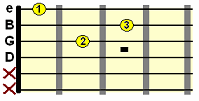 |
G
major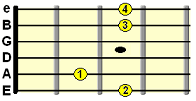 |
C major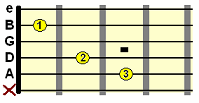 |
A minor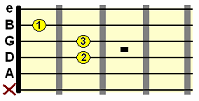 |
...and don't forget, as your songwriting develops, you might want to create progressions that use alternating patterns. For example...
I vi IV I ii V
A final word...
The most important thing is that you learn, using both your ears and eyes on the fretboard, these relationships in any key. It's all about relative movements. If the tonic chord changes position, so does the rest of the chord scale, along with the major key centre, but the scale's intervals remain intact.Over time, you'll be able to "feel" when, for example, a vi chord might be an effective addition to one of your chord sequences. By learning its sound in relation to the other chords in this scale we're building, that feeling will become more and more intuitive.
| Was this
helpful? Please support this site. I really appreciate it! |
Stay updated
and learn more Sign up to the newsletter for updates and grab your free Uncommon Chords book |
Share your thoughts...
Have any questions, thoughts or ideas about this lesson? Let us know using the comments form below.
Related
Submediant Variation
Main Guitar Chord Progressions Section



