



Open 7th Guitar Chords
In the previous two lessons in this basic guitar chords series, we've learned the elementary major and minor open position chords, down at the first few frets. But it doesn't stop there! Now that we know the basic major and minor forms, we can modify these to create more interesting chords. Free chord
cheat sheet Free chord
cheat sheetLearn how guitar chords work together in any key... Click here to start now |
In this lesson we're looking at the open
7th chords. Don't
worry about what the "7th" means right now - in time you will
understand. The main thing to know is that 7th chords are not separate
from major or minor chords, rather they add notes to those
basic major and minor chords. In other words,
7th chords are still essentially major or minor.
By the end of this lesson you'll know which type of 7th chord
creates which type of sound. You'll also know how to instantly make
those basic major/minor chords more interesting. So, let's expand our
chord library even further...
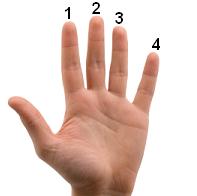 Dominant 7th open chords
Dominant 7th chords are used in place of regular major chords when the mood fits. There's no hard and fast rule, but dom-7th chords generally give the major chord a more unstable feel, and all because of one additional note, known as the flat 7th.
You can tell a chord is a dominant 7th chord
because it will be written with a 7
(e.g. E7, D7, C7).
Remember in the last lesson I asked you to try and observe which
note/string we were changing to turn major into minor chords? Well,
it's a good idea to do the same here. Take a look at the dominant 7th
chords below and see if you can identify how the basic major chord has
been altered. The fingering shapes should seem familiar from the first
major chord lesson, with slight changes to
accommodate this new 7th tone...
Click the diagrams to hear the chord.
E7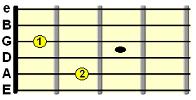 |
E7
Variation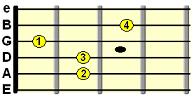 |
A7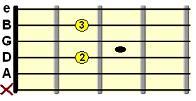 |
A7
Variation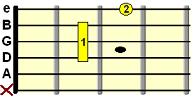
Use your index finger flat across the D G and B strings. Make sure all strings sound cleanly when fretted. |
D7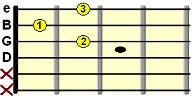 |
G7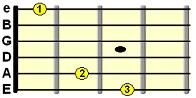
|
G7
Variation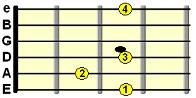 |
C7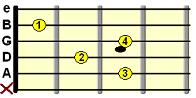 |
B7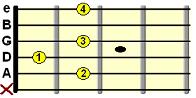 |
Minor 7th open chords
Now we're modifying the basic minor chords to become 7th chords. Like above, adding the same flat 7th note gives the minor chords a fuller sound. It's just an easy way to beef up those regular chords.
Em7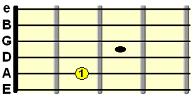 |
Em7
Variation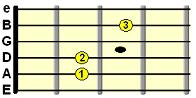 |
Am7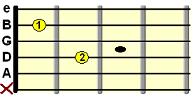 |
Am7
Variation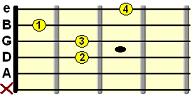 |
|
Dm7
Try using your first (index) finger flat across those top 2 strings, making sure each note in the chord sounds cleanly and in harmony.
|
Bm7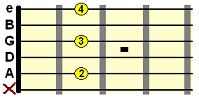 |
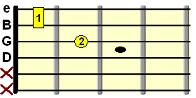
Open major 7th chords
Not to be confused with the dominant 7th chords from earlier, which were major chords with the added flat 7th.
Major 7th chords are major chords with an added major 7th. Confused? I don't blame you! The best way to tell the difference at first is to see and hear it, so take a look and listen below and see the difference between the major 7th and dominant 7th chords. Again, it's just one single note responsible for the difference (hint: with the E shape, it's the D string)...
Emaj7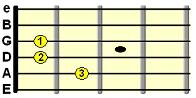
|
Amaj7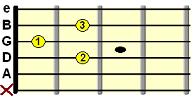
|
Dmaj7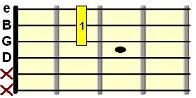
|
Gmaj7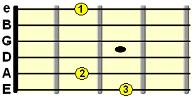
|
Cmaj7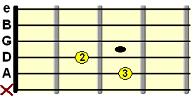
|
Fmaj7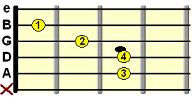 |
Practice changing between chords
After 3 lessons of chords, we now have a fairly large pot from which to pull a simple progression of our own. Use the below jam track exercises to get an idea of how 7th chords can work with the other open chords we learned to create meaningful music.
Note: Just like in the previous lessons, before you play over the jam track below, use a metronome to gradually build up your speed and confidence with changing chords. Make sure the changes are smooth and clean before you speed up a notch.
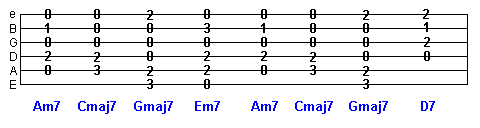
Also, as always with these lessons, try making
your own sequence
from the
guitar chords we've learned so far. The more you practice changing
between chords, the sooner you will be ready to move on to using more
advanced chord
fingerings. However, don't feel like you're in a rush.
More basic guitar chords to learn
Think back to when you'd just learned the first couple of chords. Now look at how far you've come! You may even be at the point where you can just pick up the guitar and improvise with the chords you've learned. Whatever stage you're at, these lessons are always here for you to back track through and refresh your memory.
In the final lesson of this open chord series, we will be looking at even more interesting chords you can create simply by modifying the basic major and minor open shapes. You may have experimented already by adding and removing fingers/notes to chords and changing their sound. Next lesson will build on this.
| |
Tweet |
Sign up to the newsletter for updates and grab your free Uncommon Chords book
Related
Added and Suspended Open ChordsMore Beginner Guitar Lessons
More Guitar Chord Lessons



