



Guitar Drop Tuning Lesson
Drop tuning your guitar is simply where you tune the bottom string lower than its standard pitch.Most often, the dropped string is an octave lower than the 4th fattest string on your guitar (that's the D string in standard tuning).
This type of tuning is commonly associated with heavy metal (especially the lower tunings such as drop C and B), but lowering that bottom string gives you a deeper 6th string bass note which can also complement clean or acoustic playing.
This page will provide you with audio tuning aids and tips for the most common drop tunings - D, C and B. Less common drop tunings include drop C# and drop A (technically you can drop tune to any note). For less common tunings, you can find a more comprehensive tuner on this page.
 Click
Here to tune to Drop C
Or see below for Drop
D tuning
Click
Here to tune to Drop C
Or see below for Drop
D tuningDrop D Guitar Tuning
So, first make sure your guitar is in standard tuning (E A D G B e). Go to this page for a free online tuner.Simply tune the low E string down until it becomes a lower sounding D. You can match this up with the 4th string (a higher D) to check they are the same.
Click on the Drop D diagram below to hear a low D...
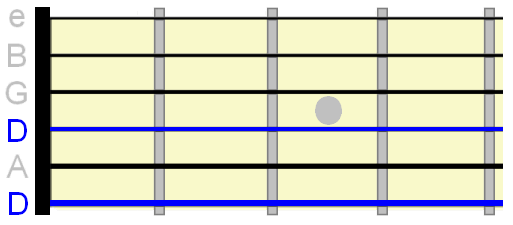
Once the lowest string has been tuned down to D, the tuning on your guitar should now be D A D G B e.
You can do a lot of things with drop tuning, but when playing power chords, the lower 6th string gives you a deeper crunch. It also changes how you finger power chords, allowing you to play riffs (arguably) a lot quicker than in standard tuning.The below tab shows a typical drop D powerchord riff. I've included the suggested fingering in blue, which shows you how little effort is needed to play decent sounding riffs in drop D. Click the tab to hear it...
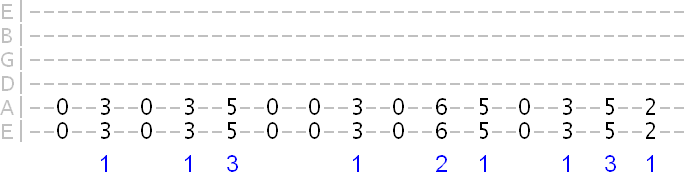
When playing the drop D powerchord like above, it's best to get all your fingers involved in a similar way you would when playing single-string lead guitar. You'll especially find it easier to use more than one finger on faster riffs involving drop tuning.
Drop C Guitar Tuning
A lot of newer heavy metal uses deeper drop tuning such as drop C and drop B. Below is a tuner for drop C to help you out.
Click on the individual strings to hear the note:
| d |  |
| A |  |
| F |  |
| C |  |
| G |  |
| C |  |
When tuning down this low, double check once all strings have been tuned down as a lot of tension on the neck will have been released during this process, putting it out of tune slightly.
If you tune that bottom C back up to a D you will be in standard D tuning which allows you to play all the familiar positions of standard tuning, but obviously with a deeper sound.
How to tune to Drop C without a tuning aid
When drop tuning to C without any note reference, the easiest way is to first make sure you're in standard tuning, or near enough (E A D G B e).
Now we need to find a C note on the fretboard to use as a reference for tuning the low E string to C. This can be found at fret 3 on the A string.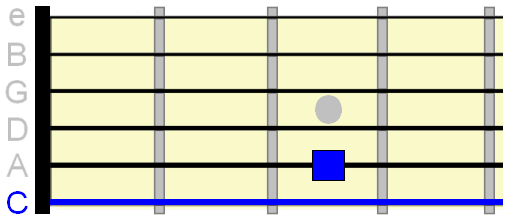
Tune down the open low E string until it matches the C note fretted on the A string. Now, the fretted C note will be an octave higher than the destination C note on the low E string, but you can still get a good indication when it's there - click to hear Once you have that low E down to a C, tune the other strings down using the following steps:
- Fret the newly tuned low C string at fret 7 and tune the A string down until it matches.
- Fret the newly tuned A string (now G) at fret 5 and tune the D string down until it matches.
- Fret the newly tuned D string (now C) at fret 5 and tune the G string down until it matches.
- Fret the newly tuned G string (now F) at fret 4 and tune the B string down until it matches.
- Fret the newly tuned B string (now A) at fret 5 and tune the E string down until it matches.
- The high E string should now be tuned down to the note D.
Drop B Guitar Tuning
First, make sure the strings on your guitar are at least a gauge 11. This will ensure enough tension in the strings when playing for optimum tone. Otherwise, it will be like playing elastic bands stretched over a cereal box (ahh memories from pre-school).
Click on each string below to hear and tune your guitar to drop B...
| c# | |
| G# | |
| E | |
| B | |
| F# | |
| B | |
Make sure you double check after tuning all strings because a lot of tension is lost in the guitar when tuning down this low.
How to tune to Drop B without a tuning aid
When drop tuning to B without any reference, first tune your guitar to standard tuning, or as close as you can (E A D G B e).
Now we need to find the note B on the fretboard to use as a reference for tuning the low E string to B. This can be found at fret 2 on the A string.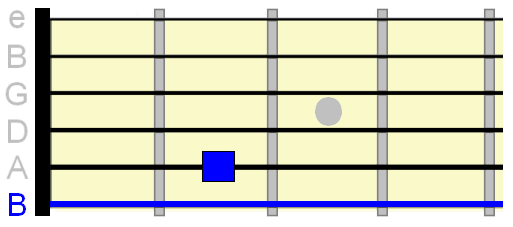
Tune down the open low E string until it matches the B note fretted on the A string. Remember, the fretted B note will be an octave higher than the destination B note on the low E string, but you can still get a good indication when it's there - click to hear
Once you have that low E down to a B, tune the other strings down using the following steps:- Fret the newly tuned low B string at fret 7 and tune the A string down until it matches.
- Fret the newly tuned A string (now F#) at fret 5 and tune the D string down until it matches.
- Fret the newly tuned D string (now B) at fret 5 and tune the G string down until it matches.
- Fret the newly tuned G string (now E) at fret 4 and tune the B string down until it matches.
- Fret the newly tuned B string (now G#) at fret 5 and tune the E string down until it matches.
- The high E string should now be tuned down to the note C#.
| Was this
helpful? Please support this site. I really appreciate it! |
Stay updated
and learn more Sign up to the newsletter for updates and grab your free Uncommon Chords book |
Share your thoughts...
Have any questions, thoughts or ideas about this lesson? Let us know using the comments form below.



