


Home
> Rhythm >
Chord
Picking 2
This lesson is about the next logical step - string skipping, and separating those chord tones out in a more layered, interesting way. We'll also touch on some funky alternative picking rhythms later on.
It's also a common lead guitar technique, but to keep within the context of this series, we'll just focus on applying string skipping to chord playing, for now.
OK, let's get started... (don't forget your metronome!)
Click to hear
It's a useful practise drill. However, we can use string skipping to create a more layered effect. The sequence of picked strings could be as follows (remember, we're using alternate picking!)...

We could choose to re-arrange that sequence and make our skips a bit wider...

So in that sequence, the skip between the root A string and B string is 3 strings "wide", as is the skip between the high E string and D string.
Note: This isn't all about randomly choosing picking distances. When you come to learn how chords are constructed, you'll want to identify and highlight particular tones of the chord you're playing before you lay out your picking pattern. This lesson is just to get you physically used to picking chords!
Finally, we could also try a "rolling pattern", where there's more emphasis on a constant direction. In this case, downward...

When coming up with your own picking sequences, it's important to analyse the chords you're playing individually. Analyse the notes/strings that make up the chord, how they relate to one another, and build up layers within that chord to create an expression you like.
For example, below I'm picking an open Em9 chord, which has a very rich and immersive quality. Now, I can exploit this quality by arranging my picking sequence so it highlights certain note relationships (intervals, essentially) within the chord...
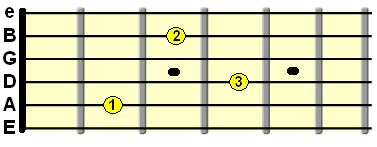
Let's build up the layers based on 4 pick strokes at a time. Remember, the below letters are in reference to the strings...
I particularly like the effect of the G and D string played one after the other (that's the minor 3rd and 9th tones of the chord - don't worry if you're not sure what that means, it's all covered in the chord theory lessons but not essential to know for now).
Let's add another layer...
Played just on its own, this layer loses the context of the E minor sound (partly because it doesn't start with that strong bass E root note), but the main thing is that you're analysing how different parts of the chord, the high and low tones, bring out these expressive note combinations.
And finally...
Now, here I've re-used the D and G string relationship that I liked from earlier, but swapped it around to give it some freshness. It's fine to repeat phrases in a given chord picking sequence, but inverting certain phrases can give it a new edge.
Also, that final note, the minor 3rd on the open G string, I felt really complemented the return to the root E string (from which we start the sequence again).
Right, let's put it together into a cyclic sequence...
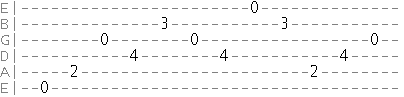
Click to hear
I like how the open G string is left to ring through to the next repeated sequence.
Beautiful, and it's just one single chord! Naturally, you'll learn to apply this technique through chord changes.
I've created a jam track below using 4 chords (G major, C major, E minor and D major). I really want you to experiment with your own pick sequence ideas, and you'll know by now that there are many different picking combinations/string skips you can use for a given chord.
For reference, here are the basic chords the backing bass is built around:
However, I prefer to use modified versions of these chords to make it more interesting (Gadd9, Cadd9#11, Em9, D7sus2):
(More on variations of basic chords here).
So, the chord change sequence is in the following order: G, C, Em, D
Remember, you don't have to pick constantly throughout the piece. Try sequences where you leave "gaps" in the picking rhythm to add another interesting variation. For example, you could pick a few times and then leave the final note in that sequence to ring out for a bit longer before the chord changes - experiment!
Download the backing track here
Well, that's all for this lesson. I hope you've found it revealing and inspiring! See you in the next part of this series, where we look at more advanced chord picking techniques.
Share your thoughts...
Have any questions, thoughts or ideas about this lesson? Let us know using the comments form below.
Guitar Chord Picking - Part 2 - String Skipping
In the first chord picking lesson, we learned the basics of using alternate picking to arpeggiate chords - playing the notes/strings separately rather than simultaneously (as with strumming).This lesson is about the next logical step - string skipping, and separating those chord tones out in a more layered, interesting way. We'll also touch on some funky alternative picking rhythms later on.
First, what is string skipping?
Exactly what it says! It simply involves missing or "jumping over" strings in a picking sequence where you might usually just play the strings consecutively, from low to high (or high to low). What this does is create more dynamic and intricate melodies, as you're jumping between high and low tones from the chord you're picking.It's also a common lead guitar technique, but to keep within the context of this series, we'll just focus on applying string skipping to chord playing, for now.
OK, let's get started... (don't forget your metronome!)
Basic string skipping chord patterns
Let's start really simple, using the open A major chord. You know the one...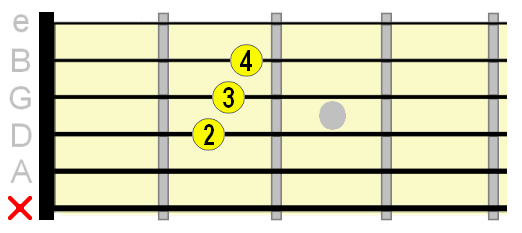
Click to hear
It's a useful practise drill. However, we can use string skipping to create a more layered effect. The sequence of picked strings could be as follows (remember, we're using alternate picking!)...
A
- G - D - B - G - e - D - B
We could choose to re-arrange that sequence and make our skips a bit wider...
A
- B - D - G - e - D - G - B
So in that sequence, the skip between the root A string and B string is 3 strings "wide", as is the skip between the high E string and D string.
Note: This isn't all about randomly choosing picking distances. When you come to learn how chords are constructed, you'll want to identify and highlight particular tones of the chord you're playing before you lay out your picking pattern. This lesson is just to get you physically used to picking chords!
Finally, we could also try a "rolling pattern", where there's more emphasis on a constant direction. In this case, downward...
A
- B - G - D - e - B - G - D
More sophisticated chord picking patterns
Before we move on to changing chord whilst picking...When coming up with your own picking sequences, it's important to analyse the chords you're playing individually. Analyse the notes/strings that make up the chord, how they relate to one another, and build up layers within that chord to create an expression you like.
For example, below I'm picking an open Em9 chord, which has a very rich and immersive quality. Now, I can exploit this quality by arranging my picking sequence so it highlights certain note relationships (intervals, essentially) within the chord...
Let's build up the layers based on 4 pick strokes at a time. Remember, the below letters are in reference to the strings...
E -
A
- G - D
Click to hearI particularly like the effect of the G and D string played one after the other (that's the minor 3rd and 9th tones of the chord - don't worry if you're not sure what that means, it's all covered in the chord theory lessons but not essential to know for now).
Let's add another layer...
B -
G - D - e
Click to hearPlayed just on its own, this layer loses the context of the E minor sound (partly because it doesn't start with that strong bass E root note), but the main thing is that you're analysing how different parts of the chord, the high and low tones, bring out these expressive note combinations.
And finally...
B - A - D - G
Click to hearNow, here I've re-used the D and G string relationship that I liked from earlier, but swapped it around to give it some freshness. It's fine to repeat phrases in a given chord picking sequence, but inverting certain phrases can give it a new edge.
Also, that final note, the minor 3rd on the open G string, I felt really complemented the return to the root E string (from which we start the sequence again).
Right, let's put it together into a cyclic sequence...
Click to hear
I like how the open G string is left to ring through to the next repeated sequence.
Beautiful, and it's just one single chord! Naturally, you'll learn to apply this technique through chord changes.
Chord change picking exercise
Let's now try some chord changes using the different picking patterns we've learned over the past two lessons. The idea is to mix them up so you can create varied rhythms through the changes in your music.I've created a jam track below using 4 chords (G major, C major, E minor and D major). I really want you to experiment with your own pick sequence ideas, and you'll know by now that there are many different picking combinations/string skips you can use for a given chord.
For reference, here are the basic chords the backing bass is built around:
G
major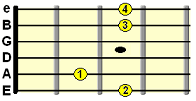 |
C
major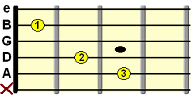 |
E
minor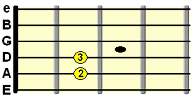 |
D
major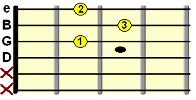 |
However, I prefer to use modified versions of these chords to make it more interesting (Gadd9, Cadd9#11, Em9, D7sus2):
Gadd9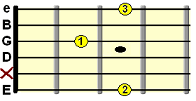 |
Cadd9#11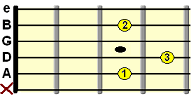 |
Em9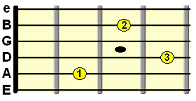 |
D7sus2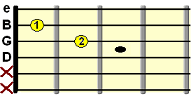 |
(More on variations of basic chords here).
So, the chord change sequence is in the following order: G, C, Em, D
Remember, you don't have to pick constantly throughout the piece. Try sequences where you leave "gaps" in the picking rhythm to add another interesting variation. For example, you could pick a few times and then leave the final note in that sequence to ring out for a bit longer before the chord changes - experiment!
Download the backing track here
Well, that's all for this lesson. I hope you've found it revealing and inspiring! See you in the next part of this series, where we look at more advanced chord picking techniques.
| Was this
helpful? Please support this site. I really appreciate it! |
Stay updated
and learn more Sign up to the newsletter for updates and grab your free Uncommon Chords book |
Share your thoughts...
Have any questions, thoughts or ideas about this lesson? Let us know using the comments form below.



