


Home
> Progressions
>
ii Chord Variation

Hopefully, if you've followed this section from part 1, you'll be getting familiar with the lesson structure, so the theory we're about to look at will be based on similar concepts from previous lessons.
Remember: it's important you have a basic understanding of chords on guitar. The chords section on the site has everything you need to learn chords!
So, where are we now? Let's spend a little more time looking at the supertonic ii chord which we were introduced to in the last lesson. There are ways to modify that 2 chord to give your chord progressions more variation.
For example, in the key of E major (E major being our tonic, I chord)...
II IV I - F#maj Amaj Emaj - click to hear
I IV II V IV - Emaj Amaj F#maj Bmaj Amaj - click to hear
So it's simply a case of experimenting with changing that ii minor chord to a II major chord to see how it interacts with the other chords in the scale we've been building over the past lessons.
In later lessons, you'll also hear how it interacts with chords outside this foundation scale.
Before, we learned that the dominant (5) chord can be enhanced using a dominant 7th chord.
We also learned that the subdominant (4) chord can be enhanced using either a major 7th, dominant 7th or minor chord.
ii V I - click to hear
IV ii I - click to hear
I II IV V - click to hear
These chord relationships are all drawing from the positions we learned in the last part. You should learn to play them in any key by learning those positions.
One effective way to use a suspended ii chord is to resolve it to a major II chord. Let's just use the last example from above...
I II IV V - click to hear
So there's a mini-resolution within the progression, between the iisus4 and the II, that adds a bit of variation to our journey away from that home/tonic chord.
And you could take it a step further, by following this sequence on the 2 chord - suspended, major, minor - then move on with the progression. So you can include all the flavours of that ii/II chord in the same sequence if you want. Experiment!
ii V I - click to hear
Try different combinations of these chord positions (I, ii, IV, V) and don't be afraid to add in some improvised chord positions (hey, you never know, you might end up picking up the rest of the chord scale by ear!).
We'll keep building this foundation scale over the next few lessons - not long to go now - then things will get a lot less constrained. You will realise, however, that me taking you through these foundation steps was absolutely necessary to enable you to fully explore your creative potential.
See you soon...
Submediant vi Chord
Main Guitar Chord Progressions Section
Supertonic ii Chord Variation
Slowly but surely, we're laying the foundations that will allow us to identify and write our own chord progressions on guitar with ease.Hopefully, if you've followed this section from part 1, you'll be getting familiar with the lesson structure, so the theory we're about to look at will be based on similar concepts from previous lessons.
Remember: it's important you have a basic understanding of chords on guitar. The chords section on the site has everything you need to learn chords!
So, where are we now? Let's spend a little more time looking at the supertonic ii chord which we were introduced to in the last lesson. There are ways to modify that 2 chord to give your chord progressions more variation.
Using a major supertonic II chord
As we learned in the last part, the supertonic is, in its naturally occurring form in the scale, a minor chord. However, you'll hear many songs that use a major 2 chord (in which case, we'll use the upper case II).For example, in the key of E major (E major being our tonic, I chord)...
II IV I - F#maj Amaj Emaj - click to hear
I IV II V IV - Emaj Amaj F#maj Bmaj Amaj - click to hear
So it's simply a case of experimenting with changing that ii minor chord to a II major chord to see how it interacts with the other chords in the scale we've been building over the past lessons.
In later lessons, you'll also hear how it interacts with chords outside this foundation scale.
Spicing up the 2 chord
Just as we had lessons on how to enhance the role of the IV and V chords, the same applies to the ii or II chord.Before, we learned that the dominant (5) chord can be enhanced using a dominant 7th chord.
We also learned that the subdominant (4) chord can be enhanced using either a major 7th, dominant 7th or minor chord.
Minor 7th ii chord
Firstly, you can use minor 7th chords to add depth to the ii chord. If you've been through the chord section on the site, you'll know how to use both open and barre chord shapes for a minor 7th chord. Here are a couple of examples...ii V I - click to hear
Am7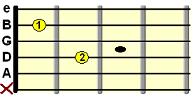 |
D7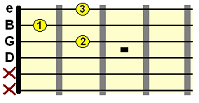 |
G major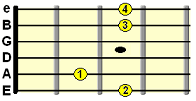 |
IV ii I - click to hear
E flat
major 7
(Ebmaj7)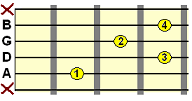 Fret 6 |
C minor 7
(Cm7)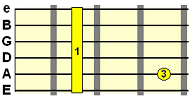 Fret 8 |
Bb major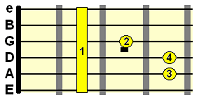 Fret 6 |
Dominant 7th II chord
When we turn the ii chord into a major II chord, we can use the dominant 7th to enhance that position...I II IV V - click to hear
E major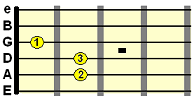 |
F#7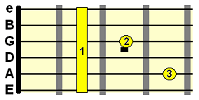 |
Amaj7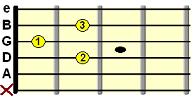 |
B7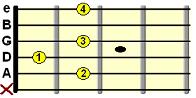 |
These chord relationships are all drawing from the positions we learned in the last part. You should learn to play them in any key by learning those positions.
Suspended ii chord
If you've been through the chords section on the site, you should be familiar with suspended chords. These are neither major nor minor because the tone responsible for making the chords major/minor (the 3rd) is replaced by another tone (the 2nd or 4th).One effective way to use a suspended ii chord is to resolve it to a major II chord. Let's just use the last example from above...
I II IV V - click to hear
| E major |
F#7 sus4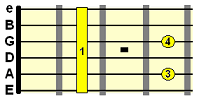 |
| F#7 |
Amaj7 |
| B7 |
So there's a mini-resolution within the progression, between the iisus4 and the II, that adds a bit of variation to our journey away from that home/tonic chord.
And you could take it a step further, by following this sequence on the 2 chord - suspended, major, minor - then move on with the progression. So you can include all the flavours of that ii/II chord in the same sequence if you want. Experiment!
Half Diminished ii chord
As covered in the diminished guitar chords lesson, we can use a half diminished (m7b5) chord on the ii chord position. This is most often used to substitute the ii chord in a ii V I turnaround. This time we're in the key of C major...ii V I - click to hear
Dm7b5
(Half Diminished)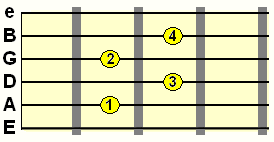 Fret 5 |
G7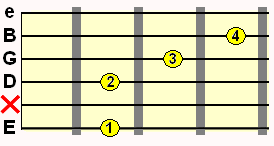 Fret 3 |
C major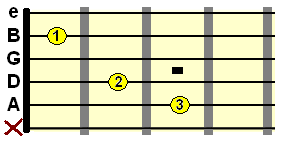 |
A recap...
We've actually come a long way since the first part, even though we only have 4 chords to play around with at the moment. We've learned how to enhance and modify the ii, IV and V chords, which means you technically have more to experiment with than just 4 chords.Try different combinations of these chord positions (I, ii, IV, V) and don't be afraid to add in some improvised chord positions (hey, you never know, you might end up picking up the rest of the chord scale by ear!).
We'll keep building this foundation scale over the next few lessons - not long to go now - then things will get a lot less constrained. You will realise, however, that me taking you through these foundation steps was absolutely necessary to enable you to fully explore your creative potential.
See you soon...
| |
Tweet |
Stay updated and learn more
Sign up to the newsletter for updates and grab your free Uncommon Chords book
Sign up to the newsletter for updates and grab your free Uncommon Chords book
Related
Submediant vi Chord
Main Guitar Chord Progressions Section



