



Subdominant IV Chord Variation
In the first subdominant chord lesson, we learned a 3rd staple chord we can use in our songwriting - the IV chord (4 chord).Using the subdominant along with the tonic (I) and dominant (V) from previous parts, we were able to create simple and natural 3 chord progressions that have been used, and built upon, in many genres of music for centuries.
Just as we devoted a lesson to learning the natural variations of the dominant chord (how to "spice it up"), let's spend some time learning the various tensions and tones of the subdominant.
Remember, a lot of this stuff requires knowledge of different chords on guitar. However, we'll look at some practical examples throughout this lesson.
Enhancing the IV chord function
In the last part, we were simply playing the basic chord forms (also known as triads), and therefore we learned the subdominant 4 chord, like the 1 and 5 chords in major key progressions, is a major chord in its natural form.For example, if we were just using open chords, we could play the following progression in the key of A major (A major being the tonic chord):
I / IV / V
A major / D major / E major.
Now, we know from the lesson on spicing up the dominant chord that we can modify that basic major chord to enhance its relationship with the tonic and other chords within a progression. This was done primarily by using a dominant 7th chord (e.g. A7, D7, E7).
We can do the same kind of thing with the subdominant, but this chord is actually far more versatile than the dominant as we shall see/hear...
The major 7th IV chord (IVmaj7)
Major 7th chords (labelled "maj7" e.g. Amaj7, Dmaj7, Emaj7 etc.) are considered a natural chord in the subdominant position. Why? Well, answering that would require a whole other lesson! However, as always, your ears will tell you what sounds natural and what sounds a little more edgy or unorthodox. There is no right or wrong in music!In the last part, we learned that the subdominant acts as a kind of musical relaxation away from the tonic. This can be contrasted with the dominant, which has a more tense and unresolved feel.
Using a major 7th chord in the subdominant position enhances this relaxation effect. Examples...
| Progression: | I | IV | V |
| In E major: | E | Amaj7 |
B7 |
So, if I were to simply use open chords for the above progression, it would look and sound something like this...
I - E major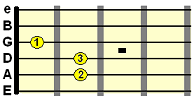 |
IV - Amaj7
(A major 7th)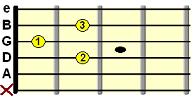 |
V - B7 (B
dominant 7th)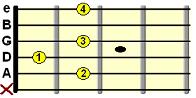 |
Click
to hear |
However, you can obviously play around with such a sequence, e.g. moving back and forth between the tonic and subdominant (click to hear), or even stay away from the tonic and play between the 4 and 5 chords (click to hear). Experiment!
You don't always have to start on the tonic for these relationships to work.
Let's look at another subdominant maj7 example, based on the I, IV, V root note positions we learned in the last lesson. Remember, these are movable chord shapes, so these relationships can be moved up and down the fretboard depending on the key you're playing in.
I - Eb (E
flat major)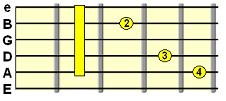 Fret 6 |
IV
- Abmaj7 (A flat major 7th)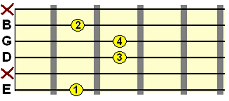 Fret 4 |
Again, it's important you familiarise yourself with the many different chord options you have!
Dominant 7th in the subdominant position (IV7)
If you want a cool bluesy feel to your subdominant chord, use a dominant 7th chord in that position. So, technically this means we can have two dominant 7th chords - one in the subdominant position, the other in its natural dominant position as we learned before.Example:
I - F# (F
sharp major)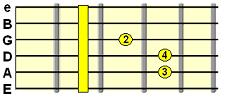 Fret 2 |
IV
- B7 (B dominant 7th)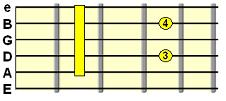 Fret 2 |
This is a good example of the versatility of the IV chord. Whereas the dominant V position is not really compatible with a major 7th chord, the subdominant is compatible with both major 7th and dominant 7th chords. This is because its function is more ambiguous.
So, this means we can use any chord we would usually for the dominant position also in the subdominant position to add a little bluesy soul to our songs.Using a minor subdominant iv chord
Yep, it's so versatile it can even be changed to a minor chord! You'll hear this in many songs. This major tonic - minor subdominant relationship is actually from a scale of its own, but we won't get into the theory behind that right now.Minor chords are represented by lower case numerals (major IV, minor iv).
Many people hear a flamenco sound in this relationship - take a listen in the key of E major (I'm just using open chords again)...
E major (I) - A minor (iv) - click to hear
This opens a whole new door to different types of minor chord we can experiment with in the sub-dom position. Again, you can get plenty of ideas for minor chords in the chord section.
One of my favourite uses of the minor subdominant is a minor chord with an added 6th. Let's use this in an I V iv progression...
I - Eb (E
flat major)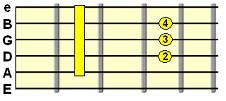 Fret 6 |
V - Bb (B
flat major) Fret 6 |
iv -
Abmadd6 (A flat minor add 6)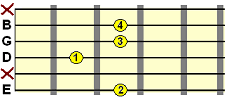 Fret 4 |
Click to hear |
So you can turn what would be quite a happy and relaxed sounding I V IV, into a more tragic, unsettling I V iv just by making a major-minor switch with the subdominant.
Tip: if a chord position is major and minor compatible, like the subdominant, try switching to the other while you're playing that chord. For example, you could play the sequence D major, G major, G minor, D major (I, IV, iv, I). This is just another option you have when songwriting, but we'll look more at these types of intricacies later.
Keep experimenting with the 4 chord
I need to make it clear that you shouldn't get too scientific with your songcraft. You don't always need to modify the subdominant chord from its natural form, and you don't even have to use it at all. What I'm helping you do here is build up a foundation chord scale which you'll later modify, twist, shape and add to in your own way - you'll see!Next time... you can probably guess... we'll be adding yet another chord to the scale, which will further expand our songwriting options.
| |
Tweet |
Sign up to the newsletter for updates and grab your free Uncommon Chords book
Related
The Supertonic ChordMain Guitar Chord Progressions Section



