


Home
> Scales
> Soloing
Over Two Chords

Video Lesson
Using what you've learned in the video, think about starting and landing notes through each chord change, carefully selecting your notes and building your phrases. Let your ears be the judge of what sounds good!
Each track is set at 88 BPM, so nice and steady! Remember to set your media player to "loop" so you don't need to keep clicking play when it ends.
Let's start with the example that was used in the video...
Download backing track (right click and "save as")
Download backing track (right click and "save as")
You could technically play the related A major scale (see above) over these two chords and it would work. However, as B minor is our tonic chord, it's related mode (Dorian) becomes the dominant scale.
Download backing track (right click and "save as")
This series is a work in progress. Subscribe below and I'll let you know as new lessons get uploaded. Thanks for your patience.
 Soloing
Over Blues Progressions
Soloing
Over Blues Progressions
Soloing Over Two-Chord Changes
Most songs use more than one chord, so as a lead guitarist you need to be able to solo confidently through chord changes. In many cases, one scale will be compatible with all the chords used in the progression. In other cases, you'll find the chord changes are less confined to a diatonic key.Video Lesson
Soloing over two-chord backing tracks
The below backing tracks have been written specifically to introduce you to soloing over chord changes. They are simple, 2 chord progressions over which you can use one single scale.Using what you've learned in the video, think about starting and landing notes through each chord change, carefully selecting your notes and building your phrases. Let your ears be the judge of what sounds good!
Each track is set at 88 BPM, so nice and steady! Remember to set your media player to "loop" so you don't need to keep clicking play when it ends.
Let's start with the example that was used in the video...
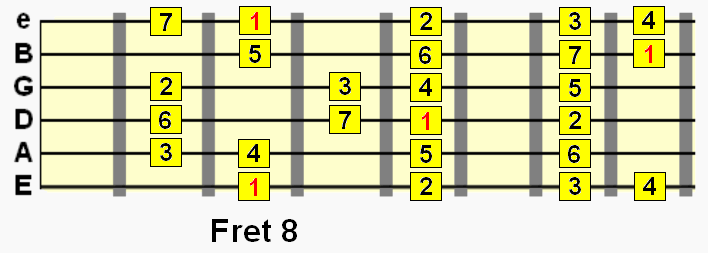
C major (I) - F major (IV)
Download backing track (right click and "save as")B minor (ii) - A major (I)
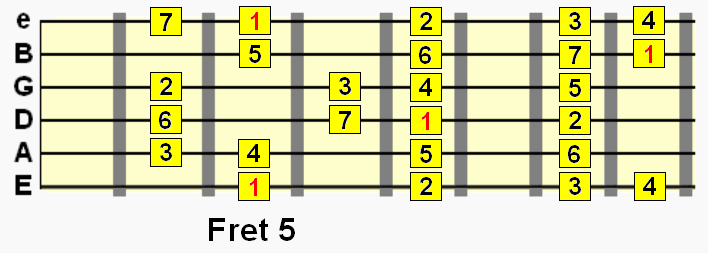
A progression that resolves to A major (the 1/tonic chord) from B minor (the 2/ii chord). As A major is the tonic chord, we use the A major scale. This track is an example of how not all progressions have to start on the tonic chord.Download backing track (right click and "save as")
G major (I) - D major (V)
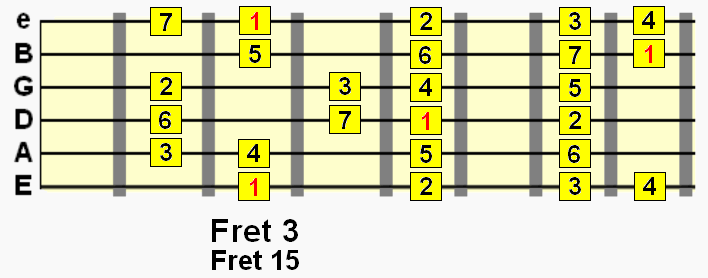
A 1-5 (I, V) progression in the key of G major, therefore G major is our scale. Remember, you can play this pattern an octave higher, beyond the 12th fret, so I've marked on the 15th fret at the root position.Download backing track (right click and "save as")
B minor (ii) - E major (V)
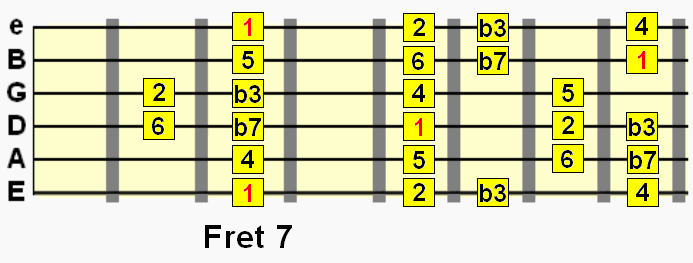
A progression that makes use of the B Dorian mode/scale. This is because the relationship between B minor and E major can be related to the 2 and 5 chords of the relative A major scale. Therefore, the 2nd and 5th modes (Dorian, Mixolydian) come into play respectively.You could technically play the related A major scale (see above) over these two chords and it would work. However, as B minor is our tonic chord, it's related mode (Dorian) becomes the dominant scale.
Download backing track (right click and "save as")
This series is a work in progress. Subscribe below and I'll let you know as new lessons get uploaded. Thanks for your patience.
| |
Tweet |
Stay updated and learn more
Sign up to the newsletter for updates and grab your free Uncommon Chords book
Sign up to the newsletter for updates and grab your free Uncommon Chords book
Related Lessons
How to Solo Over Chord Changes
Soloing
Over Blues Progressions


