


Home
> Scales
> Phrygian
Dominant Positions

These smaller patterns are built on each degree of the phrygian dominant scale, giving us 7 positions. Break it down this way and you'll be playing across the entire fretboard sooner than you might expect.
For this example, I'm using a root of G, but remember that this large pattern we're building is movable and relative to where the root note lies.
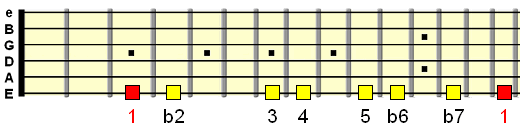
So, starting with the 1st position pattern, which we already know from the first part. You could also play the 3rd on the low E string if you wanted...
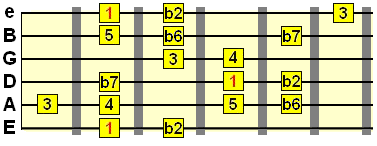
2nd position. Fingering's a little tricky at first, but a great workout for the fingers. A lot of these patterns will be useful for warming up...
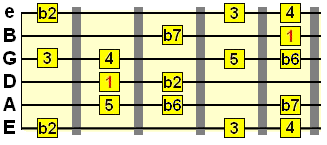
3rd position...
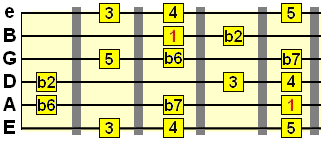
4th position. Exactly the same as the harmonic minor 1st position pattern. That's because phrygian dominant is a mode of harmonic minor (more on this another time!)...
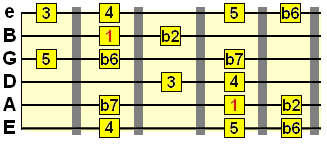
5th position. You'll notice this and the last patter overlap the A string boxed pattern we learned in the first part...
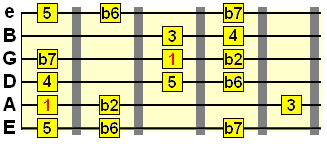
6th position...
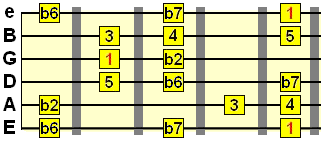
Finally the 7th position...
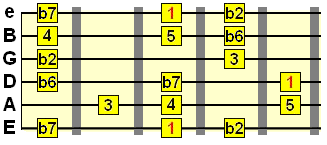
Staying in the example key of G, connecting the phrygian dominant scale positions from above would create the following large scale pattern...
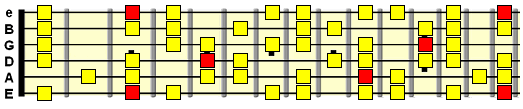
Note that as the G string is the note G (obviously!) the open G string and therefore its 12th fret will be a root note.
These root positions, and intervals such as the 3rd and 5th, should be seen as reference points to help you find your bearings. Study how these interval relationships exist in each positions. You should be able to pick the major arpeggio (1 3 5) patterns out of each one.
Remember, all major scales contain this 1 3 5 (major triad) relationship - Ionian, Mixolydian, Lydian to name a few. So it's beneficial to be able to isolate these common intervals.
As with the other scales, create your own patterns within this larger pattern, by connecting two or three positions, to accomodate techniques such as runs and string skipping.
Related
Guitar Scale Patterns
Return to Guitar Scales
Phrygian Dominant Scale Positions
In the introductory phrygian dominant scale lesson, we learned the basic patterns and functions of this wonderful scale. This lesson is about ensuring you can play this scale confidently in any position on the fretboard, by seeing one large pattern broken up into smaller patterns.These smaller patterns are built on each degree of the phrygian dominant scale, giving us 7 positions. Break it down this way and you'll be playing across the entire fretboard sooner than you might expect.
The 7 phrygian dominant scale positions
First, just as with any other scale we might apply this process to, let's lay out the intervals of phrygian dominant along the low E string. This will provide us with the positions for building the 7 patterns.For this example, I'm using a root of G, but remember that this large pattern we're building is movable and relative to where the root note lies.
So, starting with the 1st position pattern, which we already know from the first part. You could also play the 3rd on the low E string if you wanted...
2nd position. Fingering's a little tricky at first, but a great workout for the fingers. A lot of these patterns will be useful for warming up...
3rd position...
4th position. Exactly the same as the harmonic minor 1st position pattern. That's because phrygian dominant is a mode of harmonic minor (more on this another time!)...
5th position. You'll notice this and the last patter overlap the A string boxed pattern we learned in the first part...
6th position...
Finally the 7th position...
Staying in the example key of G, connecting the phrygian dominant scale positions from above would create the following large scale pattern...
Note that as the G string is the note G (obviously!) the open G string and therefore its 12th fret will be a root note.
These root positions, and intervals such as the 3rd and 5th, should be seen as reference points to help you find your bearings. Study how these interval relationships exist in each positions. You should be able to pick the major arpeggio (1 3 5) patterns out of each one.
Remember, all major scales contain this 1 3 5 (major triad) relationship - Ionian, Mixolydian, Lydian to name a few. So it's beneficial to be able to isolate these common intervals.
As with the other scales, create your own patterns within this larger pattern, by connecting two or three positions, to accomodate techniques such as runs and string skipping.
| |
Tweet |
Stay updated and learn more
Sign up to the newsletter for updates and grab your free Uncommon Chords book
Sign up to the newsletter for updates and grab your free Uncommon Chords book
Related
Guitar Scale Patterns
Return to Guitar Scales



