


Home
> Scales
> Natural
Minor Positions

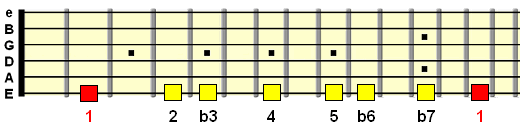
So, to start with, we need to lay out the intervals of natural minor across the low E string to give us our "position points".
In the below example, I'm using the F# minor scale, as the root note lies on F#. However, the large pattern we're building here is movable. In other words, you simply shift it up or down to a new root note depending on the key you're playing in.
We're now going to build patterns on each of these natural minor scale positions. Starting with the boxed pattern we already know...
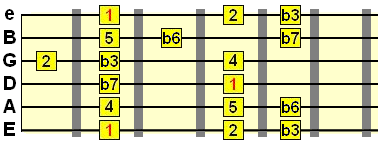
Moving up to the 2nd position...
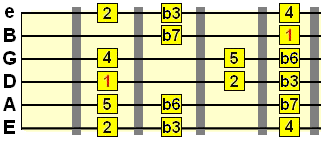
3rd position. Notice how this is exactly the same as the boxed major scale pattern! That's because natural minor is also a mode of the major scale (Aeolian), so somewhere amidst the minor scale pattern you'll see the other modes of the major scale immerge. More on modal context another time...
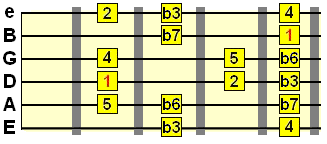
Position 4. Exactly the same as the Dorian boxed pattern...
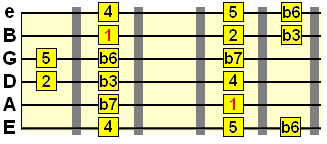
5th position. Same as the minor Phrygian boxed pattern. Notice how the root note in this position is situated on the A string, meaning this is the position of the A string boxed pattern we learned in the main lesson...
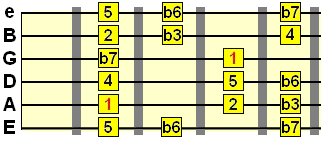
6th position. Same as the Lydian boxed pattern...
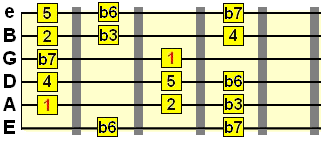
And finally, natural minor's 7th position, exactly the same as the Mixolydian boxed pattern...
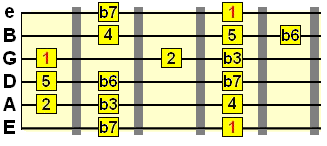
For example, you could combine the patterns around the 3rd and 4th minor scale positions to form a wider, 3-notes-per-string pattern, allowing you to practice wider finger movements on each string...
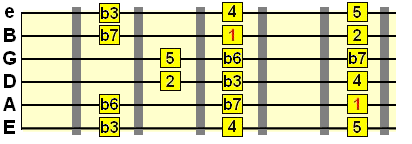
This is the beauty of knowing these positions - you now have the ability to create your own patterns for your own soloing needs.
However, learning scale patterns is only part of the picture. For a comprehensive process towards mastering scales I highly recommend the Guitar Scale Mastery Course. It shows you how to solo fluidly and effortlessly with any scale you learn.
Natural Minor Chord Progressions
Guitar Scale Patterns
More Guitar Scales
Natural Minor Scale Positions
This lesson will help you unbox the natural minor scale across the entire fretboard. We'll do this in exactly the same way we do in the other scale lessons - by using natural minor scale positions built around its 7 scale degrees.So, to start with, we need to lay out the intervals of natural minor across the low E string to give us our "position points".
In the below example, I'm using the F# minor scale, as the root note lies on F#. However, the large pattern we're building here is movable. In other words, you simply shift it up or down to a new root note depending on the key you're playing in.
We're now going to build patterns on each of these natural minor scale positions. Starting with the boxed pattern we already know...
Moving up to the 2nd position...
3rd position. Notice how this is exactly the same as the boxed major scale pattern! That's because natural minor is also a mode of the major scale (Aeolian), so somewhere amidst the minor scale pattern you'll see the other modes of the major scale immerge. More on modal context another time...
Position 4. Exactly the same as the Dorian boxed pattern...
5th position. Same as the minor Phrygian boxed pattern. Notice how the root note in this position is situated on the A string, meaning this is the position of the A string boxed pattern we learned in the main lesson...
6th position. Same as the Lydian boxed pattern...
And finally, natural minor's 7th position, exactly the same as the Mixolydian boxed pattern...
Using natural minor scale positions more effectively
Once you learn a scale's positions, connect them together and can play across the entire fretboard, you should experiment with breaking this larger pattern down in different ways.For example, you could combine the patterns around the 3rd and 4th minor scale positions to form a wider, 3-notes-per-string pattern, allowing you to practice wider finger movements on each string...
This is the beauty of knowing these positions - you now have the ability to create your own patterns for your own soloing needs.
However, learning scale patterns is only part of the picture. For a comprehensive process towards mastering scales I highly recommend the Guitar Scale Mastery Course. It shows you how to solo fluidly and effortlessly with any scale you learn.
| |
Tweet |
Stay updated and learn more
Sign up to the newsletter for updates and grab your free Uncommon Chords book
Sign up to the newsletter for updates and grab your free Uncommon Chords book
Related
Natural Minor Chord Progressions
Guitar Scale Patterns
More Guitar Scales



