


Home
>
Theory
/ Scales
> Minor
Arpeggios

Just as major arpeggios use the major triad intervals - 1 3 5 - minor arpeggios use the minor triad...
The minor 3rd is one semitone lower than the major 3rd. What this means is, rather than learning minor arpeggio patterns from scratch, all you need to do is flatten the 3rd in the major arpeggio patterns by one fret position to get your minor arp.
For example, taking this major pattern...
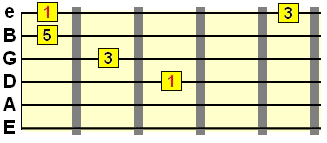
We can turn it into a minor arpeggio by simply flattening the 3rd...
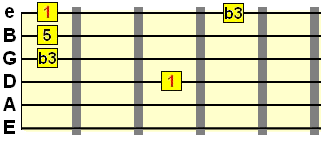
The root and 5th are part of both major and minor scales and chords, and therefore arpeggios!
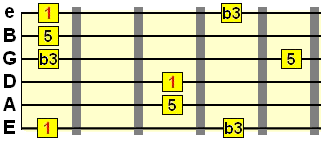
So, let's just have a review of the patterns from the last part to see how this new minor 3rd interval alters them. Remember, you can get a more comprehensive, interactive guide to arpeggio patterns using Guitar Notes Master.
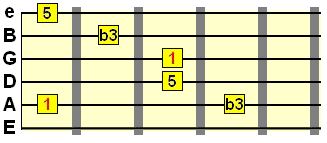
E string root minor arpeggio patterns
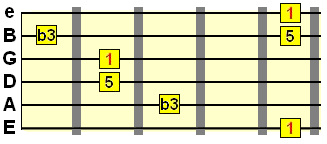
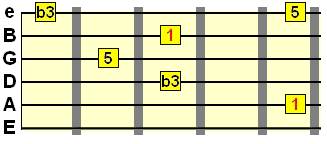
A string root minor arpeggio patterns
D string root minor arpeggio patterns
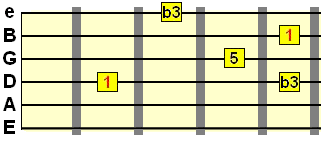
As mentioned in the last part, you don't always need to start on that root string in each pattern. These are just for reference. If a soloing phrase leads into the b3, for example, you can continue the arpeggio from that point in whatever way you wish. Learn the patterns by heart and keep your options open.
Once you've learned these patterns, it's time to work on linking them together, like we did in the key of G last time (R b3 5)
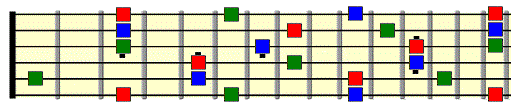
Remember, the 12th fret notes are the same as the open string notes, so the pattern is the same from the 12th as it is from open position.
You can break this and other patterns down, apply them in any key and generate bespoke exercises using this software.
The first is in the key of A minor (which means the root note of our patterns will be on the note... A)
Download the A minor backing track
The second is in the key of Eb (E flat) minor (which means the root note will be on the note... Eb)
Download the Eb minor backing track
Have a play around. Once you're happy with your progress, it's time to move on to the next stage - 7th arpeggios.
Guitar Theory Lessons
Guitar Scales Lessons
Minor Arpeggios on Guitar
If you've been through the major arpeggios lesson, there's actually not that much more you need to learn to master their minor counterparts.Just as major arpeggios use the major triad intervals - 1 3 5 - minor arpeggios use the minor triad...
Root (1)
- minor 3rd
(b3) - 5th
(5)
The minor 3rd is one semitone lower than the major 3rd. What this means is, rather than learning minor arpeggio patterns from scratch, all you need to do is flatten the 3rd in the major arpeggio patterns by one fret position to get your minor arp.
For example, taking this major pattern...
We can turn it into a minor arpeggio by simply flattening the 3rd...
The root and 5th are part of both major and minor scales and chords, and therefore arpeggios!
So, let's just have a review of the patterns from the last part to see how this new minor 3rd interval alters them. Remember, you can get a more comprehensive, interactive guide to arpeggio patterns using Guitar Notes Master.
Minor arpeggio patterns
So we've only changed one tone in these patterns from the major arpeggios - the b3. Test your co-ordination of this by switching between major and minor arps in the same position.E string root minor arpeggio patterns
A string root minor arpeggio patterns
D string root minor arpeggio patterns
As mentioned in the last part, you don't always need to start on that root string in each pattern. These are just for reference. If a soloing phrase leads into the b3, for example, you can continue the arpeggio from that point in whatever way you wish. Learn the patterns by heart and keep your options open.
Once you've learned these patterns, it's time to work on linking them together, like we did in the key of G last time (R b3 5)
Remember, the 12th fret notes are the same as the open string notes, so the pattern is the same from the 12th as it is from open position.
You can break this and other patterns down, apply them in any key and generate bespoke exercises using this software.
Minor arpeggio guitar backing tracks
We're just going to take it easy, like in the last part, and explore the patterns we've learned over the minor backing tracks below. Don't worry about speed or soloing prowess! Just focus on getting confident with the fingering for these patterns. You can always build up your speed using a metronome.The first is in the key of A minor (which means the root note of our patterns will be on the note... A)
Download the A minor backing track
The second is in the key of Eb (E flat) minor (which means the root note will be on the note... Eb)
Download the Eb minor backing track
Have a play around. Once you're happy with your progress, it's time to move on to the next stage - 7th arpeggios.
| |
Tweet |
 Like This?
Subscribe & Learn More... Like This?
Subscribe & Learn More...Subscribe to the fretjam newsletter below for updates and extras, plus grab your free copy of Uncommon Chords: 101 Vibrant Voicings You Won't Find on a Typical Chord Chart. |
Related
Arpeggios on GuitarGuitar Theory Lessons
Guitar Scales Lessons



