


Home
> Progressions
>
iii Chord Variation

Now let's find out how we can modify the iii chord to give us more variation when writing our chord progressions. Variation is good because it gives you more creative options, freeing up your expression as an original songwriter.
I'm aware I've probably repeated that a hundred times now!
Remember, a lot of the chord types used in these lessons can be learned in the chords section of the main site.
Anyway, you'll soon realise that using a major III chord can be just as compatible with the other chords in the scale as using a minor iii.
The mediant chord's overall function, in relation to other chords in the scale, doesn't change when you make it a major chord.
For example, below is a typical I - iii - vi - IV progression in the key of E major (E major being our tonic chord). You'll have probably heard this progression used in a lot of songs...
Click to hear
Now let's turn that iii chord into a major III chord to hear the difference...
III - Ab major
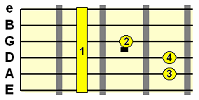
Fret 4
Click to hear
So there's quite a bit more tension in the chord, enhancing its unresolved quality. It has a certain tendency to move to the IV or (like in this example) vi chord, but those are by no means the only options. There are no "rules" as such, just musical conventions.
The idea is to experiment with both minor and major versions in your progressions and take your pick, or even interchange them.
Let's hear that same I - iii - vi - IV progression from above, but this time with a dominant 7th III chord. I'm just using a standard barre chord for this, but of course there are several ways to play the chord Ab7...
III7 - Ab dominant 7
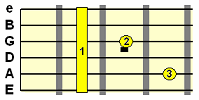
Fret 4
Click to hear
Now, when the chord is modified like this, you may see it written as III7 (II7 if it's the II chord). This is partly why roman numerals are used (otherwise we'd be writing 37 or 27 - too confusing!).
Let's just take a look at another example using the dominant 7th III chord, this time with an A string root note (different chord shape).
Click to hear
With the III chord, a typical jazzy alternative is to use an augmented 7th chord (e.g. Baug7). Here's a common (although rather excited) use of it, in an ascending pattern from the major I tonic up to the V7 chord...
Click to hear
So yet even more tension is added to the III chord by using both the dominant 7th and the augmented (sharp) 5th. If you're scratching your head wondering what "augmented" and "7th/5th" mean, this is all covered in the chord theory series.
As always, keep experimenting with different chord combinations and with modifying each chord (major/minor, dominant 7th/major 7th etc.) based on your knowledge from prior lessons.
By the end of the next part, we'll have finally built our foundations! You'll see why it was so important to spend a lot of time on this as you begin to build on these foundations with chords outside the scale...
Leading Tone Chord
Main Guitar Chord Progressions Section
Mediant iii Chord Variation
In the last part we learned about the mediant iii chord (also known as the "3 chord") in the diatonic scale.Now let's find out how we can modify the iii chord to give us more variation when writing our chord progressions. Variation is good because it gives you more creative options, freeing up your expression as an original songwriter.
I'm aware I've probably repeated that a hundred times now!
Remember, a lot of the chord types used in these lessons can be learned in the chords section of the main site.
The major III chord
As you know from the last part, the iii chord is naturally a minor chord. What do I mean by "naturally"? This is a whole subject in itself (diatonic theory) and I won't side track into that now. It's difficult to even summarise without causing possible confusion!Anyway, you'll soon realise that using a major III chord can be just as compatible with the other chords in the scale as using a minor iii.
The mediant chord's overall function, in relation to other chords in the scale, doesn't change when you make it a major chord.
For example, below is a typical I - iii - vi - IV progression in the key of E major (E major being our tonic chord). You'll have probably heard this progression used in a lot of songs...
I - E major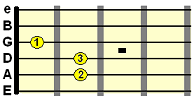 |
iii -
Ab minor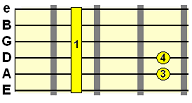 Fret 4 |
vi - C#
minor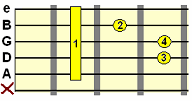 Fret 4 |
IV - A
major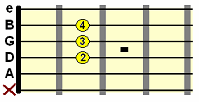 |
Click to hear
Now let's turn that iii chord into a major III chord to hear the difference...
III - Ab major
Fret 4
Click to hear
So there's quite a bit more tension in the chord, enhancing its unresolved quality. It has a certain tendency to move to the IV or (like in this example) vi chord, but those are by no means the only options. There are no "rules" as such, just musical conventions.
The idea is to experiment with both minor and major versions in your progressions and take your pick, or even interchange them.
III as a dominant 7th chord (III7)
In the supertonic lesson, we learned that the II chord could be enhanced further by using a dominant 7th (e.g. E7, D7, C7)? Well, we can do exactly the same with the III chord.Let's hear that same I - iii - vi - IV progression from above, but this time with a dominant 7th III chord. I'm just using a standard barre chord for this, but of course there are several ways to play the chord Ab7...
III7 - Ab dominant 7
Fret 4
Click to hear
Now, when the chord is modified like this, you may see it written as III7 (II7 if it's the II chord). This is partly why roman numerals are used (otherwise we'd be writing 37 or 27 - too confusing!).
Let's just take a look at another example using the dominant 7th III chord, this time with an A string root note (different chord shape).
| I - A major Fret 5 |
III -
C#7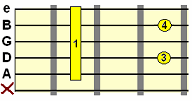 Fret 4 |
IV - Dmaj7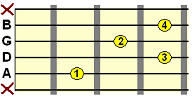 Fret 5 |
ii - B
minor Fret 2 |
Click to hear
Other mediant chord variations
I always find jazz a great genre for discovering interesting chord extentions used in the positions we've been learning.With the III chord, a typical jazzy alternative is to use an augmented 7th chord (e.g. Baug7). Here's a common (although rather excited) use of it, in an ascending pattern from the major I tonic up to the V7 chord...
| I - F#
major Fret 2 |
III -
Bbaug7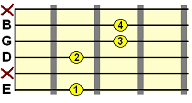 Fret 6 |
IV - Bmaj7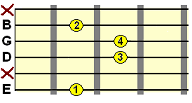 Fret 7 |
V
- C#9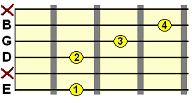 Fret 9 |
Click to hear
So yet even more tension is added to the III chord by using both the dominant 7th and the augmented (sharp) 5th. If you're scratching your head wondering what "augmented" and "7th/5th" mean, this is all covered in the chord theory series.
As always, keep experimenting with different chord combinations and with modifying each chord (major/minor, dominant 7th/major 7th etc.) based on your knowledge from prior lessons.
By the end of the next part, we'll have finally built our foundations! You'll see why it was so important to spend a lot of time on this as you begin to build on these foundations with chords outside the scale...
| |
Tweet |
Stay updated and learn more
Sign up to the newsletter for updates and grab your free Uncommon Chords book
Sign up to the newsletter for updates and grab your free Uncommon Chords book
Related
Leading Tone Chord
Main Guitar Chord Progressions Section



