



The Major Scale on Guitar
The major scale should be one of the first scales you learn on guitar, because it's one of the most commonly referenced in music (especially western music).
As you'll soon discover, it's not just a scale for the purposes of soloing, but a system for organising other important musical elements. We'll come to that!
First, we need to understand how the major scale is built. We'll then move on to its primary function - how we can use it to harmonise with (play over) chords so we can use it confidently in a solo. Take your time with this stuff because it's beneficial to have a clear understanding of this elementary scale.Major scale intervals
So what makes it a scale? In a nutshell: a repeating sequence of intervals.
Intervals are the distances/gaps between each note in a scale, the separation of a scale's degrees. The major scale has seven degrees.
Hopefully, you've taken the guitar fretboard lessons so you'll know how intervals work on the fretboard, but let's recap specifically for the major scale...
The major scale starts with note number 1 (called the root note) and continues in varying whole step and half step intervals up to 7. The intervals are as follows...
W = whole step (equivalent 2 fret interval)
H
= half step (equivalent 1 fret interval)
So if you were to start on the open low E string and lay out the intervals of the major scale on just that one string, this is how they would appear (1 being the open, unfretted string)...
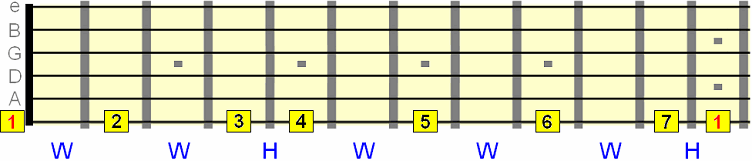
1 = the root note, and in this case the root note is E
Click to hear the above sequence.
Therefore this would be the E major scale, since the root lies on the the note E. The rest of the scale is built in relation to this root. So...
- 2 is a major 2nd interval in relation to the root.
- 3 is a major 3rd interval in relation to the root.
- 4 is a perfect 4th interval in relation to the root.
- 5 is a perfect 5th interval in relation to the root.
- 6 is a major 6th interval in relation to the root.
- 7 is a major 7th interval in relation to the root.
Once we get to note 7, the next note is the octave (sometimes labelled as 8 but to keep things simple, just call it 1 again) - the same as the root note (E in this case), but higher sounding. The scale sequence begins again an octave higher.
If we'd started from the open G string, we'd be playing G major.
If we'd started from the open B string, we'd be playing B major.
Same scale, same relative intervals, different root notes.
It's that typical "do-re-mi" scale most of us are familiar with and it's what chords and other scales can be referenced against.
For example, when we talk about a flat 5th (abbreviated as b5) in a chord or scale, we could see that as the 5th tone in its natural, major scale position flattened one half step. More on sharps and flats in another lesson.
Want to delve deeper? See the major scale formula lesson (opens in new window) to really cement these interval relationships in your mind. Otherwise, read on to get the scale under your fingers.Basic major scale guitar patterns
It's necessary to use more than one string most of the time. So we have to map these scale intervals across the six strings of the guitar for a more convenient fingering. We can call these scale formations patterns.The most commonly used pattern for the major scale is its first/root position "box" pattern (intervals followed by fingering)...
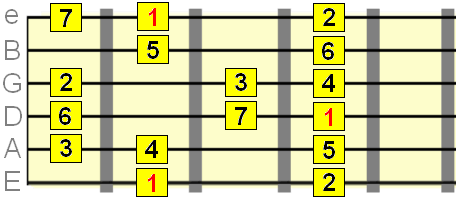
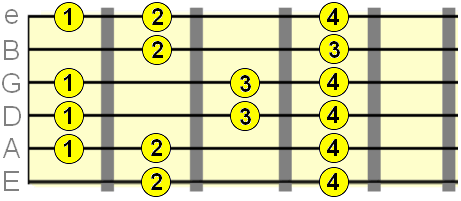
Remember, 1, the first note of the scale, is the root note, so if you started the scale at the 3rd fret on the low E string, the 1st note would be G so it would be the G major scale. The root note defines the key in which we play the scale, in other words.
You should learn that major scale pattern above to start with and learn the visual (and auditory) relationships between its intervals.
For example:
-
the second occurrence (octave) of the root note appears on the D string two frets above the 1st root note.
-
the third occurrence (even higher octave) of the root note appears on the high E string on the same fret as the 1st root note.
-
the second occurrence (octave) of the 5th appears on the B string two frets below the 1st occurrence of the 5th note.
-
the 3rd appears one fret left of the lowest root note on the A string AND a higher 3rd (octave) appears one fret left of the root's octave on the G string.
See if there are any other visual
relationships you
can pick out. You'll transfer this knowledge to other scales that share
some of
the same intervals.
There are other major scale patterns we can use, such as this one, with an A string bass root note...
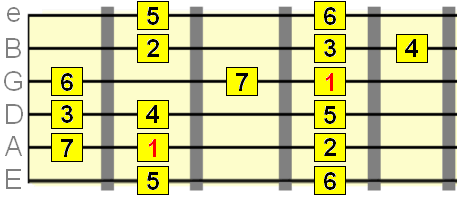
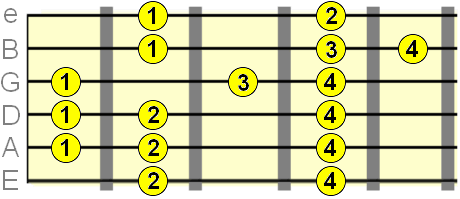
So using the two patterns we've learned, we can now play the major scale in two positions for a given root note. For example, if we wanted to play C major, we could play the E string box pattern from earlier at the 8th fret, or the A string box pattern above at the 3rd fret.
We'll look more at the different patterns we can use to span more of the fretboard in a separate lesson, but if you want a head start with it, grab this free cheat sheet.
Playing the major scale over chords
Every scale has related chord types, based on the intervals used in the scale. This section will explore the different chords we can build from the scale, so you can confidently connect the two together. A crucial "piece of the puzzle" many scale lessons gloss over.Here are the major scale's intervals again for reference...
The major triad
When analyzing the major scale, we can see it contains the root (1), major 3rd (3) and 5th (5). These three intervals make up what is known as the major triad - the basis of all major chords.This means the major scale will work naturally over major chords (as if the name wasn't obvious enough!). The other intervals from the scale (2, 4, 6 and 7) can be seen as "coloring" that basic major sound.
For example, the A major scale would be the natural (although by no means the only) choice over an A major chord.
Click to hear example
See how many 1 3 5 major triad shapes you can pull out of the below major scale pattern. I've done two for you...
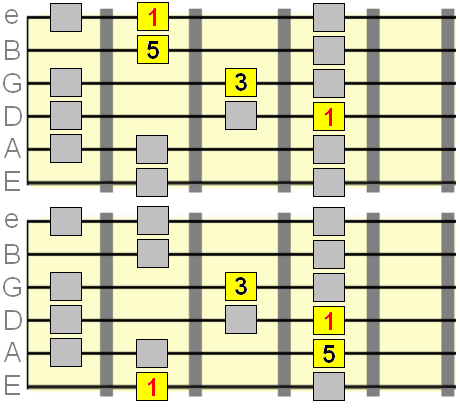
Note: this is a great way to connect chords and scales. Use the scale patterns you learn as the scaffolding for building chord shapes. Then, when you need to get your bearings for a solo, you'll find the chord shape and visualise the pattern around it.
However, that doesn't mean we should use the major scale over every occurance of a major chord in a song. Understanding when to use it will come with time, I promise!
For now, we just need to understand how the tones of the major scale interact (harmonise) with major chords.
The major 7th
The major 7th (7) can be used over major triads to give them a "dreamier" sound. This also means the major scale will be compatible with major 7th chords (1 3 5 7), which you'll learn about in the chords section.However, the major scale won't work over dominant 7th chords, because they contain a flat 7th (1 3 5 b7) which would clash with the major 7th.
Take a listen to the major 7th being held over a major chord and hear how it harmonises with and adds depth to the major chord...
Click to hear example
So when building your major scale phrases, try using the major 7th as a target note to bring out that major 7th color.
Just as before, we can also visualise major 7th chord shapes within the scale patterns...
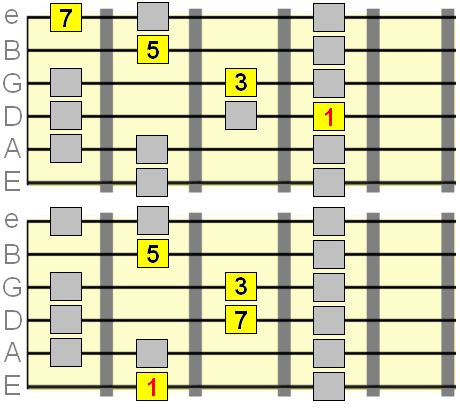
The major 7th also functions as a leading tone. This means it tends to resolve (lead) up a half step to the root...
Click to hear example
Be careful with the 4th...
The perfect 4th interval in the major scale is most commonly used as a passing tone. It can sound rather dissonant when held over a major chord. Instead, we can resolve it to the major 3rd one semitone below.For example, the phrase might be: 1 5 4 3 ... we glance over the 4th and rest on the major 3rd.
Click to hear example
So the 4th leads to a more neutral, stable tone in the scale. Try not to dwell on or emphasise that 4th over the major chord. Try also to avoid using it as a "landing note" or target note over that root major chord, because it sounds too unresolved for that.
Of course, when the chord changes away from the root major chord, the 4th may play a more harmonious role, but we'll look at soloing over chord changes another time.
The 2nd and 6th
The major 2nd and major 6th intervals can also be used to color the basic major triad or major 7th chord. Both the 2nd and 6th of the scale can be held comfortably over a major chord without dissonance. Again, see if you can find some major chord voicings within the scale patterns that use the 2nd and 6th. Some examples would be:1 3 5 6 - added 6th chord
1 3 5 9 - added 9th chord (the 9th is technically the same as the 2nd, just an octave higher)
1 3 5 7 9 - major 9th chord
1 3 5 7 13 - major 6th/13th chord (the 13th is the same as the 6th, just an octave higher)
Major scale chord tracks
Have a play around with the major scale over the below chord tracks. Don't worry about playing anything too elaborate at the moment. We just want to explore the scale's tones and hear how they color the major chord. This is a good initial ear training exercise, and it'll help you get those patterns under your fingers.The first is C major, so you'll want to play the patterns from earlier at the following frets, with the root on C...
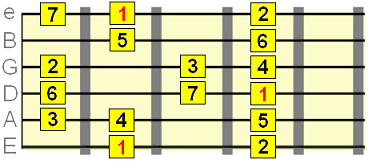
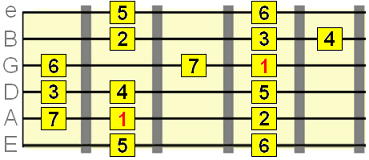
Fret 8 Fret 3
Download the chord track here (right click and "save as" to download)
The second track is E major, so our root is E...
Fret 12 Fret 7
Download the chord track here
If you want more lessons specifically for the major scale on guitar, see the related links below. Thanks for your time!
| Was this
helpful? Please support this site. I really appreciate it! |
Stay updated
and learn more Sign up to the newsletter for updates and grab your free Uncommon Chords book |
Share your thoughts...
Have any questions, thoughts or ideas about this lesson? Let us know using the comments form below.
Related
 Major
Scale Positions Major Scale Patterns Major
Scale Exercises Major
Scale Chord Progressions
Major
Scale Positions Major Scale Patterns Major
Scale Exercises Major
Scale Chord Progressions



