


Home
> Scales
>
Major Scale Exercises

Let's start with the basic "boxed" major scale pattern:
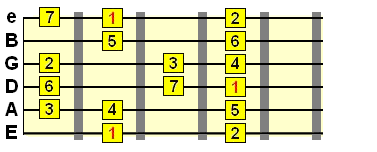
The key thing is to resist getting into the habit of simply wandering up and down the major scale in a linear sequence. You need to identify the key tones of the scale and build phrases around them.
Here are some practical examples...
The major scale's key intervals are the root (1), major 3rd (3) and 5th (5), as these three tones make up the basic major triad. Just playing these tones from the major scale will form a major arpeggio.
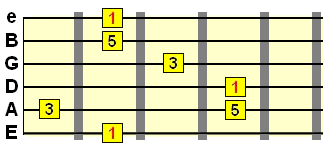
We can use these key tones as the scaffolding for building a larger phrase. For example...
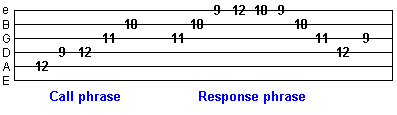
Notice how I separate the piece into two phrases, with the first phrase (call) leading into the second (response), the last 3 notes make up the major triad - root, 3rd, 5th. It's good to include these key tones occasionally to bring out the scale's major flavour and put the other color notes (2nd, 6th, 7th) into context.
Also, I've structured it in such a way that, in the response phrase, those 3 initial notes "lead in" to the phrase. It kind of carries you into the next phrase, rather than jumping in randomly. Something to think about when creating your own!
Let's try another...
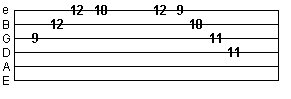
So this time I landed on the root note at the end of the first phrase, which separated the two phrases. The 3rd is also a "safe" tone to hold onto in between movements, over the major chord. If you end a phrase as the chord changes away from major, you should experiment with different suitable landing notes for that particular chord change. Trust your ears!
A note about the 4th
The 4th tone in the major scale should be mostly seen as a passing tone. In other words, if you're playing over that root major chord, the 4th shouldn't be a held note (unlike the other "safer" tones - 1, 3, 5). This is because the major 3rd being played in the chord will clash with the 4th you play in the scale.
The most common use of the 4th over a major chord is to quickly resolve it to the major 3rd, to put it into context, like in this example:
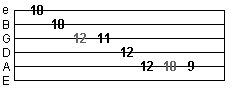
So all we're doing is glancing over that 4th, as part of the phrase, but we're not dwelling on it, as it won't sound too harmonious over a major chord it most cases.
This is why you'll often hear the 4th being used in hammer-on/pull-off sequences with the 3rd. More on these techniques another time.
You can also use the 4th as a passing tone safely between the 3rd and the 5th or root (1st). Just see it as a bridge between more stable major scale tones.
C major scale backing track
Use the backing track below to experiment with the techniques we've covered. If you're using the boxed pattern from earlier, the low E string root note will be positioned at the 8th fret, which is of course the note... C.
Experiment with different landing notes from the C major scale. Try phrasing your licks (like we looked at above) and lead up to those target landing notes.
Click here to play/download
Ready for some more advanced stuff?
It's difficult to explain exactly what a "run" is... so let's look at a few examples.
We'll start with a very basic run, heading down the scale. For this example, we're going to use the wider, ascending major scale pattern...
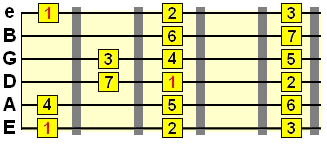
If, for example, I wanted to highlight that 3rd tone of the major scale in a sequence, I could create a run that ends on the 3rd. The starting note is not so important, as the quick succession of notes will blur it all into context.
We're in the key of B major for this...
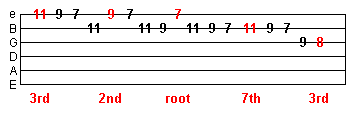
The rhythm of that run can be counted as 1 2 3 4 1 2 3 4 1 2 3 4 etc. so the key tones are highlighted on the strongest beat - 1.
We start on the 3rd, followed by 3 notes, 2nd, 3 notes, 7th, 3 notes and ending on a lower 3rd. This is a typical run, where you have a "sequence within a sequence". Those highlighted tones can be seen as "marker points" that put the entire sequence into context.
Of course, you don't have to use those major scale tones, that was just an example. You should try different combinations and rhythms, using your knowledge of weaving the major scale's key tones into phrases.
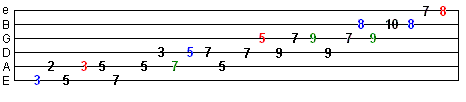
Let's now try a more complex run working up the major scale. Before we do, I just want to create a larger scale pattern by using the large scale pattern we created in the major scales positions lesson.
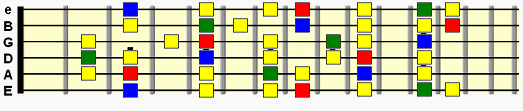
Remember the colour codes from earlier? 1st (root), 3rd, 5th.
Going on where the root notes lie, we can see that the above major scale is in the key of... C, making it the C major scale.
So we now have a rather large pattern to work with, and we could, if we wanted, build a sequence from that A string root note right up to around the B string root note (although obviously we don't have to start or finish the sequence on the root note of the scale)...
Start slow and speed up gradually using a metronome
A key point about using runs over chords
A lot of the time, you will simply be playing the major scale over its major chord equivalent (e.g. the D major scale over D major). However, the true expression of the major scale comes with chord changes. What you'll find is you can start your run before the change back to that major chord (as long as the other chord is compatible). As mentioned earlier, this is like a "lead in" phrase before the climax of the major chord fused with its major scale.
G major scale backing track
Experiment over the G major backing track below. This means our major scale root note will be on G.
Click here to play/download
Share your thoughts...
Have any questions, thoughts or ideas about this lesson? Let us know using the comments form below.
More Guitar Scales
Major Scale Exercises for Guitar
Before
we go on to look at some major scale exercises for guitar, you
need to familiarise yourself with the different major
scale shapes and positions. See the introductory major scale
lesson for that.
Basic major scale exercises & phrasing your licks
Think of guitar solos being structured in a similar way to speech. Your words are collected into sentences or phrases. These phrases are punctuated to put what you're saying into context. When you draw a sequence of tones from the major scale, think about phrasing and punctuating them in a similar way. How?Let's start with the basic "boxed" major scale pattern:
The key thing is to resist getting into the habit of simply wandering up and down the major scale in a linear sequence. You need to identify the key tones of the scale and build phrases around them.
Here are some practical examples...
The major scale's key intervals are the root (1), major 3rd (3) and 5th (5), as these three tones make up the basic major triad. Just playing these tones from the major scale will form a major arpeggio.
We can use these key tones as the scaffolding for building a larger phrase. For example...
Notice how I separate the piece into two phrases, with the first phrase (call) leading into the second (response), the last 3 notes make up the major triad - root, 3rd, 5th. It's good to include these key tones occasionally to bring out the scale's major flavour and put the other color notes (2nd, 6th, 7th) into context.
Also, I've structured it in such a way that, in the response phrase, those 3 initial notes "lead in" to the phrase. It kind of carries you into the next phrase, rather than jumping in randomly. Something to think about when creating your own!
Let's try another...
So this time I landed on the root note at the end of the first phrase, which separated the two phrases. The 3rd is also a "safe" tone to hold onto in between movements, over the major chord. If you end a phrase as the chord changes away from major, you should experiment with different suitable landing notes for that particular chord change. Trust your ears!
A note about the 4th
The 4th tone in the major scale should be mostly seen as a passing tone. In other words, if you're playing over that root major chord, the 4th shouldn't be a held note (unlike the other "safer" tones - 1, 3, 5). This is because the major 3rd being played in the chord will clash with the 4th you play in the scale.
The most common use of the 4th over a major chord is to quickly resolve it to the major 3rd, to put it into context, like in this example:
So all we're doing is glancing over that 4th, as part of the phrase, but we're not dwelling on it, as it won't sound too harmonious over a major chord it most cases.
This is why you'll often hear the 4th being used in hammer-on/pull-off sequences with the 3rd. More on these techniques another time.
You can also use the 4th as a passing tone safely between the 3rd and the 5th or root (1st). Just see it as a bridge between more stable major scale tones.
C major scale backing track
Use the backing track below to experiment with the techniques we've covered. If you're using the boxed pattern from earlier, the low E string root note will be positioned at the 8th fret, which is of course the note... C.
Experiment with different landing notes from the C major scale. Try phrasing your licks (like we looked at above) and lead up to those target landing notes.
Click here to play/download
Ready for some more advanced stuff?
Major scale exercises using runs
Scale runs are typically played faster than regular phrases and are good to inject occasionally into your solos as they have a different quality than the simple phrases we've been looking at.It's difficult to explain exactly what a "run" is... so let's look at a few examples.
We'll start with a very basic run, heading down the scale. For this example, we're going to use the wider, ascending major scale pattern...
If, for example, I wanted to highlight that 3rd tone of the major scale in a sequence, I could create a run that ends on the 3rd. The starting note is not so important, as the quick succession of notes will blur it all into context.
We're in the key of B major for this...
The rhythm of that run can be counted as 1 2 3 4 1 2 3 4 1 2 3 4 etc. so the key tones are highlighted on the strongest beat - 1.
We start on the 3rd, followed by 3 notes, 2nd, 3 notes, 7th, 3 notes and ending on a lower 3rd. This is a typical run, where you have a "sequence within a sequence". Those highlighted tones can be seen as "marker points" that put the entire sequence into context.
Of course, you don't have to use those major scale tones, that was just an example. You should try different combinations and rhythms, using your knowledge of weaving the major scale's key tones into phrases.
Let's now try a more complex run working up the major scale. Before we do, I just want to create a larger scale pattern by using the large scale pattern we created in the major scales positions lesson.
Remember the colour codes from earlier? 1st (root), 3rd, 5th.
Going on where the root notes lie, we can see that the above major scale is in the key of... C, making it the C major scale.
So we now have a rather large pattern to work with, and we could, if we wanted, build a sequence from that A string root note right up to around the B string root note (although obviously we don't have to start or finish the sequence on the root note of the scale)...
Start slow and speed up gradually using a metronome
A key point about using runs over chords
A lot of the time, you will simply be playing the major scale over its major chord equivalent (e.g. the D major scale over D major). However, the true expression of the major scale comes with chord changes. What you'll find is you can start your run before the change back to that major chord (as long as the other chord is compatible). As mentioned earlier, this is like a "lead in" phrase before the climax of the major chord fused with its major scale.
G major scale backing track
Experiment over the G major backing track below. This means our major scale root note will be on G.
Click here to play/download
| |
Tweet |
| Was this
helpful? Please support this site. I really appreciate it! |
Stay updated
and learn more Sign up to the newsletter for updates and grab your free Uncommon Chords book |
Share your thoughts...
Have any questions, thoughts or ideas about this lesson? Let us know using the comments form below.
More Guitar Scales



