


Home
> Scales
/ Progressions
> Major
Scale Progressions

Well that's what this lesson is all about! I'll take you through the theory behind what connects the major scale to countless songs out there. I'll also give you some chord tracks to help you make this connection by ear.
The aim is to get to the stage where you can hear a chord progression and almost instantly think "major scale". Impossible? Not at all. This will be an invaluable boost for your improvisation skills and your ability to write solos to existing songs.
It means we take each degree of the scale (1 2 3 4 5 6 7) and use them as root notes for our major scale chords as follows:

The upper case numerals represent major chords (I IV V), lower case minor chords (ii iii vi). vii is the odd one out because it's a diminished chord. Don't worry about that for now! We use lower case numerals for diminished chords.
So by making sure you know the intervals of the major scale, you'll automatically know the formula of its chord scale...
M m m M M m d (M = major, m = minor, d = diminished) based on the interval formula W W H W W W H
If, for example, we were to harmonize the D major scale, the tonic (I) chord would be D major, with the other chords built accordingly based on the notes of the D major scale (D E F# G A B C#)...

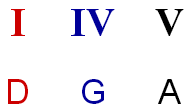
From this, we could build chord progressions in the key of D major, using various combinations of the chords in the scale. This means that the D major scale would be compatible over the entire progression, because all its chords use notes from the scale (D E F# G A B C#). For example...
Click to hear
That's a very common major key progression, known as 1 4 5, over which the D major scale (and therefore D major pentatonic) could be used. We could also use it if just two of those chords were being played back and forth - I IV I IV etc.
And we don't have to start the progression on the tonic chord...

Click to hear
As the E minor and A major chords are taken from that D major chord scale, we could even play the D major scale over a progression that just uses the ii and V chords back and forth and it would still be compatible.
By learning the sound of these chord intervals across several keys, you'll train your ear to pick out these major scale compatible chord movements. We'll go deeper into this ear training shortly.
Now, if the tonic was instead Bb major, we could use the Bb major scale around any progression built from its scale...
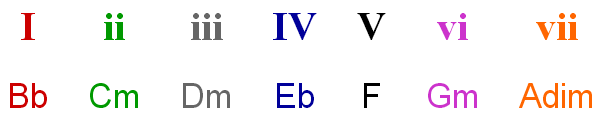
Using the 2 5 1 example from earlier...

Click to hear
So, spend time applying this chord scale, based on your knowledge of the major scale's intervals, in different keys.
The tonic chord defines the key of the progression.
The tonic chord also defines the key of your major scale solo, as the root note of the tonic chord should be the same as the root note of the major scale.
The roman numerals are just to show you the chord relationships without specifying a key. It's the interval movement that gives these progressions their sound, no matter what key they're in. For example, you'd still recognise your favourite song if it was in a different key, because the chord movements are the same.
For example, Cmaj / Fmaj / Gmaj is the same as Amaj / Dmaj / Emaj. Both these are 1 4 5 (I IV V) progressions in two different keys, the first in C major, the second in A major. Both will sound the same, just in a different pitch ("higher" or "lower" sounding).
Strum these chord sequences on your guitar. Even just playing the bass notes of each chord along the low E and A strings will help train your ear to these interval movements.
Remember that these progressions can be reordered (for example you could play I V ii instead of ii V I - same chords). You should also try modifying them, adding other chords from the scale. I just use the basic open chord or barre chord forms for getting to know these interval relationships.
Of course there are sharp and flat keys as well, but the main thing is you experiment with these major scale chord intervals and how these relationships sound. Spend time mastering this, and you'll be able to write chord progressions for major scale soloing. Also, you'll be able to identify a chord progression suitable for using the major scale over.
Major Scale Exercises
Learn More Guitar Scales
Learn More About Guitar Chord Progressions
Major Scale Chord Progressions
So, you've learned the major scale and maybe a few of its patterns, but now you need to know how it works over chords.Well that's what this lesson is all about! I'll take you through the theory behind what connects the major scale to countless songs out there. I'll also give you some chord tracks to help you make this connection by ear.
The aim is to get to the stage where you can hear a chord progression and almost instantly think "major scale". Impossible? Not at all. This will be an invaluable boost for your improvisation skills and your ability to write solos to existing songs.
Theory - Major Scale Chords
The first thing we need to do is build a chord scale around the intervals of the major scale. This is often referred to as "scale harmonization".It means we take each degree of the scale (1 2 3 4 5 6 7) and use them as root notes for our major scale chords as follows:
The upper case numerals represent major chords (I IV V), lower case minor chords (ii iii vi). vii is the odd one out because it's a diminished chord. Don't worry about that for now! We use lower case numerals for diminished chords.
So by making sure you know the intervals of the major scale, you'll automatically know the formula of its chord scale...
M m m M M m d (M = major, m = minor, d = diminished) based on the interval formula W W H W W W H
If, for example, we were to harmonize the D major scale, the tonic (I) chord would be D major, with the other chords built accordingly based on the notes of the D major scale (D E F# G A B C#)...
From this, we could build chord progressions in the key of D major, using various combinations of the chords in the scale. This means that the D major scale would be compatible over the entire progression, because all its chords use notes from the scale (D E F# G A B C#). For example...
Click to hear
That's a very common major key progression, known as 1 4 5, over which the D major scale (and therefore D major pentatonic) could be used. We could also use it if just two of those chords were being played back and forth - I IV I IV etc.
And we don't have to start the progression on the tonic chord...
Click to hear
As the E minor and A major chords are taken from that D major chord scale, we could even play the D major scale over a progression that just uses the ii and V chords back and forth and it would still be compatible.
By learning the sound of these chord intervals across several keys, you'll train your ear to pick out these major scale compatible chord movements. We'll go deeper into this ear training shortly.
Now, if the tonic was instead Bb major, we could use the Bb major scale around any progression built from its scale...
Using the 2 5 1 example from earlier...
Click to hear
So, spend time applying this chord scale, based on your knowledge of the major scale's intervals, in different keys.
The tonic chord defines the key of the progression.
The tonic chord also defines the key of your major scale solo, as the root note of the tonic chord should be the same as the root note of the major scale.
The roman numerals are just to show you the chord relationships without specifying a key. It's the interval movement that gives these progressions their sound, no matter what key they're in. For example, you'd still recognise your favourite song if it was in a different key, because the chord movements are the same.
For example, Cmaj / Fmaj / Gmaj is the same as Amaj / Dmaj / Emaj. Both these are 1 4 5 (I IV V) progressions in two different keys, the first in C major, the second in A major. Both will sound the same, just in a different pitch ("higher" or "lower" sounding).
Major scale chord progressions chart
The chart below shows you some common major scale chord progressions in different keys. The idea is to really get to know the sound of these chord movements in as many different keys as possible so you don't have to rely on your solos being in the same key all the time.Strum these chord sequences on your guitar. Even just playing the bass notes of each chord along the low E and A strings will help train your ear to these interval movements.
Remember that these progressions can be reordered (for example you could play I V ii instead of ii V I - same chords). You should also try modifying them, adding other chords from the scale. I just use the basic open chord or barre chord forms for getting to know these interval relationships.
| Key | I IV V |
ii V I | I V vi IV | I iii IV |
| A | A D E | Bm E A | A E F#m D | A C#m D |
| B | B E F# | C#m F# B | B F# Ab E | B Ebm E |
| C | C F G | Dm G C | C G Am F | C Em F |
| D | D G A | Em A D | D A Bm G | D F#m G |
| E | E A B | F#m B E | E B C#m A | E Abm A |
| F | F Bb C | Gm C F | F C Dm Bb | F Am Bb |
| G | G C D | Am D G | G D Em C | G Bm C |
Of course there are sharp and flat keys as well, but the main thing is you experiment with these major scale chord intervals and how these relationships sound. Spend time mastering this, and you'll be able to write chord progressions for major scale soloing. Also, you'll be able to identify a chord progression suitable for using the major scale over.
Was this lesson helpful? Please let others know, cheers...
| |
Tweet |
Stay updated and learn more
Sign up to the newsletter for updates and grab your free Uncommon Chords book
Sign up to the newsletter for updates and grab your free Uncommon Chords book
Related
Major Scale PositionsMajor Scale Exercises
Learn More Guitar Scales
Learn More About Guitar Chord Progressions



