



How to Hold a Guitar
It sounds bloody obvious, but knowing how to hold a guitar properly is the most important beginner step before you even think about working on your chords and picking/strumming.This lesson is for both electric and acoustic guitars - the main difference is the size of the body (acoustic guitars tend to be bulkier), but the holding position remains the same for both types.
If there's one piece of advice I could give you, to remember every single time you pick up the guitar... don't hunch!
So many guitarists get into the habit of hunching over their guitar. Annoys the hell out of me. Hunching will inevitably affect your posture and can lead to back problems later in life.
Let's look at how to hold a guitar whilst sitting down...
Sitting position
 |
A
typical sitting position with open legs. The guitar is resting on his right leg because he strums with his right hand (he is right handed, in other words!) The guitar comfortably sits just below the chest. The guy's back is straight and his left arm (the fret hand arm) is at a right angle meaning minimal strain on the wrist when reaching around to press the strings. |
 |
This
lady has crossed her legs, which you might find more comfortable. If you strum with your right arm, cross your right leg. Her left arm is at a more acute angle, but this is fine as she can reach around the fretboard comfortably and touch all the strings. The important thing is that your fret hand arm isn't at more than a 90 degree right angle as this will cause unnecessary strain on your wrist. The elbow of her strumming (right) arm is positioned at the top corner of the guitar, providing a smooth pivot point across the sound hole (or first pickup). |
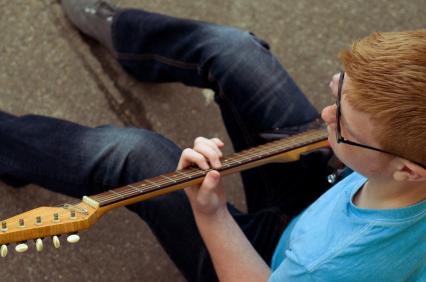 |
This
guy has tilted his electric guitar towards him slightly, giving him a
better view of the fretboard. Eventually, you won't need to look at the fretboard very often, but it's fine to tilt your guitar in this way if you need to. |
 |
You
can also sit on the ground with your guitar. Again, the legs are positioned in such a way that the guitar body sits at chest height (or just below), with minimal hunching. The strumming/picking arm is in that top corner position. |
 |
This
guy is sat on a railway track. He is a fool. Nice straight back though. |
To summarise:
-
Whether you're sitting with your legs crossed or uncrossed, ensure your knees are high enough to support the guitar at (or just below) chest height.
-
Rest the dip of the guitar (most guitars have a dip for this purpose) on your lap. Rest it on the same side as your strumming hand (e.g. if you strum with your right hand, rest it on your right lap).
-
Rest the guitar flat against your chest (although some people prefer to slightly tilt it towards them - emphasis on the word slightly!)
- Don't hunch your back.
-
Make sure your elbow points out towards the top corner of your guitar. It should also rest so your forearm and wrist can pivot over the strings while at the same time supporting the body of the guitar against your body
- The arm of your fret hand (the hand that presses the strings) should be at no more than a 90 degree right angle. The more acute the angle, the less strain is put on your wrist to reach around the fretboard.
Standing position
If you have a strap for your guitar you should practice playing standing up regularly, because you'll find it a completely different playing experience. If you plan on playing shows/gigs, you'll most likely want to be able to stand up and move around a bit.
A couple of examples of how (and how not) to hold a guitar standing up...
 |
This
"cool dude" has tilted
the neck
up for easier access to the fretboard, which is fine,
because it doesn't affect anything else, such as the elbow position. His fret hand elbow is at no more than 90 degree angle (acute, in other words). His back is straight. The body of the guitar remains at a comfortable height for strumming/picking. The elbow on his strumming arm is forward, square-on with his body and nicely provides that pivot point. It's subtle, but you'll also noticed his left leg is slightly bent for support. If he wants to lean over and get a better view of the fretboard, a lot of the weight will go into his partially lunged leg, rather than having to hunch over. |
 |
Blimey,
this lass has got it all wrong. Firstly, the strap is way too loose and she is having to compensate by hunching over. Secondly, her fret hand arm is at an obtuse angle (more than a 90 degree right angle) meaning she may cause strain on her wrist trying to reach around to press the strings. Her strumming/picking arm is also positioned with the elbow pushed back, meaning there's no smooth pivot point for strumming and pick positioning. Good luck to her! |
Key things to note here:
-
Don't loosen the strap too much. If the guitar gets too low (i.e. down at your knees) you will have problems wrapping your fingers around the neck properly to play chords. Nobody really cares about how "cool" or "uncool" it looks.
- As a general rule, the guitar should be positioned so that your fret-hand arm is at no more than a 90 degree right angle.
-
Again, don't hunch!
-
Still make sure your forearm is square-on and angled out towards the top corner of your guitar (not back behind you) so it can pivot smoothly over the strings.
Holding the guitar neck
Guitar neck hand positioning is also very important guitar basic to get right from the beginning because playing chords will be 10 times harder if you don't get it right.
First, let's see how your
fret hand
would look holding the guitar from the back of the neck...
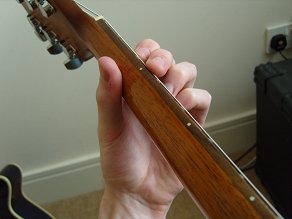
|
So as you can see, your
thumb should rest comfortably towards the top edge of
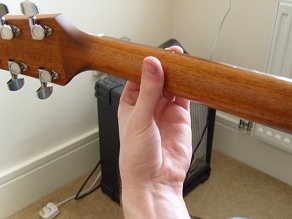
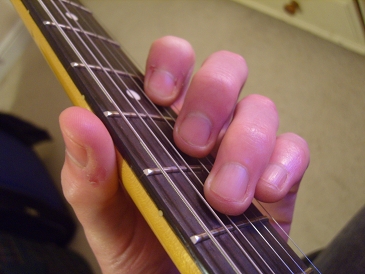
the guitar neck. Your wrist should be relaxed but not hanging too low. The wrist should be bent, but only slightly. If your wrist is bent too much, it will cause problems later on. If you have smaller hands, you're thumb will be positioned further towards the center of the back of the neck. As long as you get this initial, relaxed position first you'll be fine. When we begin to look at chords, obviously your fingers will be moving in many different positions, so at the moment, just focus on getting comfortable with the general positioning of the guitar. Note: Guitarists with larger hands may find it more comfortable to bring their wrist up and curl the top of their thumb over the top of the neck slightly (see photo on the left). Comfort always comes first, but be aware, if you do choose to have your thumb over the edge of the neck like this, you will need to move it back to the centre of the neck for certain chords. It will require more thumb movement, in other words. |
How to hold the guitar pick
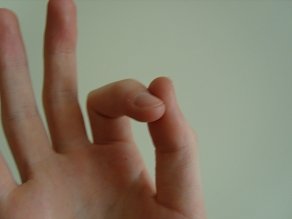
The main thing to remember when holding the plectrum is not to hold it too firmly. It needs to flex over the strings with ease.
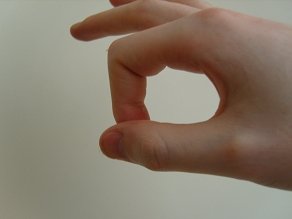
Holding the pick between the tips of your index finger and thumb is the best way to acheive this.
| Personally,
I like
to
create an elongated circle like this...
|
So
it'll look like this from
the front...
|
|
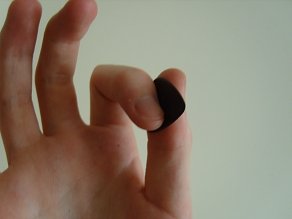
With
pick in hand, we
can see how the straightness of the thumb supports the base of the
pick, and the index finger supports
more
towards the tip of the plectrum.
|
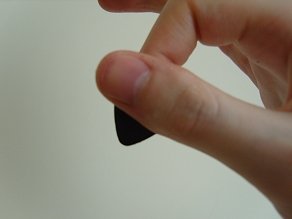
See
how
the thumb is kept
relatively straight...
|
When we get to the lessons on strumming and picking the guitar strings, holding your pick this way will really help keep your playing smooth and flexible. You'll just glide over the strings rather than jab at them!
Time to move on...
Hopefully now you should know how to hold a guitar properly so your playing won't be let down by a few basic errors! You can now move on to other guitar basics such as fingering chords and basic picking.
Remember to practice standing and sitting in equal regularity as you will find playing standing up quite different and perhaps a bit more difficult at first. But you need to think about the possibility of one day standing up and playing on stage!
| |
Tweet |
Related
 Best
Way to Hold a Guitar Pick
Best
Way to Hold a Guitar Pick


