


Home
> Scales
>
Harmonic
Minor

The aim is not just to memorise a scale pattern, but to really understand the scale as intimately as possible.
From the perspective of western music, harmonic minor is often referred to as an "exotic scale", because of its sound. It's most associated with flamenco and middle eastern musical traditions.
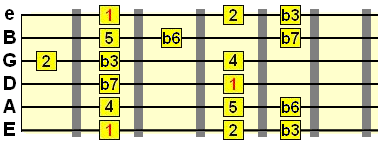
Natural minor / Aeolian (b7 = flat/minor 7th)
Harmonic minor (7 = major 7th)
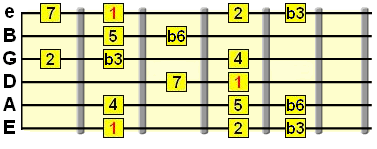
The major 7th
So by raising the 7th of the natural minor scale, we get a very different sound. It's a lot more tense when played over minor chords.
Look at the position of the 7th in relation to the root note. It's now only a semitone/half step lower. Therefore, if we wanted to add a leading tone before the lowest root note, on the low E string, we'd know where to put it!
What do I mean by "leading tone"? Well, by using the 7th immediately before resolving to the root note, a semitone higher, we get a natural flow of harmony. The resolution sounds... natural. When we get to playing harmonic minor over chord sequences, you'll see how that natural resolution is enhanced.
 Take a
listen to some basic interval movements from within the A
harmonic minor scale to get a feel for its raw flavour:
Take a
listen to some basic interval movements from within the A
harmonic minor scale to get a feel for its raw flavour:
Click to here
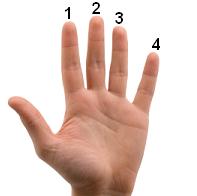
Also try and get a feel for it yourself by jumping around different interval sequences. Below is a suggested fingering, but you may need to change this for certain movements.
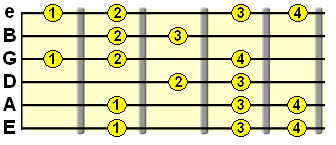
Since the above is a movable scale pattern, if the root note sits on the note B, for example, you'll be playing the B harmonic minor scale. If it sits on the note F#, you'll be playing F# harmonic minor.
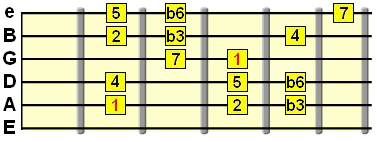
There's also a boxed harmonic minor pattern with the lowest root note on the A string, which is useful if you want to quickly build a scale around a chord shape in that same position (e.g. A form barre chords):
Let's now see how harmonic minor works over chords.
When analysing a scale to see what chords it will be compatible with, you need to look at the tones that make up the scale Vs the tones that make up the backing chord.
Since harmonic minor has that major 7th, its minor chord equivalent must either include the same, or not have any 7th at all (e.g. just a basic minor triad).
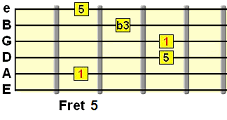
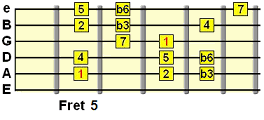
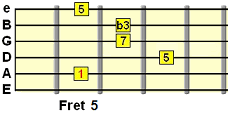
For example, take a look at the D minor chords below, the first being a regular D minor triad, the other being that same triad with an added major 7th.
So we can see that the DmM7 chord uses that major 7th from the harmonic minor scale, which means it would be compatible. However, just using the standard triad above it will also be compatible, because it doesn't use any tones that lie outside the harmonic minor scale.
You may want to try using the regular, natural minor scale (with the flat 7th) if that major 7th sounds too harsh. Either that, or just use the major 7th strictly as a passing tone - in other words, don't dwell on or hold the major 7th over minor chords!
Take a listen to harmonic minor being played over its equivalent chords:
Harmonic minor over minor triad
Harmonic minor over major/major 7th
What this also means is that, because of the major 7th, harmonic minor won't be compatible over chords which use a flat 7th.
Harmonic minor over a sequence of chords
So, we've established harmonic minor works over certain minor chords. However, this does not simply mean you can play it over any instance of those minor chords. It's best used, and most commonly used, over a tonic minor chord. This means that the minor chord is the resolution chord, or the "starting/finishing" chord of a chord sequence. Chord progressions are covered in a separate section on this site, but let's look at some examples here:
D minor - G minor - A major - D minor/DmM7 - click to hear
A very simple sequence there in which D minor is the tonic chord.
This is a typical progression that is derived from the harmonic minor "chord scale".
Most often, the tense DmM7 (which uses the major 7th of harmonic minor) is only used as a finishing chord, and should be used sparingly because of how unstable it sounds.
Listen to how the A chord resolves to that D minor tonic chord. This is where the 7th in the scale can be used as a leading tone, ready for that resolution back to D minor - example here
Or, if you wanted a really tense, unstable "resolution", you could actually end on that 7th, over the D minor tonic chord. This is used commonly in jazz. You should experiment with using each of the tones of harmonic minor as resolution notes. Each one offers a different flavour.
Ok, I think we now know enough to try out some ideas over a backing track, using the boxed scale patterns from earlier to start with (we'll expand out of these boxes soon!). I'm playing the D minor chord progression from above in a continuous cycle, so have an experiment with different interval movements of D harmonic minor).
Remember, you can play D harmonic minor using the A string boxed pattern at fret 5, or using the full boxed pattern rooted on the low E string at fret 10.
Fret 10
Download the backing track here
Below, I've extended the boxed patterns from above across the fretboard. We're in the key of C minor this time, but remember that these patterns are movable and it's the root note positions that define the key - the interval relationships move with the root note.
In other words, you should be able to move the patterns we've covered in this lesson into any key - A minor, Bb minor, G minor, F minor etc. based on their root note positions.
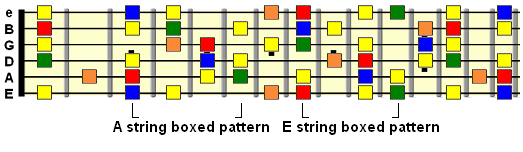
The root, minor 3rd, 5th and 7th tones have been highlighted, as these are the key tones of harmonic minor - the minor triad (root, minor 3rd, 5th) plus the major 7th. The tones in yellow can be seen as "dressing" in between those key tones.
So, we can see the two boxed patterns we learned from earlier, although now we're in the key of C minor, so they've changed position accordingly (their root notes now lie on... C).
Let's work that wide pattern above over the backing tracks below, using everything we've learned in this lesson, thinking about tension and resolution notes from the scale.
Remember, we're in the key of C...
Download the backing track here
I hope you've enjoyed this lesson and learned something new!
Learn More Guitar Scales
Harmonic Minor Scale on Guitar
The harmonic minor scale is a slight variation on the natural minor scale. In a moment, we'll learn exactly what makes harmonic minor a unique scale, its basic fingering on guitar, when to use it and which chords and chord sequences it's "compatible" with.The aim is not just to memorise a scale pattern, but to really understand the scale as intimately as possible.
 Free scale
pattern cheat sheet Free scale
pattern cheat sheetEssential scale patterns that every guitarist must know... Click here to start now |
From the perspective of western music, harmonic minor is often referred to as an "exotic scale", because of its sound. It's most associated with flamenco and middle eastern musical traditions.
Harmonic minor scale basics
As mentioned in the intro, you may already be aware of the natural minor scale. There's only one tone difference between natural minor and harmonic minor, and that's the position of the 7th. Let's compare both these minor scales using their first position patterns:Natural minor / Aeolian (b7 = flat/minor 7th)
Harmonic minor (7 = major 7th)
The major 7th
So by raising the 7th of the natural minor scale, we get a very different sound. It's a lot more tense when played over minor chords.
Look at the position of the 7th in relation to the root note. It's now only a semitone/half step lower. Therefore, if we wanted to add a leading tone before the lowest root note, on the low E string, we'd know where to put it!
What do I mean by "leading tone"? Well, by using the 7th immediately before resolving to the root note, a semitone higher, we get a natural flow of harmony. The resolution sounds... natural. When we get to playing harmonic minor over chord sequences, you'll see how that natural resolution is enhanced.
Take a
listen to some basic interval movements from within the A
harmonic minor scale to get a feel for its raw flavour:Click to here
Also try and get a feel for it yourself by jumping around different interval sequences. Below is a suggested fingering, but you may need to change this for certain movements.
Since the above is a movable scale pattern, if the root note sits on the note B, for example, you'll be playing the B harmonic minor scale. If it sits on the note F#, you'll be playing F# harmonic minor.
There's also a boxed harmonic minor pattern with the lowest root note on the A string, which is useful if you want to quickly build a scale around a chord shape in that same position (e.g. A form barre chords):
Let's now see how harmonic minor works over chords.
Playing the harmonic minor scale over chords
As mentioned before, harmonic minor is a minor scale!When analysing a scale to see what chords it will be compatible with, you need to look at the tones that make up the scale Vs the tones that make up the backing chord.
Since harmonic minor has that major 7th, its minor chord equivalent must either include the same, or not have any 7th at all (e.g. just a basic minor triad).
For example, take a look at the D minor chords below, the first being a regular D minor triad, the other being that same triad with an added major 7th.
| D minor triad (Dm) | D harmonic minor scale |
 |
 |
| D minor/major 7 (DmM7) | D harmonic minor scale (as above!) |
 |
|
So we can see that the DmM7 chord uses that major 7th from the harmonic minor scale, which means it would be compatible. However, just using the standard triad above it will also be compatible, because it doesn't use any tones that lie outside the harmonic minor scale.
You may want to try using the regular, natural minor scale (with the flat 7th) if that major 7th sounds too harsh. Either that, or just use the major 7th strictly as a passing tone - in other words, don't dwell on or hold the major 7th over minor chords!
Take a listen to harmonic minor being played over its equivalent chords:
Harmonic minor over minor triad
Harmonic minor over major/major 7th
What this also means is that, because of the major 7th, harmonic minor won't be compatible over chords which use a flat 7th.
| Confused? Learn more about how 7th chords are built here. You just need to be able to distinguish between a dominant 7th (b7) and a major 7th (7). This tells us which minor scale will be compatible - a minor scale with a flat 7th (e.g. natural minor, Dorian, Phrygian etc.) or a minor scale with a major 7th (e.g. harmonic minor!). |
Harmonic minor over a sequence of chords
So, we've established harmonic minor works over certain minor chords. However, this does not simply mean you can play it over any instance of those minor chords. It's best used, and most commonly used, over a tonic minor chord. This means that the minor chord is the resolution chord, or the "starting/finishing" chord of a chord sequence. Chord progressions are covered in a separate section on this site, but let's look at some examples here:
D minor - G minor - A major - D minor/DmM7 - click to hear
A very simple sequence there in which D minor is the tonic chord.
This is a typical progression that is derived from the harmonic minor "chord scale".
Most often, the tense DmM7 (which uses the major 7th of harmonic minor) is only used as a finishing chord, and should be used sparingly because of how unstable it sounds.
Listen to how the A chord resolves to that D minor tonic chord. This is where the 7th in the scale can be used as a leading tone, ready for that resolution back to D minor - example here
Or, if you wanted a really tense, unstable "resolution", you could actually end on that 7th, over the D minor tonic chord. This is used commonly in jazz. You should experiment with using each of the tones of harmonic minor as resolution notes. Each one offers a different flavour.
Ok, I think we now know enough to try out some ideas over a backing track, using the boxed scale patterns from earlier to start with (we'll expand out of these boxes soon!). I'm playing the D minor chord progression from above in a continuous cycle, so have an experiment with different interval movements of D harmonic minor).
Remember, you can play D harmonic minor using the A string boxed pattern at fret 5, or using the full boxed pattern rooted on the low E string at fret 10.
Fret 10
Download the backing track here
The big harmonic minor picture
Naturally, you'll want to eventually expand your scale fingering out of those 4-5 fret wide boxes.Below, I've extended the boxed patterns from above across the fretboard. We're in the key of C minor this time, but remember that these patterns are movable and it's the root note positions that define the key - the interval relationships move with the root note.
In other words, you should be able to move the patterns we've covered in this lesson into any key - A minor, Bb minor, G minor, F minor etc. based on their root note positions.
The root, minor 3rd, 5th and 7th tones have been highlighted, as these are the key tones of harmonic minor - the minor triad (root, minor 3rd, 5th) plus the major 7th. The tones in yellow can be seen as "dressing" in between those key tones.
So, we can see the two boxed patterns we learned from earlier, although now we're in the key of C minor, so they've changed position accordingly (their root notes now lie on... C).
| Learn more on how to unbox the harmonic minor scale here |
Let's work that wide pattern above over the backing tracks below, using everything we've learned in this lesson, thinking about tension and resolution notes from the scale.
Remember, we're in the key of C...
Download the backing track here
I hope you've enjoyed this lesson and learned something new!
| |
Tweet |
 Like This?
Subscribe & Learn More... Like This?
Subscribe & Learn More...Subscribe to the fretjam newsletter below for updates and extras, plus grab your free copy of Uncommon Chords: 101 Vibrant Voicings You Won't Find on a Typical Chord Chart. |
Related
Harmonic Minor & PhrygianLearn More Guitar Scales



