


Guitar Power Chords Lesson - The Basics
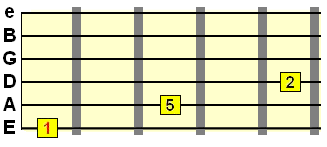
Guitar power chords are simple things. They comprise of just two notes,
those being the root and
a 5th interval. Don't worry if you're unsure what
"root and 5th" mean. Just learn the visual relationship between these
two important notes and how they sound together.They're not strictly chords (which involve three or more notes), they're dyads - two notes played together.
The reason they have been given their own name and have been used in rock and metal for decades is mainly due to the following:
 They
sound
especially good with
distortion/gain.
They
sound
especially good with
distortion/gain.
- They are versatile because they have no major/minor/extended color tones. The color can be created through inventive movements and key changes.
- They allow for faster chord changes and speed playing because the fingerings are simple (only two fingers required!).
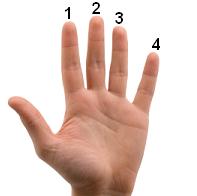
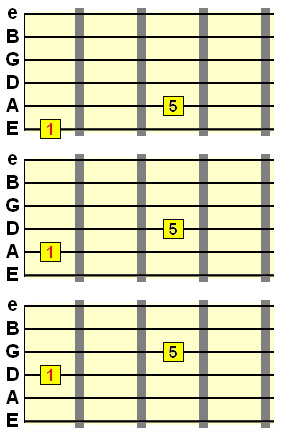
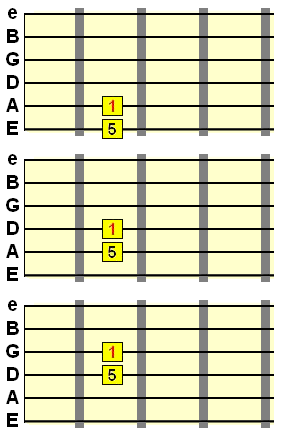
Below is how typical guitar power chords are formed on the fretboard (I use my index finger for the root (1) and my ring finger for the 5th)...
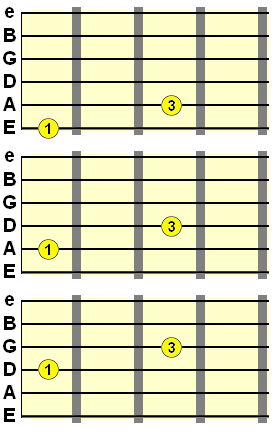
The video below shows me moving these three root power chord shapes around different positions...
A root-5th power chord is abbreviated using the root note followed by the number 5. For example, C5, E5, F5, G5 etc. So if the root was A, the power chord would be... A5.
Let's go through a few exercises to improve your speed, timing and accuracy with power chords.
Later on, we'll look at power chord variations that create different sounds.Warm up guitar power chord exercises
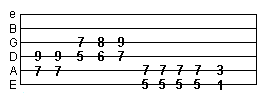
So as a warm up we're going to play a simple riff comprising solely of power chords using the shape from above. Download the drum track below (right click and "save as") and try out your own powerchord riffs...
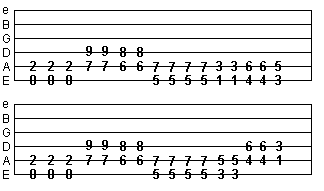
Remember, you can also use this shape on the D and G strings for a higher sounding power chord riff. Mixing high and low tones in a riff can make it more interesting and dynamic.
Try the exercise below using all 3 root strings...
Chunkier power chords
You can add an extra note to standard power chords as a lower octave of the 5th (see diagram at top of page for the "5th") by including the E string on powerchords played on the A and D strings.
This makes the higher, A string power chords sound a little deeper and fuller...
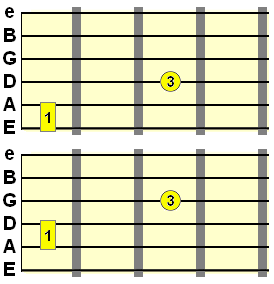
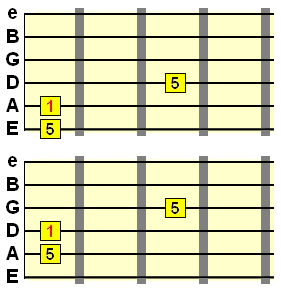
Simply bar your index across those bottom 2 strings in the power chord and then use your ring or pinky finger as usual to fret the higher 5th.
This is a different type of power chord because the root note is not actually the lowest note like usual, but because of how the 5th harmonises with the root, the key stays the same. Think of it as a downward extension of the basic powerchord shape.Listen to me play a regular powerchord followed by the meatier extended version from above...
You could also extend it to the G string, giving us an extra root note as follows (use your little/4th finger to fret the G string note)...
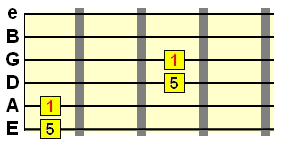
An even meatier powerchord!
Tip:
this
extended powerchord is great to ring out as a closing "chord" in a song
because it
has a big sound.
Lead / double stop power chords
There is another shape you can use which allows you to play powerchords with the characteristics of a lead guitar solo. Smoke on the Water is probably the most famous track in which this technique is used, in that opening riff, but loads of rock and metal songs use it. In a lead context it's known as a double stop - two notes played simultaneously.
What this shape allows you to do is use one finger at a time, barred across the two strings, and then quickly switch to another finger just like you would when soloing. You can accomplish a faster, more free flowing powerchord riff like the one below...
Click the tab to hear.

Another thing this shape allows you to do is hammer ons and pull offs (like above) and other lead guitar techniques.
Drop tuning power chords
Firstly, if you're unsure what drop tuning is, head over to the drop tuning page.
The only difference in fingering for drop tuned power chords is the bottom string and A string. The A and D string root-5th shape stays exactly the same, as it does on the D and G string.
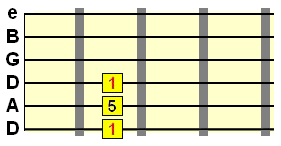
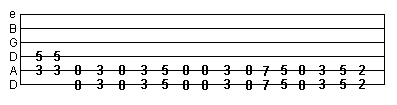
Just like the "lead" powerchord shape, with drop tuning you can simply bar a finger across the bottom 2 (or 3) strings (root, 5th and the optional octave) and slide, hammer on, pull off using other fingers.
Take a look and listen to the Drop D exercise below...
Open power chords
Powerchords don't just have to be played on three strings up the fretboard. Remember those open position chords you (hopefully) learned when you first picked up the guitar? They can be turned into power chords as well, and made more suitable for high gain/distortion.
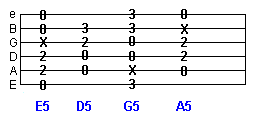
All that's going on here is we're blocking out the "3rd" in the chords (marked by the X on the E, G and A and simply left out on the D) leaving just those root and fifth notes to ring out. AC/DC used these a lot for their vibrant and "big" sound under amp gain.
Altered power chords
A 9th (also the 2nd scale degree) can be added to the standard root 5th to make a 9th power chord. This means we're adding the 2nd tone of the major scale to the root and 5th (if you're not sure what that means, don't worry at the moment).Here's how it would look on the first 3 strings at the 2nd fret of your guitar...
All you need to do is practice a few riffs with this chord shape. Below are a couple of exercises with clean and distorted example clips...
Clean example
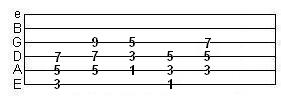
Distorted/metal example
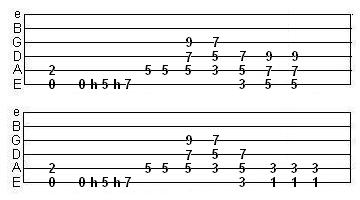
I hope you now have some good exercises to help warm up and improve your power chord playing. The secret is to mix them up when you're writing a new riff so your music becomes diverse and interesting.
There is more to rock and metal than just power chords, but rhythm guitar power chords support the percussion and bass in such a satisfying way - they're simple but very effective, which is why they're used so religiously.
| |
Tweet |
Related
Learn More Guitar Chords



