



Chord Theory - Advanced Voicings
In guitar chord theory part 5, we looked at creating alternate chord voicings using different chord shapes.In this lesson we're pushing it to another level and looking at more advanced voicings and also chord inversions, where the root note is not the bass/lowest note in a chord. Although the root is still there, it can take on the octave position and actually be voiced higher than the 3rd, 6th, 9th etc.
Note that there is a series of
lessons dedicated to guitar
chord inversions, but this lesson will give you a good
introduction and round off the chord theory series.
 Free chord
cheat sheet Free chord
cheat sheetLearn how guitar chords work together in any key... Click here to start now |
Basic chord inversions
You'll know from studying this series that the major triad consists of the root (1), 3rd (3) and 5th (5).
Now, the standard way to play a major triad is with an open position chord or barre chord (which is a movable version of the open position shape). While they certainly "do the job", these types of chords can start to sound a bit stale after a while, so it's good to hunt down some fresh voicings to give your chord progressions some variation.
We can do this by inverting the order of notes, so the root no longer sits as the lowest sounding (bass) note in the chord.
Try the chord below at any
fret. Avoid playing the low E, D and high E strings as indicated by the
X.
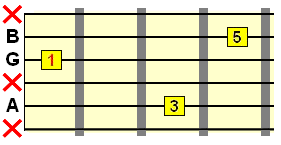
So, a standard R 3 5 major triad there, but the order of stacked tones has changed and the root is no longer in the bass position.
Usually if you play, for example, an E shape barre chord for a major triad, the order of tones appears as R 5 3 - Root on the E string, 5th next up on the A string and finally the 3rd on the G string. This is known as a root postion or root voicing, as the root is in the bass.
In the major triad voicing above, the order has changed to 3 R 5 giving the chord a very different flavour. It adds tension (or an "unresolved" feeling).
The 3rd is now the lowest sounding note in the chord.
Using scale patterns as "scaffolding" for building chords
One way you can construct inversions like this by yourself is by learning the 8 major scale patterns! Use those patterns as the scaffolding for building your chord shapes in different positions.
The below video shows you how you can pull several chord voicings (including inversions) right out of a scale pattern. This is your first step in connecting chords and scales...For example, we can build a higher voicing of the major chord as follows...
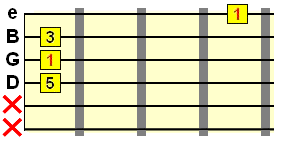
So that's the same major triad as before but with the 5th as the lowest note in the chord.
Can you see how we built this from the major scale pattern below?
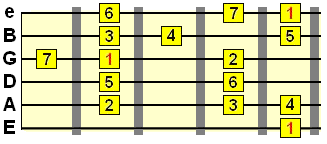
Another thing to notice here - chord shapes overlap!
In the chord form above, the formation of the 5th (D string), Root (G string) and 3rd (B string) might look familiar to you if you know your barre chords. It's "taken" from the A major barre chord form...
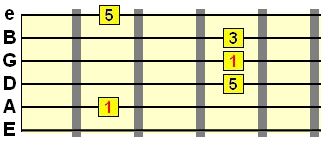
These two chord forms share tones because of their close proximity on the fretboard when using the same root note on each.
Added 9th voicings
We learned in part 4 that add9 (added 9th) chords are made up of the root, 3rd, 5th and an added 9th.
Again, the standard barre
chord voicings can lose their freshness after
years of playing, so you'll eventually want to find new voicings, like
we did with the major triad above, but this time we'll be adding
the 9th (which is the same as the 2nd)...
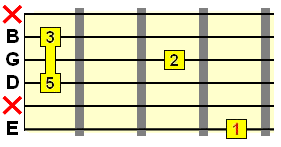
See how the notes of the chord descend from the first root note on the E string - that's a sign it's connected to the E string root (descending) major scale.
Learn to be resourceful and free up your fingers for outside or anticipated movement by only fretting the strings needed for the chord. Doubling up tones and big, 5/6 string chords aren't always necessary to "get the point across".
Let's look at a fuller voicing
for an added 9th (2) barre chord inversion...
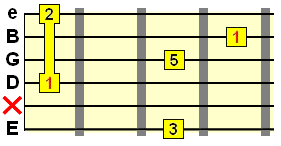
Now, the 3rd is the lowest sounding note in this chord voicing, but if you know your scales you should have picked out that
-
There is a root note on the D string
-
Most of the chord lies in the D shape barre position
-
The low 3rd has been "borrowed" from another shape/pattern...
The acsending E string scale and the D string scale both overlap.
The D string scale is just the top part of the E string scale.
So what's my point?!
If you can build a chord on any root note, and you know how the major scale patterns and their related chord shapes overlap, you can "borrow" notes from nearby shapes/patterns like in the example above!
Another voicing of an add9
chord...
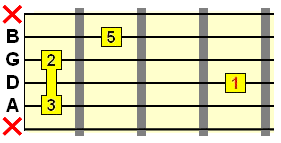
This has been taken straight from the "boxed" E string major scale shape (view). The low root note has been removed, and the first occurance of the 3rd in the scale has been used as the lowest note in the chord!
| Sidenote: You can let the bass player in your band (if you have one) cover the root notes. This allows you to free up your fingers for the other notes. If you can do without a note somehow (e.g. a bassist can cover the root) you'll have an extra finger to create more interesting chords. Basic finger economics! |
Full chord inversions
So what happens if the root note becomes the highest
sounding note in the chord?
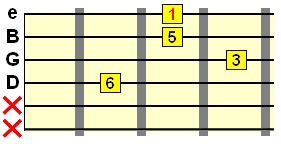
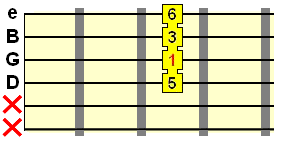
That's an added 6th chord completely inverted.
Play it and you will notice something quite peculiar...
It sounds like a minor chord!
Yes, it technically is. This is what inverting chords to this degree does - the chord tones end up expressing something completely different when stacked in a different order.
This is where a bass player comes in. They ultimately define the bass note and therefore the context in which the chord form is played.
A typical progression example would be - C♯m7 F♯7 Badd6
It's all about context - if you used that chord above at the start of a progression (for example) and the bass was firmly planted on the 6th of the chord, you'd get the minor sound.
| I know this can all be a complete head f**k, but the best way to get it to sink in is to keep investigating how scale patterns connect with chord shapes (and vice-versa), borrowing chord tones from nearby patterns (of the same key of course) and knowing what tones each type of chord includes. Study the fretboard. |
Stick with it. Here are some
more interesting
chord voicings to play around with. Remember, all these chords are movable
(no open strings) so you can play them in any position on the fretboard.
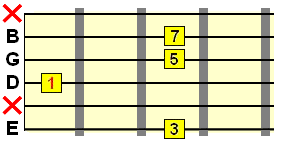
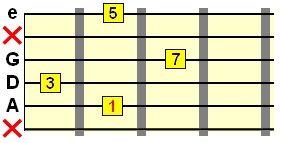
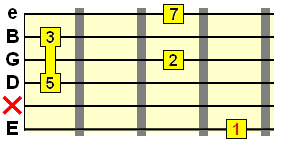
Major 9th - R 3 5 7 9
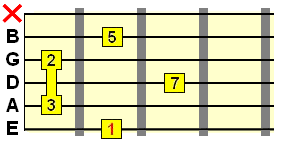
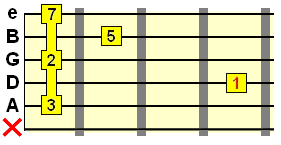
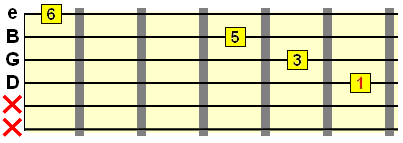
Added 6th - R 3 5 6 (remember, 6 may also be written as 13)
This stuff takes time to learn, but it's very rewarding to accomplish whether you want to improvise in a band or sit down and write a song on your own. Knowing different chord voicings gives you more creative options and a more accurate expression of whatever you want to "say" with your guitar.
It all boils down to experimentation. Have fun with it.
| |
Tweet |
Sign up to the newsletter for updates and grab your free Uncommon Chords book
Related
Chord Inversions
Main Guitar Chords Section



