



Chord Theory - 7th Chords
In guitar chord theory part 1 we looked at major, minor and suspended triads (three note chords). In part 2 we learned how to construct augmented and diminished triads. These five chord types form the basis of all chords.
Today we're looking at a family of chords that contain four notes, known as 7th chords. These can be seen as primary extensions of the basic, three note triads we learned in the first two parts.
 Free chord
cheat sheet Free chord
cheat sheetLearn how guitar chords work together in any key... Click here to start now |
In music theory, the 7th chords are (with their tones/intervals):
| Chord Name | Abbreviations | Chord Tones |
| Major 7th | maj7, M7 | 1, 3, 5, 7 |
| Dominant 7th | 7, dom7 | 1, 3, 5, ♭7 |
| Minor 7th | min7, m7 | 1, ♭3, 5, ♭7 |
| Minor major 7th | minMaj7, mM7 | 1, ♭3, 5, 7 |
| Augmented 7th | aug7, +7 | 1, 3, ♯5, ♭7 |
| Half diminished | m7♭5, ø | 1, ♭3, ♭5, ♭7 |
| Diminished 7th | dim7, °7 | 1, ♭3, ♭5, ♭♭7 |
| Suspended 7th | 7sus | 1, 2/4, 5, ♭7 |
Don't get confused at this stage with their names. Just focus on getting to know how each one is built and the unique sound each one creates. A lot of this knowledge will come naturally if you know the fretboard.
Here's a useful introductory video on 7th chords and what the "7th" refers to...Major 7th chords
Major 7th chords have been described as "dreamy" and relaxed or resolved (i.e. lacking tension) and are therefore often used for resolution in chord progressions.
Remember that a major triad was the Root, 3rd and 5th notes from the major scale? Well a major 7th chord is the triad with an added major 7th tone...
The Root (1), 3rd (3), 5th (5) and 7th (7) form a major 7th chord. For example...
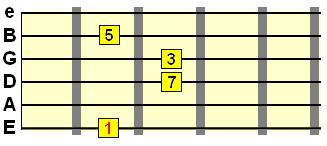
Notice how it just uses those 4 tones (1 3 5 7), unmoved from the major scale.
Here's a common major 7th chord shape rooted on the A string...
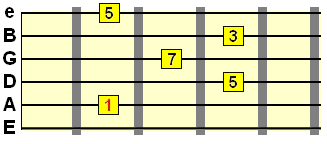
You
don't have to include that higher 5th voicing on the high E string, but
the option is there.
Sometimes, it may be abbreviated further to "M7" (capital M), e.g. AM7, BM7, CM7 etc.
Dominant 7th chords
Dominant 7th chords include a flat/minor 7th (♭7) instead of a major 7th (7). A way of visualising this is if you flatten the 7th from the major 7th position (its natural major scale position) one semitone (the equivalent of one fret).
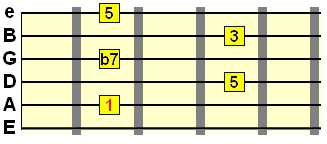
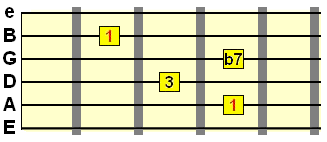
Note, in that second example, there is no 5th. This is fine, as the 5th is considered a "neutral" tone and is often left out to accomodate a certain fingering/position. The key tones are the root, 3rd and b7. It still has that dominant 7th sound without the 5th and that's what matters.
Dominant 7th chords are abbreviated by simply adding a 7 to the root letter. For example, C7, B7, D7 etc.
When you see just the 7 added like this, we can assume that the 3rd and 5th (with some exceptions) of the major triad are also part of the chord.
Sometimes they may be written as Cdom7, Bdom7, Ddom7 etc.
Minor 7th chords
Minor 7th chords are a minor triad (1 ♭3 5) with a flat/minor 7th (♭7).
Two commonly used minor 7th chord forms, rooted on the E and A strings...
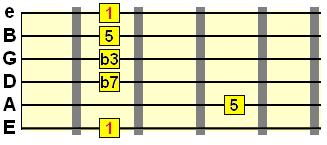
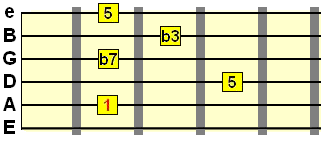
We abbreviate minor 7th chords as "m7". E.g. Cm7, Bm7, Dm7 etc. sometimes as "min7".
Minor major 7th chords
"Minor major 7th" might sound contradictory, but as the minor comes first these can be seen as minor chords/triads with an added major 7th...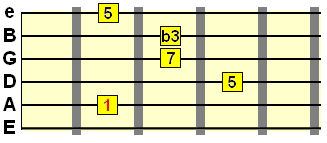
This wonderfully mysterious sounding chord is often used as a more tense minor tonic/resolution chord within harmonic or melodic minor based progressions. Also used in between regular minor and minor 7th chords, creating a harmony line through both 7th positions.
We can abbreviate this as "mM7" or "minMaj7". E.g. CmM7, BmMaj7 etc.
Remember, with a good knowledge of the fretboard, you'll start to see these chord forms pop up all over the neck. This interactive software will help you see the big picture.
Augmented 7th chords
I think you can see where we're going with this now!
In part 2, we looked at augmented triads (1 3 ♯5), well an augmented 7th chord is exactly that with an added flat/minor 7th.
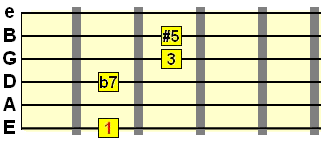
Very tense sounding chords, used a lot in jazz in the dominant (V) position, before returning to the tonic.
The abbreviation for augmented 7th chords is "aug7". E.g. Baug7, Caug7, Eaug7 etc. and occasionally you'll see it symbolised with a + sign, e.g. B+7, C+7, E+7.
The aug part refers to the sharpened 5th and the 7 refers to the flat 7th.
Half diminished chords
Half diminished? Well, you'll know from part 2 how a regular diminished triad is made up (1 ♭3 ♭5). A half diminished chord is the diminished triad plus a flat 7th tone. It's a bit of a confusing name, I know! Just make sure you learn the elements that make up this chord to clarify in your own mind...
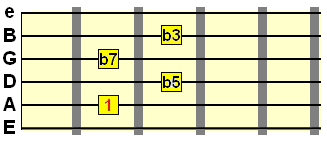
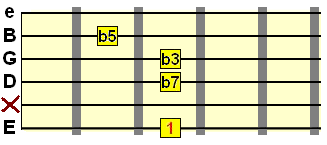
When writing the chord, we use "m7♭5" (minor 7th, flat 5th) to avoid confusion. E.g. Bm7♭5, Cm7♭5 etc.
Sometimes, you'll see a special symbol used for half diminished chords - ø - e.g. Bø, Cø etc. However, I would discourage people from using it as not everyone knows what it means and music should be a common language!
So really, it's just a minor 7th chord with a flat 5th!
Diminished 7th chords
Diminished 7th chords involve the 7th being flattened twice from its natural major scale position. Incidentally, this puts it in the position of a major 6th. However, in the context of diminished chords (1 ♭3 ♭5) we label it as a double flat 7th (♭♭7), also known as a diminished 7th...
In other words, it's a half diminished chord with the 7th flattened one more semitone (or fret).
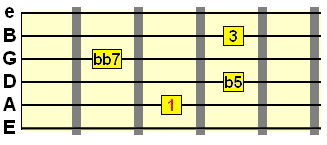
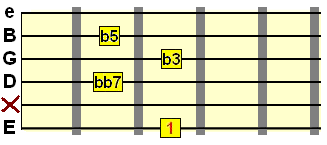
The abbreviation of this chord is simply "dim7", e.g. Cdim7, Fdim7, Gdim7 etc. but can also be abbreviated using the diminished symbol (which looks like a degrees symbol) as °7 , e.g. C°7, F°7, G°7 etc.
As I said at the beginning, don't worry yourself over why some of these chord names sound a bit confusing, just know what notes they involve and the sound they create.
Just think of diminished 7th chords as minor chords with a flat 5 and double flat 7th.Suspended 7th chords
In part 1 we learned about suspended triads, where the 3rd of a major or minor triad is replaced with the 2nd or 4th (sus2 and sus4 respectively).
These triads can also be extended by adding the flat 7th (♭7). Starting with 7th suspended 4th...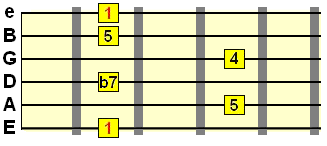
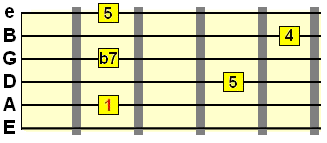
Abbreviated as "7sus4", e.g. C7sus4, E7sus4, G7sus4 etc.
And here's a commonly used A string chord shape for a 7th suspended 2nd...
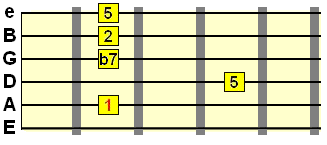
Abbreviated as "7sus2", e.g. D7sus2, F7sus2, A7sus2 etc.
Onwards and upwards...
You should now have a good idea about how to construct and identify 7th chords. They add more depth to the standard triad forms, so get to know them well.
In the next guitar chord theory lesson we'll cover further chord extensions such as added 6ths and 9ths and creating "13th chords", stacking our chords even higher.
We only looked at the most common chord forms in this lesson. To truly dominate the fretboard with any one of these chord types, I highly recommend you spend some time studying the fretboard - this interactive fretboard learning software will make sure you don't bore yourself to death in the process!
Was this lesson helpful? Please let others know, cheers...
| |
Tweet |
Sign up to the newsletter for updates and grab your free Uncommon Chords book
Related



