



Augmented & Diminished Chord Theory
In the first guitar chord theory lesson, we learned about constructing major and minor triads.The other two chord forms in the triad "family" are known as augmented and diminished chords.
Just like major and minor triads, they contain just three notes (hence, triad!).
Let's look at how to construct
these chords tone by tone. This will allow you to create chord voicings
anywhere on the fretboard. Make sure, however, you have a good
understanding of the fretboard to underpin what we're
learning.
 Free chord
cheat sheet Free chord
cheat sheetLearn how guitar chords work together in any key... Click here to start now |
Augmented chords
Augmented chords have quite an unusual quality. They sound unstable and tense when used in a chord progression, so they must be used in the appropriate context. You'll learn more about this chord's function in a separate lesson.
As with every other chord, the most basic form of augmented chord is a triad. Augmented triads are basically major triads with an augmented 5th (♯5), also called a sharp 5th, which means you take the 5th tone of the major triad and move it up one half step (the equivalent of one fret).
So if we build an augmented chord with the E string as the root, we might get something like this...
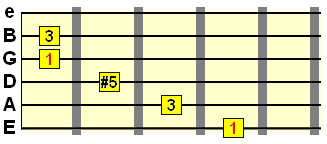
If the root (1) note lied on C, that would be C augmented or Caug for short. Augmented chords are also sometimes abbreviated with a + sign, e.g. C+.
Note, that it's only necessary to include the 3 notes in the triad - in the example above we've included a second root an octave higher on the G string, but this isn't necessary. Keep this in mind when you're forming chords around the neck and you want a particular voicing that can't accomodate more than 3 or 4 strings on the guitar.
Let's also look at an
augmented chord form with an A string root.
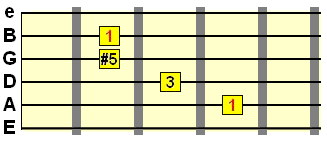
The augmented 5th gives the chord a completely different sound to a major triad because the augmented 5th interacts with the root and 3rd differently to the perfect 5th found in major triads.
See the augmented guitar chords lesson for more chord charts and theory behind how these chords can function in your music.
Diminished chords
Diminished triads are basically minor chords with a diminished (flat) 5th...
Simply remember:
Aug = major, sharp 5th
Dim = minor, flat 5th
Let's look at a typical diminished chord form built on an E string root note...
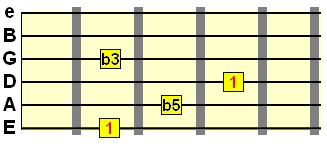
See how the 5th has been flattened from its original major scale position. If the root note was F, the chord would be written as F diminished or Fdim for short. It's also shortened using a ° symbol, e.g. F°.
And on the A string...
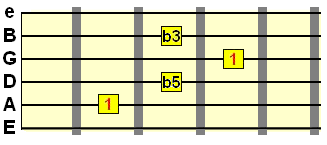
See the diminished guitar chords lesson for more forms and some of their common functions.
Study in your own time...
As you learn the fretboard, you'll naturally see chord forms appear all over, giving you several voicings for the same chord. I recommend using this interactive learning software to help develop and connect your fretboard and chord knowledge.
In the next guitar chord theory lesson we'll cover 7th chords which can be seen as the primary extensions of the triads we've looked at.
| |
Tweet |
Sign up to the newsletter for updates and grab your free Uncommon Chords book
Related
Chord Theory Part 3 - 7th Chords
More Guitar Theory LessonsMore on Guitar Chords



