


Home
> Progressions
> Basics
2

Minor key chord progressions are based around the same concept - a tonic or "home" chord, a journey away from home (the progression), followed by a resolution (the return home). With minor key songs, however, this tonic chord is... minor.
As we're using a minor tonic, the numeral to represent this will be a lower case i as opposed to the major I.
Note that with the most common open fingerings (based around those 5 basic shapes), there are only 3 minor chords we can use. We'll expand on this at a later time. The important thing at this stage is you get an ear for the relationships we're building...
i iv
So each of these is effectively the same relationship (the same chord intervals), just with different tonic chords. It is these tonic minor chords that allow us to create songs "in the key of __ minor".
Just like the major key I - IV relationship we looked at in part 1, its minor equivalent has been used in music for centuries and is part of the diatonic scale. It can be used as part of your songs when you need it. Get to know its sound.
Another important minor key relationship... the i v, although the minor v chord is commonly replaced by a major V chord as this gives it more harmonic weight when resolving back to the minor tonic.
The major V chord provides more tension before the return home. A common use of the v/V position is to start with the minor v and change to a major V in the same bar...
Click to hear
We'll be looking at other ways you can enhance and modify these relationships in later lessons.
Another natural relationship in minor keys... i VII...
Let's just take a moment now to combine the relationships we've learned and build some simple chord progressions. Below are a couple of examples...
E minor - D major - A minor - click to hear
A minor - D minor - E major - click to hear
So you can hear how these relationships form very natural sounding progressions, reinforcing that minor key sound with whichever minor tonic we use.
Another relationship... i VI
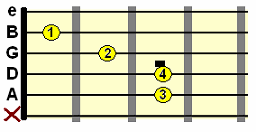
Note that, because we're focussing on those basic open chord fingerings, you can use the F major fingering as shown in the 3rd part of the open chord series, also shown below...
Open F major fingering
Before we move on to look at a final important relationship, let's again take stock of the relationships we've learned and look at some example progressions...
A minor - F major - G major - E minor/major - Click to hear
E minor - D major - C major - A minor - Click to hear
See, if you identify a major tonic, its relative minor key will be the vi chord we learned in the first part.
Similarly, if we start with a minor tonic, it will have its own relative major key. That's our final relationship in this lesson...
So let's say our song started in the key of C major. We could use some or all of the relationships we learned in part 1, but by resolving that journey away from home to its relative minor chord, A minor, instead of back to the C major tonic, we switch into its relative minor key!
And vice versa if you start in the key of A minor. Resolving to its relative major chord, C major, will move the progression into its relative major key.
The difference between relative key changes and proper key changes (which we'll look at another time) is that relative key changes sound more natural and you can still use those same relationships/chords you were in the original key. The only difference is the chord you're resolving to.
Resolution is what defines the key centre of our songs.
Some relative key change examples:
F major - G major - C major/A minor - click to hear
G major - A minor - D major - C major - E minor - click to hear
Hear how this relative key change alters the overall feel of the progression - to put it simply, you can either resolve to happiness or misery!
When we go on to look at song structure, you'll see how knowledge of this relative key can be further enhanced, using minor key verses and major key choruses, for example.
For now though, keep experimenting with different major and minor key combinations, building on those relationships we've learned. Of course, these relationships exist outside open chord fingerings, but more on that another time.
Basic Chord Progressions Part 3
Main Guitar Chord Progressions Section
Basic Chord Progressions - Part 2
In the first basic guitar chord progressions lesson we looked at playing simple major key progressions using those basic open chords down at the first few frets. Free chord
cheat sheet Free chord
cheat sheetLearn how guitar chords work together in any key... Click here to start now |
Minor key chord progressions are based around the same concept - a tonic or "home" chord, a journey away from home (the progression), followed by a resolution (the return home). With minor key songs, however, this tonic chord is... minor.
Minor key relationships in chord progressions
Just as in the first part we looked at some natural relationships that help define a major key chord progression, let's do the same for minor key progressions.As we're using a minor tonic, the numeral to represent this will be a lower case i as opposed to the major I.
Note that with the most common open fingerings (based around those 5 basic shapes), there are only 3 minor chords we can use. We'll expand on this at a later time. The important thing at this stage is you get an ear for the relationships we're building...
i iv
| Tonic (i) | E minor | A minor | D minor |
| iv | A minor | D minor | G minor |
So each of these is effectively the same relationship (the same chord intervals), just with different tonic chords. It is these tonic minor chords that allow us to create songs "in the key of __ minor".
Just like the major key I - IV relationship we looked at in part 1, its minor equivalent has been used in music for centuries and is part of the diatonic scale. It can be used as part of your songs when you need it. Get to know its sound.
Another important minor key relationship... the i v, although the minor v chord is commonly replaced by a major V chord as this gives it more harmonic weight when resolving back to the minor tonic.
| Tonic (i) | G minor | D minor | A minor |
| v V |
D minor D major |
A minor A major |
E minor E major |
The major V chord provides more tension before the return home. A common use of the v/V position is to start with the minor v and change to a major V in the same bar...
Click to hear
We'll be looking at other ways you can enhance and modify these relationships in later lessons.
Another natural relationship in minor keys... i VII...
| Tonic (i) | E minor | D minor | A minor |
| VII | D major | C major | G
major |
Let's just take a moment now to combine the relationships we've learned and build some simple chord progressions. Below are a couple of examples...
E minor - D major - A minor - click to hear
A minor - D minor - E major - click to hear
So you can hear how these relationships form very natural sounding progressions, reinforcing that minor key sound with whichever minor tonic we use.
Another relationship... i VI
Note that, because we're focussing on those basic open chord fingerings, you can use the F major fingering as shown in the 3rd part of the open chord series, also shown below...
Open F major fingering
| Tonic (i) | E minor | A
minor |
| VI | C major | F major |
Before we move on to look at a final important relationship, let's again take stock of the relationships we've learned and look at some example progressions...
A minor - F major - G major - E minor/major - Click to hear
E minor - D major - C major - A minor - Click to hear
Relative major and minor keys
Now we know the basic relationships that make up major and minor keys, we can create both major and minor tonic resolutions in the same song, if we wish. It's sort of like a key change, but not strictly, because we're still within the same diatonic key. It's known as relative key.See, if you identify a major tonic, its relative minor key will be the vi chord we learned in the first part.
Similarly, if we start with a minor tonic, it will have its own relative major key. That's our final relationship in this lesson...
| Relative Major (I) | C major | G major | F major |
| Relative Minor (i) | A minor | E minor | D minor |
So let's say our song started in the key of C major. We could use some or all of the relationships we learned in part 1, but by resolving that journey away from home to its relative minor chord, A minor, instead of back to the C major tonic, we switch into its relative minor key!
And vice versa if you start in the key of A minor. Resolving to its relative major chord, C major, will move the progression into its relative major key.
The difference between relative key changes and proper key changes (which we'll look at another time) is that relative key changes sound more natural and you can still use those same relationships/chords you were in the original key. The only difference is the chord you're resolving to.
Resolution is what defines the key centre of our songs.
Some relative key change examples:
F major - G major - C major/A minor - click to hear
G major - A minor - D major - C major - E minor - click to hear
Hear how this relative key change alters the overall feel of the progression - to put it simply, you can either resolve to happiness or misery!
When we go on to look at song structure, you'll see how knowledge of this relative key can be further enhanced, using minor key verses and major key choruses, for example.
For now though, keep experimenting with different major and minor key combinations, building on those relationships we've learned. Of course, these relationships exist outside open chord fingerings, but more on that another time.
| |
Tweet |
 Like This?
Subscribe & Learn More... Like This?
Subscribe & Learn More...Subscribe to the fretjam newsletter below for updates and extras, plus grab your free copy of Uncommon Chords: 101 Vibrant Voicings You Won't Find on a Typical Chord Chart. |
Related
Basic Chord Progressions Part 3
Main Guitar Chord Progressions Section



