



Tuning Down Half Step / Whole Step
This page provides you with guitar tuning aids and tips to help tune down a half step or whole step. Basically, standard tuning, but lower!Down tuning is used in many genres of music, but it's especially popular in rock and heavy metal, to give your distortion a deeper crunch.
Tuning down is also good for acoustic/clean playing though, because you can get a fresh sound from those vibrant open position chords.
Tip: If you're going to tune down, you might want to try some heavier gauge strings on your guitar, because the lower you tune, the less tension in the strings. Strings that lack enough tension tend to buzz on the fretboard and can kill tone and sustain.
I would say if you're going to tune down more than half a step you should at least use a gauge 10 set of strings (.010 inches being the gauge of the high E string). That's just my opinion though - you might actually prefer the snappier tone you get with lighter strings.
Don't
forget there's also drop
tuning, where you simply tune down the bottom string.
Tuning the guitar down half a step / Eb (E flat) tuning
Some guitarists think playing in a flat/sharp key sounds fresher, because we're so conditioned to guitar pop music being recorded in standard E A D G B e tuning. I think there's definitely something in that!...
See, if you played a regular open G chord, it would in fact be G flat or F sharp because of the half step lower tuning.
Click on the strings below to hear the tuned note...






Tip: When you're trying to match your guitar's string to a string above, you'll hear a sort of oscillating effect, and as you tune up or down, closer to the correct pitch, this vibrating effect will become slower and slower until you're in tune! You have to listen closely and train your ear to pick this up.
Tuning the guitar down half a step without tuning aids
This is useful to know when there's no reference to help match the tuning of your strings to the correct pitch.
Over time, your ear will become more and more accurate in identifying specific note pitches. However, here's a quick and simple way to get tuned...
As we're tuning down half a step (also known as a semi-tone), that's the equivalent of tuning down one fret position, so all we need to do is first get that low E string tuned down to Eb (E flat). E flat can be found on the A string at fret 6.
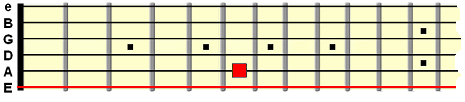
Simply
fret the A string at fret 6 and tune down the open low E string until
it matches. Even though the fretted E flat will be an octave higher
than the destination E flat on the E string, you should be able to hear
when it's there - click to hear
Once you have the
low Eb sorted, tune the other strings down relative to that string by
using the following steps:
- Fret the low Eb string at fret 5 and tune the A string down until it matches.
- Fret the newly tuned A string (now Ab) at fret 5 and tune the D string down until it matches.
- Fret the newly tuned D string (now Db) at fret 5 and tune the G string down until it matches.
- Fret the newly tuned G string (now Gb) at fret 4 and tune the B string down until it matches.
- Fret the newly tuned B string (now Bb) at fret 5 and tune the high E string down until it matches.
- The high
E string should now be Eb.
Tuning down a whole step / whole tone / D tuning
This tuning allows you to get that low bottom end D in, but as part of standard tuning intervals, so you can form all the chord shapes you're used to, especially open chords, and get that deeper atmosphere.






Tip: Just like with standard tuning, when you're trying to match your guitar's string to a string above, you'll hear a sort of oscillating effect, and as you tune closer to the correct pitch, this vibration effect will become slower and slower until you're in tune! You have to listen closely and train your ear to pick this up.
Tip: You can drop tune the low D string down to the same as the C string and you get... Drop C tuning.
Tip: If the strings are so slack they hang at your ankles (or cause a lot of fret buzz) after tuning down a whole step, you might want to think about buying some heavier gauge strings.
Tuning the guitar down a whole step without tuning aids
This is useful to know when there's no reference to help match the tuning of your strings to the correct pitch.
Over time, your ear will become more and more accurate in identifying specific note pitches. However, here's a quick and simple way to get tuned...
As we're tuning down a whole step (also known as a whole tone), that's the equivalent of tuning down two fret positions, so all we need to do is first get that low E string tuned down to D. D can be found on the A string at fret 5.
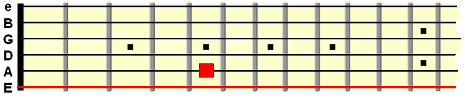
Simply fret the A string at fret 5 and tune down the open low E string until it matches. Even though the fretted D note will be an octave higher than the destination D note on the E string, you should be able to hear when it's there - click to hear
Once you have the low D sorted, tune the other strings down relative to that string by using the following steps:
- Fret the low D string at fret 5 and tune the A string down until it matches.
- Fret the newly tuned A string (now G) at fret 5 and tune the D string down until it matches.
- Fret the newly tuned D string (now C) at fret 5 and tune the G string down until it matches.
- Fret the newly tuned G string (now F) at fret 4 and tune the B string down until it matches.
- Fret the newly tuned B string (now A) at fret 5 and tune the high E string down until it matches.
- The high E string should now be D.
| |
Tweet |
Related



