


Home
> Progressions
>
V chord

If this all sounds complete gobbledygark, then make sure you're confident with what was covered in the introductory dominant chord lesson.
So, you should now have a good understanding of the relationship between the dominant and tonic chord. This is an important musical relationship as you'll come to appreciate.
What we're going to look at now is how to enhance the natural tension of that dominant chord - firstly by modifying the chord itself.
Rather than just play a basic major chord, dominant chords naturally use the dominant 7th. If you've been through the basic guitar chords series, you'll know, for example, how to play a D dominant 7th (D7) chord...
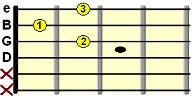
Listen to the difference between using a regular D major chord and a dominant 7th D major chord. The dominant 7th version enhances that tension before the return back to the G major tonic.
Click to hear
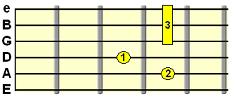
We could also use extended dominant 7th chords from the lessons in the chords section of this site. One of my favourites is the dominant 9th (e.g. D9) chord...
3 4 5 6
In its D major position (fret 5 on the A string), we now have another more interesting use of the dominant chord....
Click to hear
So, once you know the basic relationship between the tonic and dominant, it's simply a case of expanding your chord library to enhance that relationship in interesting and unique ways.
Another example - B major (tonic) and F#7 (dominant)...
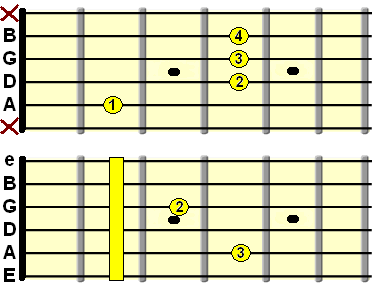
Fret 2
Click to hear
Note: the different root note positions of the tonic and dominant were covered in part 1! Move at your own pace.
In summary, here are the most commonly used natural extensions of the dominant V chord. These are all covered in the extended chord theory lesson.
Let's go back to our tonic chord of G major. So we know in this position, the dominant chord will be built on a D root note (e.g. D major, D7, D9 etc.). We can also use a suspended D chord as the dominant chord.
For example - D7sus4 (remember, as it's D, we're at the 5th fret on the A string for this movable chord shape)...
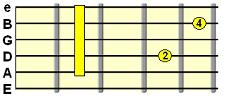
5 6 7 8
Another favourite of mine - D9sus4 - easy to finger as you simply barre your index finger from the A string up...
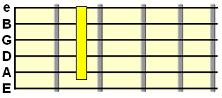
Or you could mix the two to really enhance that dominant tension before returning back to G major - click to hear
Suspended 2nd chords also work in the dominant positon.
We could also play around with a suspended chord and a regular dominant 7th chord in the same sequence, before returning to the G major tonic...
Click to hear
Countless examples!! You just have to know your chord voicings and experiment!
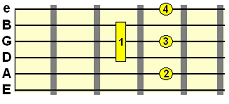
3 4 5 6
Click to hear
The addition of the flat 9th (b9) in the chord creates an air of dissonance that is resolved to the tonic chord.
If we go back to the B major - F# major relationship from before, we can use that dominant F# position for some interesting chord shapes built on the low E string root note...
Another tense, jazzy one - F#aug7 (that's an augmented 7th chord, so still uses the dominant 7th!)
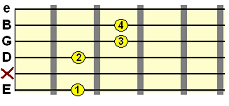
2 3 4 5
Click to hear
Are you starting to hear this natural relationship between the dominant and tonic chord? How they play off each other?
It's why this relationship has been used in music for centuries. Of course, you don't always have to use it in this context (your music might become a little predictable if you did!), but it's there, when you need that gateway.
Dominant V Chord Variation - Using the 5 Chord
In the last lesson, we were introduced to the concept of dominant chord function in chord progressions. We learned that the dominant (or 5 chord) acts primarily as a tension chord, which often resolves to the tonic (or 1 chord).If this all sounds complete gobbledygark, then make sure you're confident with what was covered in the introductory dominant chord lesson.
So, you should now have a good understanding of the relationship between the dominant and tonic chord. This is an important musical relationship as you'll come to appreciate.
What we're going to look at now is how to enhance the natural tension of that dominant chord - firstly by modifying the chord itself.
Spicing up the dominant chord in chord progressions
In the first part, we learned that the dominant (V) chord is naturally a major chord. For example, a typical sequence could be G major, D major, G major. Tonic (I) - dominant (V) - tonic (I).Rather than just play a basic major chord, dominant chords naturally use the dominant 7th. If you've been through the basic guitar chords series, you'll know, for example, how to play a D dominant 7th (D7) chord...
Listen to the difference between using a regular D major chord and a dominant 7th D major chord. The dominant 7th version enhances that tension before the return back to the G major tonic.
Click to hear
We could also use extended dominant 7th chords from the lessons in the chords section of this site. One of my favourites is the dominant 9th (e.g. D9) chord...
3 4 5 6
In its D major position (fret 5 on the A string), we now have another more interesting use of the dominant chord....
Click to hear
So, once you know the basic relationship between the tonic and dominant, it's simply a case of expanding your chord library to enhance that relationship in interesting and unique ways.
Another example - B major (tonic) and F#7 (dominant)...
Fret 2
Click to hear
Note: the different root note positions of the tonic and dominant were covered in part 1! Move at your own pace.
In summary, here are the most commonly used natural extensions of the dominant V chord. These are all covered in the extended chord theory lesson.
| Name | Dominant 7th | Dominant 9th | Dominant 13th |
| Examples | C7, D7, E7 | C9, D9, E9 | C13, D13, E13 |
| Tones | 1 3 5 b7 | 1 3 5 b7 9 | 1 3 5 b7 9 13 |
Using suspended dominant chords in your progressions
Another way to colour that dominant tension is to use a suspended chord. Again, if you're not familiar with what suspended chords are, it's all covered in the chord section of the site. We'll look at a few examples anyway...Let's go back to our tonic chord of G major. So we know in this position, the dominant chord will be built on a D root note (e.g. D major, D7, D9 etc.). We can also use a suspended D chord as the dominant chord.
For example - D7sus4 (remember, as it's D, we're at the 5th fret on the A string for this movable chord shape)...
5 6 7 8
Another favourite of mine - D9sus4 - easy to finger as you simply barre your index finger from the A string up...
Or you could mix the two to really enhance that dominant tension before returning back to G major - click to hear
Suspended 2nd chords also work in the dominant positon.
We could also play around with a suspended chord and a regular dominant 7th chord in the same sequence, before returning to the G major tonic...
Click to hear
Countless examples!! You just have to know your chord voicings and experiment!
Other good uses of dominant chords
Genres such as jazz typically use even more tense dominant chords, such as the flat 9th dominant 7th chord (in this example - D7b9 - still a dominant 7th chord, but with an added tone - a flat 9th)...3 4 5 6
Click to hear
The addition of the flat 9th (b9) in the chord creates an air of dissonance that is resolved to the tonic chord.
If we go back to the B major - F# major relationship from before, we can use that dominant F# position for some interesting chord shapes built on the low E string root note...
Another tense, jazzy one - F#aug7 (that's an augmented 7th chord, so still uses the dominant 7th!)
2 3 4 5
Click to hear
Are you starting to hear this natural relationship between the dominant and tonic chord? How they play off each other?
It's why this relationship has been used in music for centuries. Of course, you don't always have to use it in this context (your music might become a little predictable if you did!), but it's there, when you need that gateway.
| |
Tweet |
 Like This?
Subscribe & Learn More... Like This?
Subscribe & Learn More...Subscribe to the fretjam newsletter below for updates and extras, plus grab your free copy of Uncommon Chords: 101 Vibrant Voicings You Won't Find on a Typical Chord Chart. |
Main Guitar Chord Progressions Section



